Facts
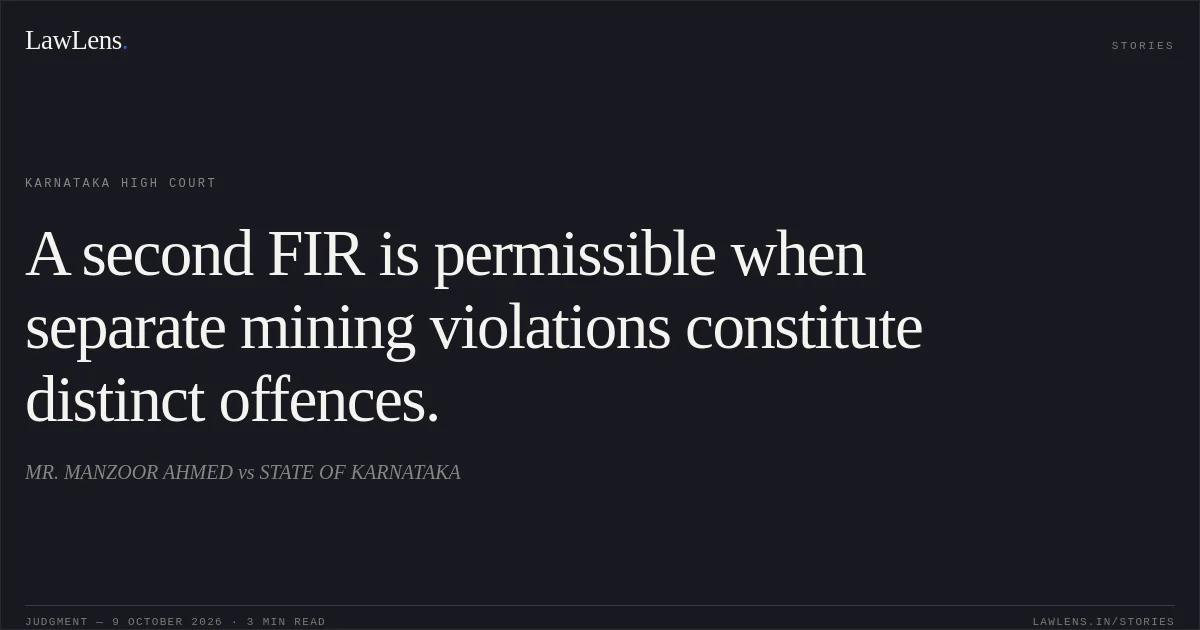
The petitioner held a mining licence for iron ore in Sandur Taluk. Following allegations of mining beyond the licensed area, a Forest Department complaint was registered and remained pending before the jurisdictional Magistrate at Sandur.
Source reference: pp. 4–6Later, pursuant to directions of the Supreme Court, a Special Investigation Team (SIT) investigated alleged mining-licence violations and filed a separate charge sheet against the petitioner in Special C.C. No. 586/2023, alleging offences under Sections 447, 409, 420 read with Section 120B of the IPC and Sections 21 and 23 read with Sections 4(1) and 4(1-A) of the Mines and Minerals (Development and Regulation) Act, 1957.
Source reference: pp. 4–6The petitioner sought to quash the cognizance order and proceedings, principally arguing that the second FIR concerned the same offence as the pending Sandur case.
Source reference: pp. 4–6He also challenged the applicability of IPC Section 409.
Source reference: p. 27Issues
Whether the SIT case and the pending Sandur case arose from the same offence or occurrence, making the second FIR and prosecution impermissible.
Source reference: pp. 25–27, 29Whether the petitioner’s contention that IPC Section 409 did not apply because he was not a public servant justified quashing the proceedings.
Source reference: p. 27Law Applied
The Court considered Sections 154 and 173 of the Code of Criminal Procedure and the rule in T.T. Antony v. State of Kerala, (2001) 6 SCC 181, that a second FIR is generally impermissible where it concerns the same cognizable offence, occurrence, or transaction.
Source reference: pp. 6–24It also referred to Vijay Kumar Ghai v. State of West Bengal, (2022) 7 SCC 124, on that principle and the availability of quashing where a subsequent FIR is an abuse of process.
Source reference: pp. 6–24The Court considered Prem Chand Singh v. State of Uttar Pradesh, (2020) 3 SCC 54, concerning the bar on a second trial under Section 300 CrPC after conviction or acquittal, and Krishna Lal Chawla v. State of Uttar Pradesh, (2021) 5 SCC 435, and Kapil Agarwal v. Sanjay Sharma, (2021) 5 SCC 524, concerning the High Court’s power to quash proceedings that abuse criminal process.
Source reference: pp. 6–24IPC Section 409 applies to criminal breach of trust committed in specified capacities, including by a public servant or in the course of business as a banker, merchant, factor, broker, attorney, or agent.
Source reference: p. 28Reasoning
The Court distinguished the two cases on the material before it: the earlier case concerned forest violations, whereas the SIT charge sheet alleged distinct offences arising from alleged repeated mining in forest land beyond the licence.
Source reference: pp. 26–27, 29It considered that each alleged instance of such mining could constitute a separate offence and held that the question whether the petitioner repeatedly trespassed and mined beyond the licensed area should be determined at trial, not in a mini-trial on the writ petition.
Source reference: pp. 26–27, 29It therefore found the cited second-FIR and abuse-of-process authorities distinguishable.
Source reference: pp. 26–27, 29The Court also rejected the Section 409 objection, reasoning that the petitioner was engaged in the business of mining iron ore.
Source reference: p. 28Holding
The Court held that the pending Sandur case and the SIT prosecution concerned distinct offences and that the grounds raised did not warrant quashing the charge sheet or proceedings in Special C.C. No. 586/2023.
It dismissed the petition, clarifying that its observations were confined to disposal of the petition and would not affect the petitioner’s rights at trial.
Source reference: pp. 30–31Acts & Sections Cited
36 provisions across 7 statutes referred to in this judgment. Each provision opens on LawLens.
Code of Criminal Procedure, 1973
Indian Penal Code, 1860
Mines and Minerals (Development and Regulation) Act, 19573
KARNATAKA FOREST ACT, 19636
Prevention of Corruption Act, 19882
Negotiable Instruments Act, 18811
Code of Civil Procedure, 19081
Original Court PDF
MR. MANZOOR AHMEDvsSTATE OF KARNATAKA
Click to open original judgment
Original judgment, available to read, download and summarize on LawLens.in