Facts
Manish Dubey died from injuries sustained in a collision involving a Tata Tipper insured by the appellant.
Source reference: no citationHis mother, wife and son obtained an award of ₹61,53,240 with interest under Section 166 of the Motor Vehicles Act, 1988.
Source reference: no citationThe Tribunal found no breach of the policy conditions.
Source reference: no citationThe insurer appealed, contending that the vehicle had no valid fitness certificate; the owner and driver had not produced one despite the insurer’s pleadings, cross-examination and application seeking its production
Source reference: para. 1–4, 10Issues
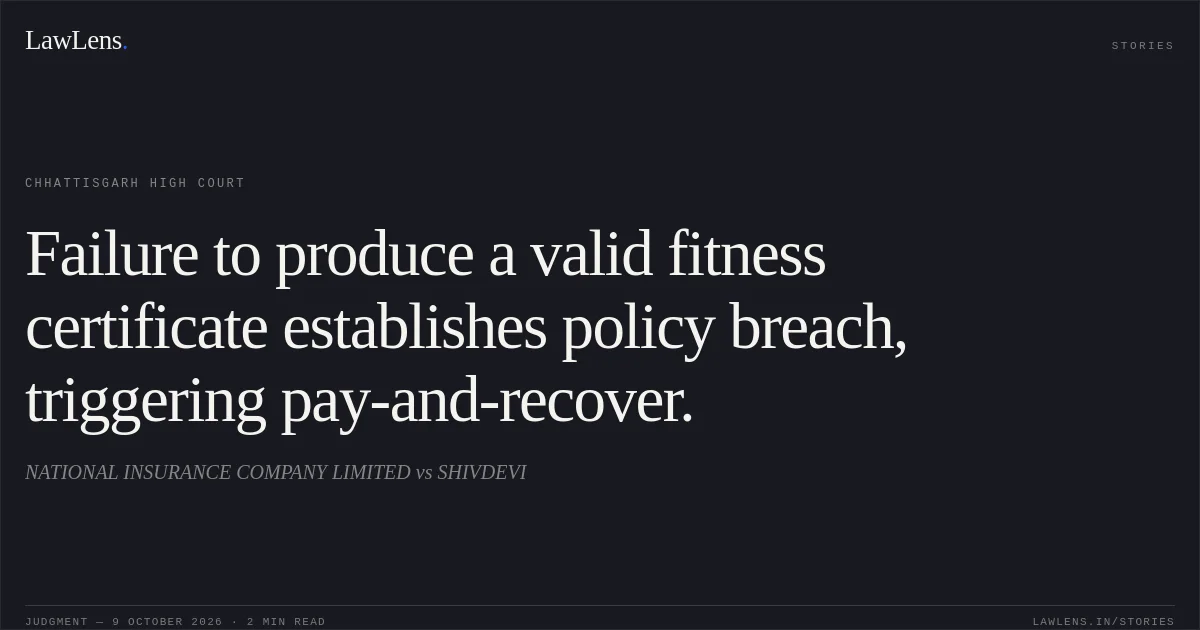
Whether the failure to produce a valid fitness certificate established a breach of the insurance policy conditions
Source reference: para. 4, 10–11Whether, despite that breach, the insurer was required to pay the claimants first and could then recover the amount from the vehicle’s owner and driver
Source reference: para. 12Law Applied
Under Section 166 of the Motor Vehicles Act, 1988, claimants may seek compensation for death arising from a motor accident; an appeal against the award lies under Section 173.
Source reference: no citationUnder National Insurance Co. Ltd. v. Swaran Singh, the insurer relying on a policy defence must establish the defence and breach by the vehicle owner.
Source reference: para. 7Kamala Mangalal Vayani v. United India Insurance Co. Ltd. holds that, once insurance cover is established, claimants are not required to prove the vehicle’s regulatory compliance; the burden shifts to the insurer to establish its defence.
Source reference: para. 8Amrit Paul Singh v. Tata AIG General Insurance Co. Ltd. supports a pay-and-recover direction where the insured vehicle’s permit-related breach is established.
Source reference: para. 9Relying also on Pareed Pillai v. Oriental Insurance Co. Ltd., the Court treated absence of a valid fitness certificate at the time of the accident as a breach of policy conditions.
Source reference: para. 11Reasoning
The insurer pleaded that the vehicle lacked a fitness certificate, questioned the owner-driver about its non-production, and sought an order compelling its production.
Source reference: para. 10The owner-driver produced no certificate, and the seizure memo did not record seizure of one.
Source reference: para. 10The Court held that, in these circumstances, the insurer had discharged its burden and that the Tribunal erred in finding no breach.
Source reference: para. 10However, because the vehicle was insured and the claimants were entitled to the award, the appropriate remedy was pay and recover: the insurer must satisfy the award first and may then recover from the owner and driver.
Source reference: para. 11–12Holding
The appeal was partly allowed.
The finding that there was no breach of the policy conditions was set aside, and the insurer was held entitled to recover the compensation from the registered owner and driver.
Source reference: para. 11–13The insurer was nevertheless directed to pay the awarded compensation to the claimants first
Source reference: para. 11–13Acts & Sections Cited
2 provisions across 1 statute referred to in this judgment. Each provision opens on LawLens.
Motor Vehicles Act, 19882
Original Court PDF
NATIONAL INSURANCE COMPANY LIMITEDvsSHIVDEVI
Click to open original judgment
Original judgment, available to read, download and summarize on LawLens.in