Facts
The parties married on 1 December 2025 and separated on 23 February 2026, within 84 days of the marriage.
Source reference: paras. 4–7, pp. 2–3They stated on oath that the marriage was never consummated, that they had no children, and that their disputes had been fully settled by a Memorandum of Understanding dated 30 April 2026.
Source reference: paras. 4–7, pp. 2–3On 6 May 2026, they jointly presented a petition under Section 13B(1) of the Hindu Marriage Act, 1955 (HMA), accompanied by an application under Section 14(1) seeking leave to present it before the first anniversary of the marriage.
Source reference: para. 7, p. 3The Family Court dismissed the application, finding the parties’ assertion of non-consummation insufficiently explained, and consequently dismissed the petition as premature.
Source reference: para. 8, pp. 3–4The parties appealed under Section 19 of the Family Courts Act, 1984 read with Section 28 of the HMA.
Source reference: para. 3, p. 1Issues
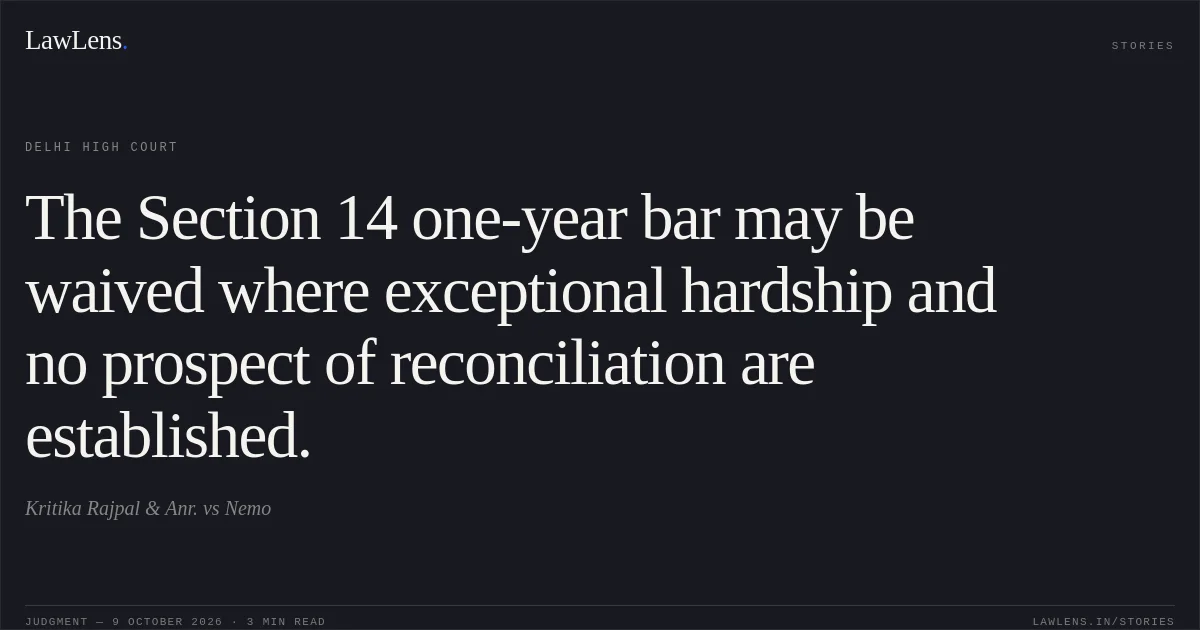
Whether leave under the proviso to Section 14(1) of the HMA should be granted to present a joint petition for divorce by mutual consent before one year has elapsed from the date of marriage.
Source reference: paras. 3, 12, pp. 1, 5–6Whether the parties’ short-lived, unconsummated marriage, early separation, settled disputes and lack of any reasonable prospect of reconciliation established exceptional hardship warranting that leave.
Source reference: paras. 14, 17–20, pp. 7–10Law Applied
Section 13B(1) of the HMA ordinarily requires the parties to have lived separately for at least one year before presenting a joint petition for divorce by mutual consent; the proviso to Section 14(1) permits earlier presentation where the case involves exceptional hardship to the petitioner or exceptional depravity by the respondent, with the court also considering the interests of any children and the reasonable probability of reconciliation before the year expires.
Source reference: paras. 11–12, pp. 4–6In Shiksha Kumari v. Santosh Kumar, MAT.APP. (F.C.) 111/2025 (Full Bench, Delhi High Court, 17 December 2025), the Court held that the Section 13B(1) period may be waived under Section 14(1); waiver is not automatic and requires exceptional circumstances, assessed with the applicable considerations concerning reconciliation and hardship.
Source reference: para. 13, pp. 5–7The Full Bench also held that waiver of the Section 13B(1) period and the Section 13B(2) cooling-off period are considered independently.
Source reference: para. 13, pp. 6–7Amardeep Singh v. Harveen Kaur, (2017) 8 SCC 746, establishes that a waiting period is intended to allow reconciliation where reasonably possible, not to prolong a purposeless marriage or the parties’ agony where reconciliation is unlikely.
Source reference: para. 16, p. 8Reasoning
The Court held that residence under one roof for 84 days did not, by itself, contradict the parties’ sworn evidence of non-consummation; given the private nature of that fact and the absence of contrary material, the Family Court had wrongly characterised the assertion as “bald”.
Source reference: para. 17, p. 9The parties had separated within weeks, had no children, had settled their disputes and had unequivocally rejected continuation of the marriage; the record disclosed no reasonable prospect of reconciliation.
Source reference: paras. 17–18, pp. 9–10The Court found that requiring them to wait for the short remaining period and then refile on substantially the same facts would serve no meaningful statutory purpose and would instead cause avoidable hardship.
Source reference: paras. 18–20, pp. 9–10Holding
The Court answered the issues in favour of the appellants, set aside the Family Court’s order and granted leave for the parties to present their joint petition under Section 13B(1) forthwith, without waiting for the first anniversary of the marriage.
It remanded the matter to the Family Court to proceed with the petition in accordance with law and expeditiously, and directed that any second-motion petition under Section 13B(2) be considered and decided as expeditiously as possible in accordance with law.
Source reference: paras. 23–25, p. 11Acts & Sections Cited
4 provisions across 3 statutes referred to in this judgment. Each provision opens on LawLens.
Family Courts Act, 19841
Hindu Marriage Act, 19552
Code of Civil Procedure, 19081
Original Court PDF
Kritika Rajpal & Anr.vsNemo
Click to open original judgment
Original judgment, available to read, download and summarize on LawLens.in