01Facts
Late Barnawas Maltu, a Panchayat Sewak, died in harness on 11 July 2011.
The appellant, Martha Murmu, claimed to be his second wife and sought compassionate appointment and retiral benefits for herself and her minor son.
¶ 10–11 · p. 3The deceased employee’s first wife, Sarojani Kisku, also claimed similar benefits, resulting in parallel proceedings before the High Court.
¶ 10–11 · p. 3In L.P.A. No. 613 of 2017, the Division Bench directed distribution of gratuity between the first wife and the minor son of the appellant and directed reconsideration of both wives’ claims for compassionate appointment; however, the appellant’s subsequent claim was rejected.
¶ 12 · p. 3The learned Single Judge dismissed the appellant’s challenge to that rejection by order dated 2 July 2026, leading to the present appeal.
¶ 13 · p. 302Issues
i.Whether the appellant, claiming to be the second wife of the deceased Government servant, could seek compassionate appointment in the absence of prior Government permission for the second marriage under Rule 23 of the Bihar Government Servants’ Conduct Rules, 1976, as applicable in Jharkhand?
¶ 14–16 · pp. 4–5ii.Whether the alleged permissibility of the second marriage under Santhali customary law entitled the appellant to compassionate appointment despite the absence of such permission?
¶ 16 · p. 5iii.Whether the decision in Rameshwari Devi v. State of Bihar, (2000) 2 SCC 431, entitled the appellant to compassionate appointment or other benefits?
¶ 17–19 · pp. 5–6iv.Whether the appellant’s financial hardship justified a direction for compassionate appointment?
¶ 20 · p. 603Law Applied
The Court applied Rule 23(1) and (2) of the Bihar Government Servants’ Conduct Rules, 1976, which prohibit a Government servant from contracting a marriage during the subsistence of an existing marriage, unless the Government permits it after being satisfied that the marriage is permissible under the applicable personal law and that other grounds exist.
¶ 14 · p. 4The Court relied on Sanjeev Kumar Yadav v. State of Bihar, 2002 (2) PLJR 253, for the proposition that the required permission is a condition governing the validity of the Government servant’s second marriage for service-related claims.
¶ 15 · p. 5It also considered Ghulam Nabi Shergujri v. The Union of India, 2016 SCC OnLine Tripura 259, cited for the mandatory nature of such permission.
¶ 7 · p. 2Rameshwari Devi v. State of Bihar, (2000) 2 SCC 431, was distinguished on the basis that it protected the retiral and pensionary rights of children born from a void second marriage, rather than recognising an entitlement of the second wife to compassionate appointment.
¶ 17–19 · pp. 5–604Reasoning
The Court held that no document established that Barnawas Maltu had obtained Government permission before contracting the second marriage with the appellant.
¶ 15 · p. 5Even assuming that Santhali customary law permitted such a marriage, Rule 23 required prior Government permission in addition to permissibility under personal law; therefore, custom alone could not overcome the service-rule restriction.
¶ 16 · p. 5The earlier order directing distribution of gratuity to the deceased employee’s minor son did not establish the appellant’s entitlement as a wife or create a right to compassionate appointment.
¶ 17–19 · pp. 5–6Rameshwari Devi was inapplicable because it concerned the independent statutory entitlement of children of a void marriage, whereas the appellant sought a benefit in her capacity as the second wife.
¶ 17–19 · pp. 5–6The Court further held that financial hardship, by itself, could not justify compassionate appointment contrary to the governing rules.
¶ 20 · p. 605Holding
The appeal was dismissed.
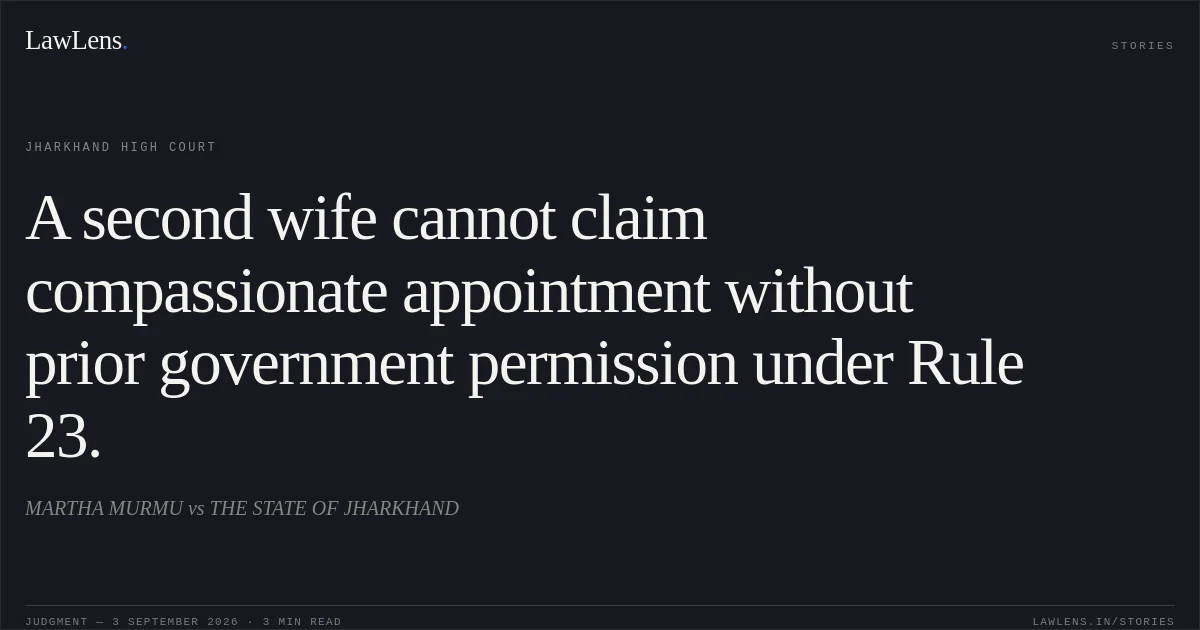
¶ 21–22 · p. 6The Court held that, in the absence of prior Government permission under Rule 23, the appellant could not claim compassionate appointment on the basis of her second marriage while the deceased employee’s first marriage subsisted.
¶ 21–22 · p. 6Santhali customary law and the appellant’s financial hardship did not alter that conclusion, and Rameshwari Devi did not support her claim.
¶ 21–22 · p. 6The order of the learned Single Judge was upheld, with no order as to costs.
¶ 21–22 · p. 6Original Court PDF
MARTHA MURMUvsTHE STATE OF JHARKHAND
Click to open original judgment
Original judgment, available to read, download and summarize on LawLens.in