Facts
Late Amal Saikia, a Railway employee, married Malati Saikia (Respondent No. 5) in 1987.
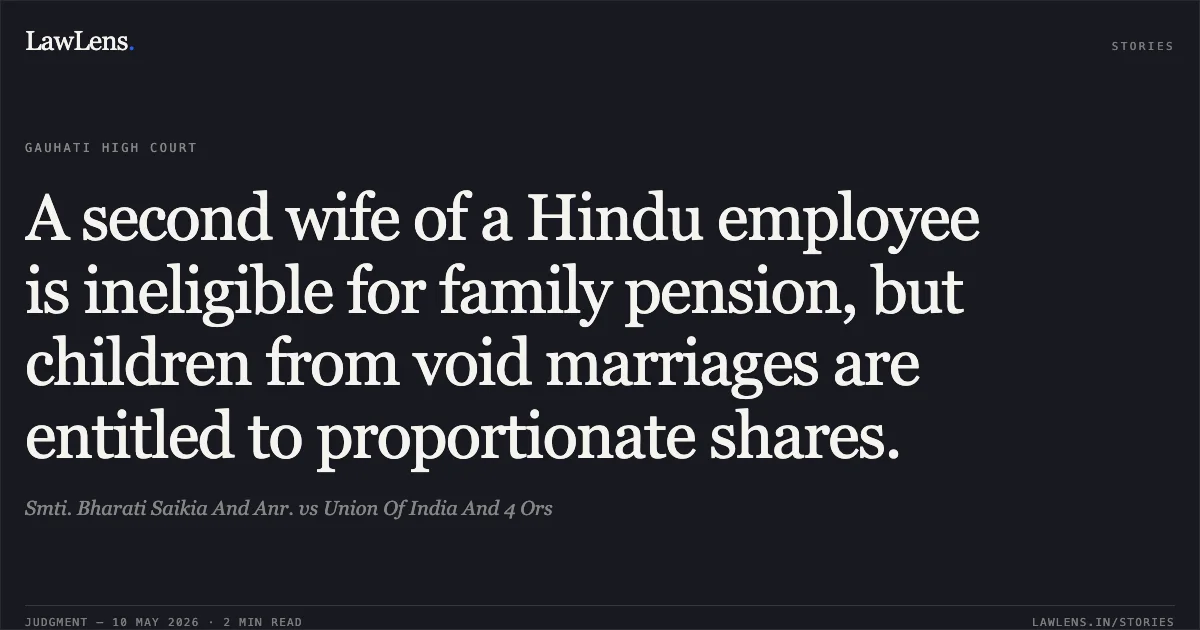
Source reference: p. 3In 2010, while the first marriage was subsisting and without a divorce, he married Bharati Saikia (Petitioner No. 1), with whom he had a son, Mousum Saikia (Petitioner No. 2).
Source reference: p. 3Upon the employee’s death, Petitioner No. 1 sought a share of the family pension, death gratuity, and retiral benefits under the Railway Services (Pension) Rules, 1993.
Source reference: p. 2The Central Administrative Tribunal (CAT) denied the claim, holding that the first wife was exclusively entitled to the benefits.
Source reference: p. 3The petitioners challenged this order via writ petition before the Gauhati High Court.
Source reference: p. 2Issues
1. Whether a second wife, whose marriage is void under the Hindu Marriage Act, 1955, is entitled to a share of the family pension and retiral benefits under the Railway Services (Pension) Rules, 1993?
Source reference: p. 52. Whether the child born out of a void second marriage is entitled to a proportionate share of the family pension?
Source reference: p. 6Law Applied
The Court applied Rules 70 and 75 of the Railway Services (Pension) Rules, 1993, which provide for death gratuity and family pension distribution among "widows".
Source reference: p. 4Rule 21 of the Railway Services (Conduct) Rules, 1966, which prohibits a Railway servant from contracting a second marriage without permission and without satisfying that such marriage is permissible under personal law.
Source reference: p. 5Sections 5, 11, and 12 of the Hindu Marriage Act, 1955, regarding void marriages.
Source reference: p. 5-6The precedent of the Full Bench of the Bombay High Court in Kamalbai v. State of Maharashtra & Ors. (2019), which established that a second wife must be "legally wedded" to claim pensionary benefits.
Source reference: p. 5-6Reasoning
The Court reasoned that the terms "wives" or "widows" used in the Pension Rules, 1993, must be interpreted harmoniously with personal laws and Conduct Rules.
Source reference: p. 5-6Since the deceased was Hindu, the Hindu Marriage Act applies proprio vigore; therefore, any marriage solemnized during the subsistence of a prior marriage is void ab initio under Section 11.
Source reference: p. 5-6Consequently, Petitioner No. 1 cannot be considered a "legally wedded wife" and is ineligible for pensionary benefits.
Source reference: p. 6Under the Pension Rules, 1993, the legitimacy of the child's claim to a proportionate share of the family pension is protected regardless of the void status of the mother's marriage.
Source reference: p. 6Holding
The Court held that Petitioner No. 1 (the second wife) is not entitled to any pensionary benefits as her marriage was void.
It held that Petitioner No. 2 (the minor son) is entitled to a proportionate share of the family pension according to the Pension Rules of 1993.
Source reference: p. 6The High Court modified the Tribunal’s order to the extent that the Railway authorities must pay the proportionate share of the family pension to the minor son, and the writ petition was partially allowed.
Source reference: p. 6-7Acts & Sections Cited
2 provisions across 1 statute referred to in this judgment. Each provision opens on LawLens.
Hindu Marriage Act, 19552
Original Court PDF
Smti. Bharati Saikia And Anr.vsUnion Of India And 4 Ors
Click to open original judgment
Original judgment, available to read, download and summarize on LawLens.in


