Facts
The petitioner, a fabric supplier, claimed that goods supplied to the respondent between September 2019 and August 2021 remained unpaid, leaving ₹19,88,360 outstanding.
Source reference: paras. 4–8The challans contained an arbitration clause referring disputes to arbitration through the Delhi Hindustani Mercantile Association. After the respondent obtained a reference to arbitration under Section 8 of the Arbitration and Conciliation Act, 1996, the petitioner invoked arbitration by notice dated 23 July 2026 and filed this Section 11(6) petition on 14 August 2026.
Source reference: paras. 4–8The respondent objected that the underlying claims were time-barred, but consented to appointment of an independent arbitrator and proposed DIAC as the administering institution; the petitioner did not oppose that proposal.
Source reference: paras. 9, 14–15Issues
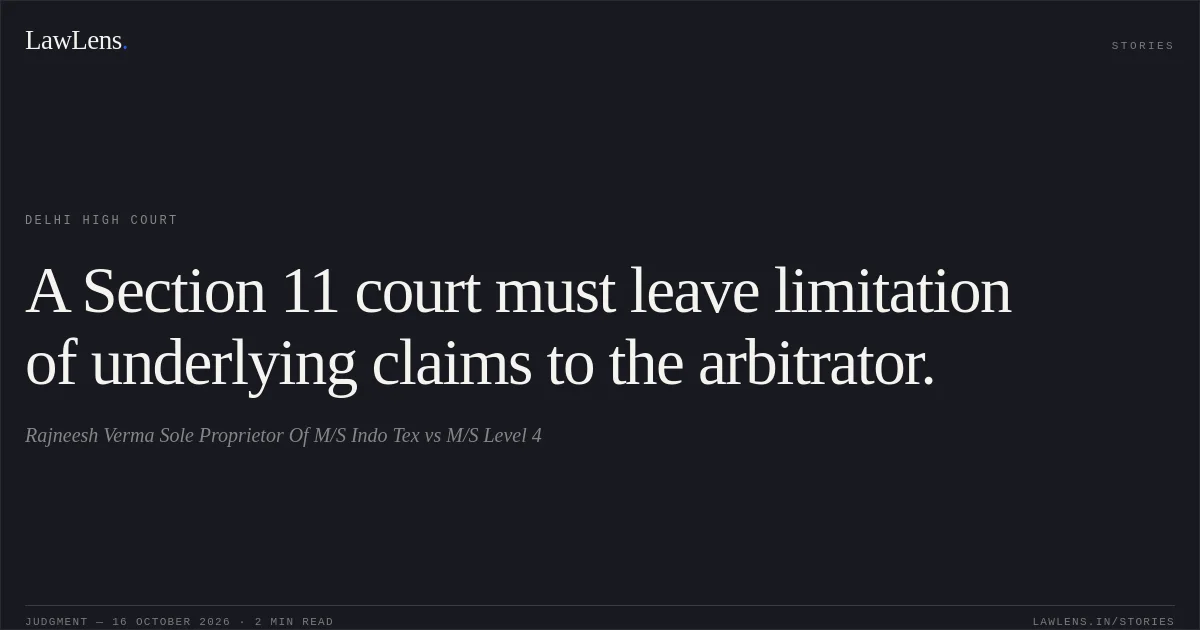
1. Whether the respondent’s objection that the underlying claims were time-barred prevented the Court from appointing an arbitrator under Section 11(6).
Source reference: paras. 9–132. Whether, by mutual consent, the parties could replace the institution named in the arbitration clause with DIAC as the institution administering the arbitration.
Source reference: paras. 15–17Law Applied
Section 11(6A) of the Arbitration and Conciliation Act, 1996 confines the referral court’s examination to the existence of an arbitration agreement.
Source reference: para. 11In In Re: Interplay between Arbitration Agreements under the Arbitration and Conciliation Act, 1996 and the Indian Stamp Act, 1899, (2024) 6 SCC 1, the Supreme Court held that this examination is prima facie and does not require a laborious or contested inquiry.
Source reference: para. 11In SBI General Insurance Co. Ltd. v. Krish Spinning, (2024) 12 SCC 1, the Court held that, at the Section 11 stage, the referral court may examine whether the Section 11 petition itself is within limitation, but should not conduct an intricate evidentiary inquiry into whether the underlying claims are time-barred; that question is for the arbitrator.
Source reference: para. 12The Court also relied on Shaf Broadcast (P) Ltd. v. Doordarshan, (2019) 10 SCC 447, which supports modification of an arbitration arrangement by mutual consent recorded in court.
Source reference: para. 16Reasoning
The arbitration agreement’s existence was undisputed, and the Section 11 petition had been filed in 2026 after the arbitration notice issued that year.
Source reference: paras. 10–13The respondent’s limitation objection concerned the underlying claims and required consideration of the pleaded running account and payments—matters involving fact and law that the arbitrator, rather than the referral court, should decide.
Source reference: paras. 10–13Since both parties agreed to DIAC administration, their consent permitted that aspect of the arbitration arrangement to be modified, while leaving the seat at Delhi unchanged.
Source reference: paras. 15–16Holding
The Court allowed the petition and appointed Mr. Nikhil Aradhe, Advocate, as Sole Arbitrator.
The arbitration is to proceed under the aegis of, and in accordance with the rules of, DIAC, subject to the arbitrator’s disclosures under Section 12.
Source reference: paras. 17–22The arbitrator must decide the respondent’s limitation objection as a preliminary issue at the outset; all other rights and contentions were left open.
Source reference: paras. 17–22Acts & Sections Cited
4 provisions across 1 statute referred to in this judgment. Each provision opens on LawLens.
Arbitration and Conciliation Act, 19964
Original Court PDF
Rajneesh Verma Sole Proprietor Of M/S Indo TexvsM/S Level 4
Click to open original judgment
Original judgment, available to read, download and summarize on LawLens.in