Facts
The suit property, originally agricultural land, was leased to Pune Fuel Merchants Association Ltd. in 1944.
Source reference: no citationThe District Court decreed eviction in 1974, and the Bombay High Court affirmed the decree in 1982.
Source reference: no citationIn execution proceedings begun in 1993, the bailiff encountered obstruction by the applicant, whose objection was treated as an application under Order XXI Rule 97 CPC.
Source reference: para. 5–9, 23The applicant claimed tenancy rights over part of the property under a rent receipt allegedly issued in 1999 by a son of the original landlord.
Source reference: para. 5–9, 23He applied under Section 47 CPC to have the decree declared a nullity for want of jurisdiction; that application was rejected on 14 July 2015.
Source reference: para. 5–9, 23He also sought to prevent the decree-holders from leading evidence because they had not filed a reply to the obstruction application; that request was rejected on 9 June 2015.
Source reference: para. 5–9, 23Issues
1. Whether a third-party obstructionist whose objection is being adjudicated under Order XXI Rule 97 CPC may invoke Section 47 CPC to challenge the decree as a nullity
Source reference: para. 23–24, 38–422. Whether the executing court could examine the decree’s jurisdictional validity where that issue had been considered in the original proceedings and its determination would require factual inquiry
Source reference: para. 37, 47–563. Whether the decree-holders could lead evidence in the obstruction proceedings despite not filing a written reply
Source reference: para. 58–63Law Applied
Section 47 CPC confines the executing court’s determination to questions relating to execution, discharge or satisfaction of a decree arising between the suit parties or their representatives; it does not permit a stranger to the suit to challenge the decree through that provision.
Source reference: para. 38–45Under Order XXI Rules 97 and 101 CPC, the executing court adjudicates relevant questions—including right, title or interest—arising between the parties to an obstruction proceeding.
Source reference: para. 35–37An executing court ordinarily cannot go behind the decree; a jurisdictional objection that requires investigation of facts and is not apparent on the face of the record cannot be determined in execution.
Source reference: para. 47–49An Order XXI Rule 97 inquiry does not invariably require a detailed evidentiary hearing, but the court may direct evidence where necessary; the obstructionist bears the burden of establishing the asserted independent right.
Source reference: para. 59–62Reasoning
The applicant had proceeded as a third-party obstructionist claiming an independent tenancy, not as a representative of a party to the suit; he could not shift positions and use Section 47 to contest the decree while pursuing his obstruction claim under Order XXI Rule 97.
Source reference: para. 41–46Further, the decree had been affirmed on appeal, and the jurisdictional issue had been considered in the earlier proceedings. Determining whether the land qualified as “premises” under the Bombay Rent Act would require factual inquiry into the nature and purpose of the lease, which the executing court could not undertake to invalidate the decree.
Source reference: para. 47–56As to evidence, the CPC did not make a decree-holder’s written reply a precondition to leading evidence. Since the applicant’s claim called for adjudication, the executing court was justified in permitting the decree-holders to adduce evidence.
Source reference: para. 58–63Holding
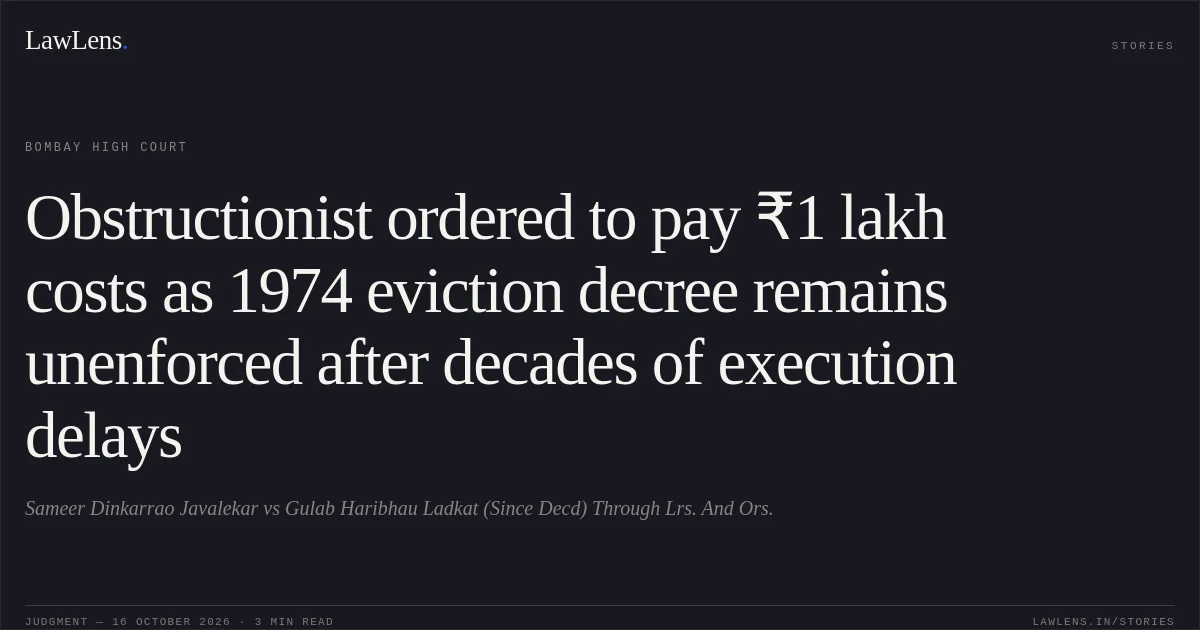
The Bombay High Court dismissed Civil Revision Application No. 394 of 2015 and Writ Petition No. 5401 of 2015, and disposed of the pending civil application.
It directed the applicant to pay costs of ₹1,00,000 within four weeks; payment was made a condition precedent to prosecuting the obstruction application.
Source reference: para. 64The executing court was directed to decide the execution proceedings, pending since 1993, expeditiously and preferably within four months.
Source reference: para. 64Acts & Sections Cited
3 provisions across 3 statutes referred to in this judgment. Each provision opens on LawLens.
Code of Civil Procedure, 19081
Suits Valuation Act, 18871
Transfer of Property Act, 18821
Original Court PDF
Sameer Dinkarrao JavalekarvsGulab Haribhau Ladkat (Since Decd) Through Lrs. And Ors.
Click to open original judgment
Original judgment, available to read, download and summarize on LawLens.in