Facts
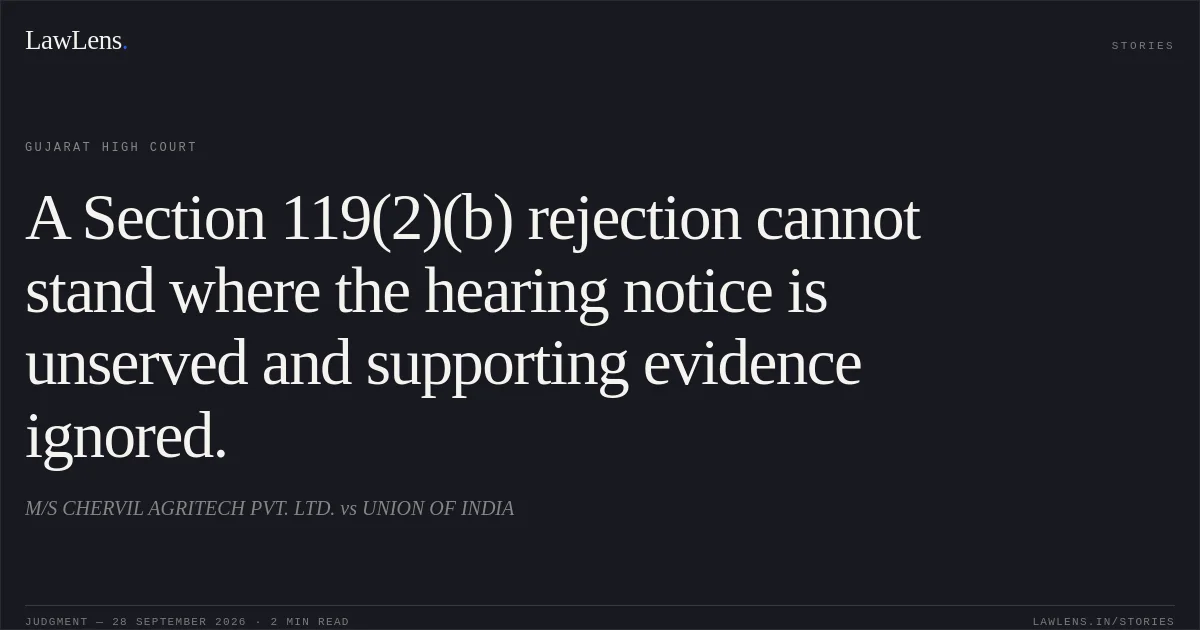
The petitioner sought condonation under Section 119(2)(b) of the Income Tax Act, 1961, of delays in filing returns for A.Ys. 2016–17 and 2019–20.
Source reference: paras. 2–7, 9–10; pp. 1–4Its applications were made from its new address.
Source reference: paras. 2–7, 9–10; pp. 1–4Although the respondent’s communication of 4 August 2023 seeking documents was sent to the old address, the petitioner notified the respondent on 17 August 2023 of its new address and supplied an email address.
Source reference: paras. 2–7, 9–10; pp. 1–4The petitioner asserted that it never received the respondent’s letter of 1 September 2023 seeking further material and an opportunity to be heard.
Source reference: paras. 2–7, 9–10; pp. 1–4The respondent rejected the applications by an order dated 27 September 2023, which referred to the old address and did not address documents the petitioner had submitted.
Source reference: paras. 2–7, 9–10; pp. 1–4The petitioner learned of the order after enquiring by email in February 2024 and challenged it by writ petition.
Source reference: paras. 2–7, 9–10; pp. 1–4Issues
Whether the rejection of the petitioner’s condonation applications was procedurally unfair because the petitioner did not receive the communication providing an opportunity to submit further material.
Source reference: paras. 6, 8, 10; pp. 3–4Whether the rejection order was unsustainable because it failed to consider the petitioner’s documentary evidence and was cryptic.
Source reference: paras. 5, 8, 10; pp. 2–4Law Applied
Section 119(2)(b) of the Income Tax Act, 1961, empowers the competent authority to consider applications for condonation of delay in filing returns.
Source reference: paras. 2, 9The authority must observe the principles of natural justice by giving the applicant a fair opportunity to present its case.
Source reference: paras. 8, 10An order deciding such an application must also address the relevant material placed before the authority; a cryptic order that does not deal with the applicant’s documentary evidence is inadequate.
Source reference: para. 10Reasoning
The petitioner had notified the respondent of its new address and provided an email address, but the respondent’s communications and the impugned order continued to refer to the old address.
Source reference: paras. 8, 10; pp. 3–4The respondent did not dispute that the petitioner had not received the 1 September 2023 letter seeking further documents and an opportunity to be heard.
Source reference: paras. 8, 10; pp. 3–4Further, although the petitioner had submitted financial statements, returns and computations, the authority did not deal with that evidence when rejecting the applications.
Source reference: paras. 8, 10; pp. 3–4The Court therefore found both a failure to provide an effective opportunity and a failure to give a reasoned consideration of the material.
Source reference: paras. 8, 10; pp. 3–4Holding
The Court set aside the order dated 27 September 2023 rejecting the applications for condonation of delay.
It reserved liberty to the respondents to pass a fresh order after complying with the principles of natural justice and giving the petitioner an opportunity to present its case.
Source reference: para. 11; p. 5Acts & Sections Cited
1 provisions across 1 statute referred to in this judgment. Linked provisions open on LawLens.
Income Tax Act, 19611
Original Court PDF
M/S CHERVIL AGRITECH PVT. LTD.vsUNION OF INDIA
Click to open original judgment
Original judgment, available to read, download and summarize on LawLens.in