Facts
The appellant, the original complainant, filed an appeal under Section 378 of the Code of Criminal Procedure, 1973 (“CrPC”) and/or Section 419 of the Bharatiya Nagarik Suraksha Sanhita, 2023 (“BNSS”), challenging the judgment dated 30 April 2019 by which the Additional Chief Judicial Magistrate, Idar-Sabarkantha acquitted the respondent-accused of the offence under Section 138 of the Negotiable Instruments Act, 1881 (“NI Act”).
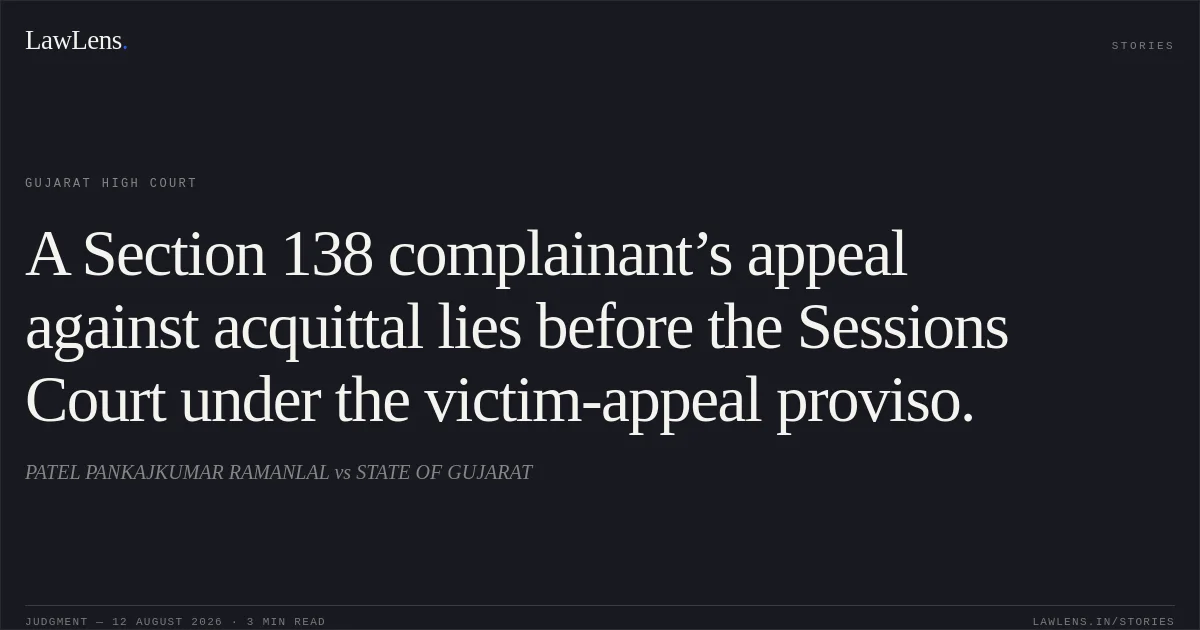
Source reference: p.1, para.1During the hearing, the parties submitted that, in view of Celestium Financial v. A. Gnanasekaran, the complainant in a Section 138 proceeding is a “victim” and must pursue an appeal under the proviso to Section 372 CrPC before the immediately superior appellate court, namely, the Sessions Court.
Source reference: p.2, paras.3–4The Court also noted that the issue in Celestium Financial was pending consideration before a larger Bench of the Supreme Court in Special Leave to Appeal (Crl.) No. 12350/2024.
Source reference: p.2, para.6Issues
1. Whether an original complainant/payee in a prosecution under Section 138 of the NI Act is a “victim” entitled to appeal against acquittal under the proviso to Section 372 CrPC, or the corresponding provision of the BNSS, before the immediately superior court—the Sessions Court?
Source reference: p.2, paras.3–4; p.3, para.72. Whether the present appeal filed before the High Court under Section 378 CrPC/Section 419 BNSS should be transferred to the concerned Sessions Court for treatment and numbering as an appeal under the proviso to Section 372 CrPC/Section 413 BNSS?
Source reference: p.2, paras.5–8Law Applied
The Court applied Section 138 of the NI Act, which creates the offence of dishonour of cheque, along with the appellate framework under Section 378 and the proviso to Section 372 CrPC.
Source reference: no citationUnder Celestium Financial v. A. Gnanasekaran, the complainant/payee in a Section 138 proceeding is also the victim of the cheque dishonour and has an independent right to appeal against acquittal, conviction for a lesser offence, or inadequate compensation under the proviso to Section 372 CrPC, without the requirement of special leave under Section 378(4).
Source reference: pp.3–5, para.7The corresponding BNSS provisions are Section 413, concerning the victim’s right of appeal, and Section 419, concerning appeals against acquittal.
Source reference: no citationThe Court also relied on Shivsinh Ganpatsinh Solanki v. State of Gujarat and Thakar Hariprasad Dalsukhram v. State of Gujarat, which recognise that such an appeal lies before the court immediately superior in the judicial hierarchy, ordinarily the Sessions Court.
Source reference: p.2, para.4; p.5, para.8Reasoning
The High Court observed that the complainant in a Section 138 NI Act case suffers the direct legal and financial impact of the dishonoured cheque and therefore falls within the definition of “victim” under Section 2(wa) CrPC.
Source reference: p.5, para.7Consequently, the complainant’s appeal against acquittal is governed by the proviso to Section 372 CrPC rather than exclusively by the complainant-specific mechanism under Section 378 CrPC.
Source reference: no citationSince the Sessions Court is the court immediately superior to the Magistrate who rendered the acquittal, the proper appellate forum was the concerned Sessions Court.
Source reference: p.2, paras.3–5Although the Supreme Court’s ruling in Celestium Financial was stated to be pending reconsideration before a larger Bench, the High Court followed the prevailing legal position and directed transfer of the matter without examining the merits of the acquittal.
Source reference: p.2, para.6; p.5, paras.8–9Holding
The appeal was disposed of with directions for transfer to the concerned Sessions Court.
Upon transfer, the matter was to be treated and numbered as an appeal under the proviso to Section 372 CrPC or Section 413 BNSS, and notice was to be issued to the parties.
Source reference: p.5, para.8The Registry was directed to transmit the complete record, including the certified copy of the impugned judgment and the record and proceedings, to the Sessions Court forthwith.
Source reference: p.5, para.8The Sessions Court was requested to dispose of the matter expeditiously, and the High Court expressly clarified that it had not considered the merits of the case.
Source reference: p.6, para.9Acts & Sections Cited
9 provisions across 3 statutes referred to in this judgment. Each provision opens on LawLens.
Code of Criminal Procedure, 19735
Bharatiya Nagarik Suraksha Sanhita, 20232
Negotiable Instruments Act, 18812
Original Court PDF
PATEL PANKAJKUMAR RAMANLALvsSTATE OF GUJARAT
Click to open original judgment
Original judgment, available to read, download and summarize on LawLens.in