Facts
The complainant alleged that, while working as a contractor for Subhash Project Marketing Ltd. at NTPC, he received a cheque for ₹70,000 dated 16 December 2015.
Source reference: pp. 2, 6–7The cheque was dishonoured and returned on 16 March 2016.
Source reference: pp. 2, 6–7A legal notice was issued on 16 April 2016, and the complaint under Section 138 of the Negotiable Instruments Act, 1881 (“NI Act”) was filed on 26 April 2016.
Source reference: pp. 2, 6–7The Magistrate took cognizance against S. C. Sethi on 12 August 2016.
Source reference: pp. 2, 6–7Sethi sought to quash the cognizance order, arguing, among other things, that the complaint was filed before expiry of the statutory 15-day period and that the company had not been impleaded.
Source reference: pp. 2, 6–7He also submitted that the cheque amount had been paid.
Source reference: pp. 2, 6–7Issues
1. Whether a complaint under Section 138 of the NI Act filed before expiry of 15 days from receipt of the statutory notice is maintainable and can support cognizance.
Source reference: pp. 2–62. Whether the cognizance order should be quashed where the petitioner asserted that the cheque amount had been paid.
Source reference: p. 73. Whether the petitioner could be proceeded against without the company being arraigned as an accused.
Source reference: p. 6Law Applied
Section 138 of the NI Act makes failure to pay the cheque amount within 15 days of receipt of the statutory notice a condition for completion of the offence.
Source reference: pp. 9–10Under Section 142(1), cognizance of a Section 138 offence requires a written complaint by the payee or holder in due course, made within the prescribed period after the cause of action arises.
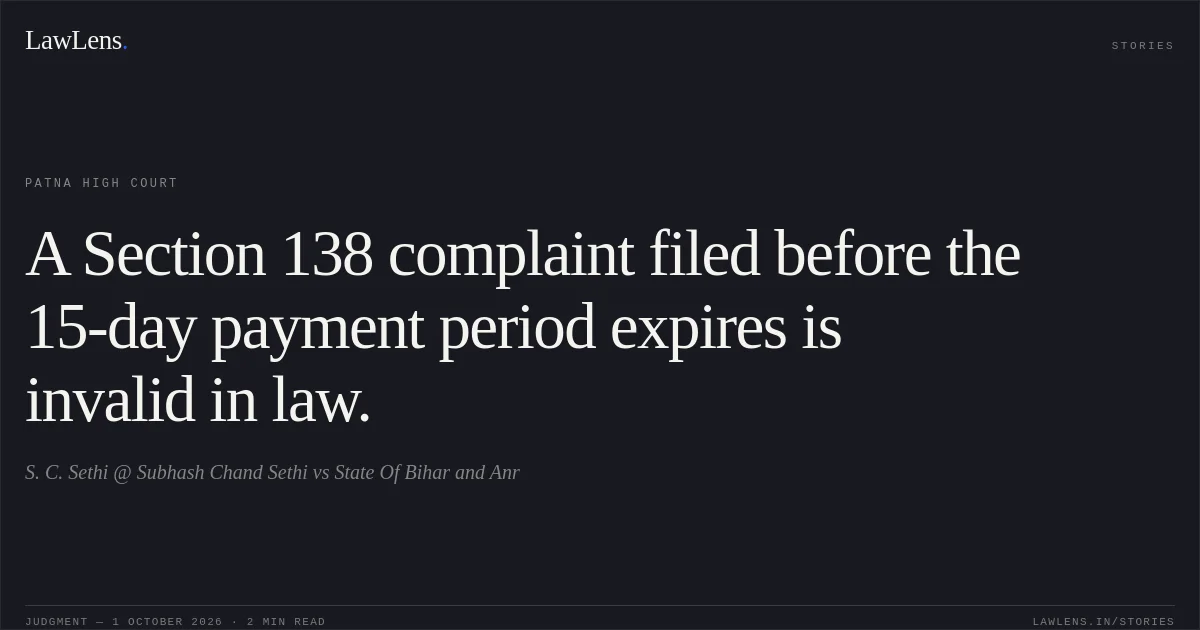
Source reference: pp. 7–9Relying on Yogendra Pratap Singh v. Savitri Pandey, (2014) 10 SCC 713, the Court stated that a complaint filed before expiry of the 15-day period is not a valid complaint in law and cannot support cognizance.
Source reference: pp. 3–6The petitioner also cited Shiv Kumar Jatia v. State (NCT of Delhi), (2019) 17 SCC 193, in support of the company-related submission, but the Court did not separately apply or analyse that authority.
Source reference: p. 6Reasoning
The Court noted that the legal notice was issued on 16 April 2016 and that the complaint was filed on 26 April 2016—ten days later.
Source reference: pp. 6–7Applying Section 138(c) and the rule in Yogendra Pratap Singh, it treated the complaint as having been filed before the 15-day period expired and concluded that the statutory prerequisite for a Section 138 offence had not been met.
Source reference: pp. 6–7, 9–10The Court also took account of the petitioner’s submission that the cheque amount had already been paid.
Source reference: p. 12Although the petitioner raised the company’s non-joinder, the judgment does not provide a separate determination of that contention.
Source reference: p. 6Holding
The High Court held that the complaint was premature and that cognizance was legally barred.
It quashed the Magistrate’s order dated 12 August 2016 in Complaint Case No. 212(C) of 2016 and allowed the application.
Source reference: p. 10Acts & Sections Cited
3 provisions across 2 statutes referred to in this judgment. Each provision opens on LawLens.
Negotiable Instruments Act, 18812
Code of Criminal Procedure, 19731
Original Court PDF
S. C. Sethi @ Subhash Chand SethivsState Of Bihar and Anr
Click to open original judgment
Original judgment, available to read, download and summarize on LawLens.in