Facts
The petitioner purchased paddy worth ₹4,64,515 from Respondent No. 2 and issued two post-dated cheques for ₹2,64,500 and ₹2,00,000 towards payment.
Source reference: pp. 2–3Both cheques were dishonoured for insufficiency of funds.
Source reference: pp. 2–3After issuance of a legal notice, Respondent No. 2 instituted Complaint Case No. 1834 of 2019 under Sections 420 IPC and 138 of the Negotiable Instruments Act, 1881 (“NI Act”).
Source reference: pp. 2–3The trial court convicted the petitioner under Section 138 of the NI Act and sentenced him to six months’ rigorous imprisonment and payment of ₹5,00,000 as compensation.
Source reference: p. 1The appellate court affirmed the conviction but reduced the sentence to six months’ simple imprisonment.
Source reference: p. 1During the pendency of the revision, the dispute was referred to mediation.
Source reference: pp. 4–6The parties entered into a Memorandum of Agreement dated 17 April 2026, under which the petitioner agreed to pay ₹6,50,000 to Respondent No. 2.
Source reference: pp. 4–6The petitioner subsequently paid the entire settled amount through UPI, PhonePe and cheque transactions.
Source reference: pp. 4–6Issues
Whether the High Court could exercise its inherent jurisdiction to give effect to the parties’ settlement and compound the offence under Section 138 of the NI Act at the revision stage, notwithstanding the concurrent findings of conviction by the subordinate courts?
Source reference: paras. 9–12, 15Whether, upon full payment of the settlement amount and voluntary resolution of the dispute, the petitioner was entitled to have the conviction and sentence set aside and to be treated as acquitted on account of compounding?
Source reference: paras. 10–16Law Applied
Section 147 of the NI Act makes offences under the Act compoundable notwithstanding the provisions of the Code of Criminal Procedure, 1973, and permits compounding at any stage where the parties have voluntarily settled the dispute.
Source reference: para. 13The High Court’s inherent jurisdiction may be exercised to give effect to an order under the CrPC, prevent abuse of the process of court, or otherwise secure the ends of justice, as stated in S.W. Palanitkar v. State of Bihar, (2002) 1 SCC 241.
Source reference: para. 12Relying on Gian Chand Garg v. Harpal Singh, 2025 SCC OnLine SC 2317, including the principles drawn from Gimpex (P) Ltd. v. Manoj Goel and B.V. Seshaiah v. State of Telangana, the Court held that a voluntary settlement in a cheque-dishonour prosecution may be honoured and that courts should not override such compounding.
Source reference: para. 13The Court also relied on P. Mohanraj v. Shah Brothers Ispat Pvt. Ltd., (2021) 6 SCC 258, which characterises Section 138 proceedings as essentially civil in nature, despite their criminal form, since they primarily protect the complainant’s financial interest.
Source reference: para. 14Reasoning
The Court acknowledged that both subordinate courts had concurrently found the petitioner guilty and that the scope of interference in revision was therefore limited.
Source reference: para. 9However, the parties had voluntarily entered into a written mediation settlement, and the petitioner had paid the entire agreed amount of ₹6,50,000 to Respondent No. 2.
Source reference: paras. 10–11Since the offence under Section 138 of the NI Act is compoundable and the dispute had been fully resolved, continuing the criminal proceedings would serve no useful purpose.
Source reference: paras. 12–15Exercising its inherent jurisdiction to secure the ends of justice, the Court gave effect to the settlement and accepted the compounding of the offence.
Source reference: paras. 12–15Holding
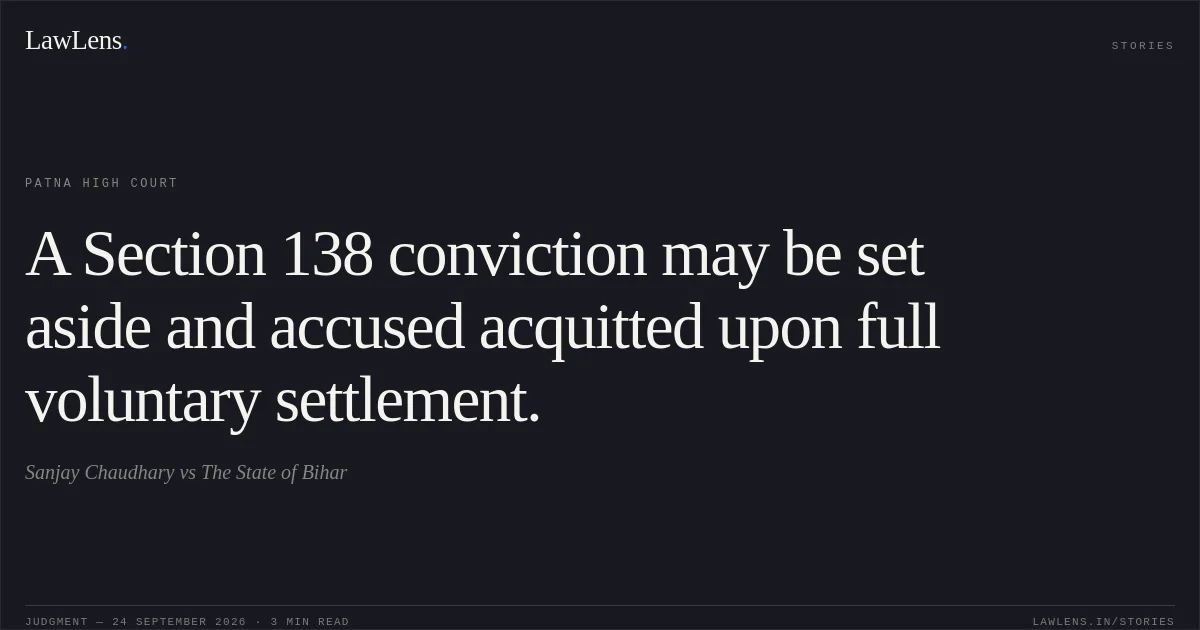
The Court held that the settlement between the parties and the petitioner’s full payment of the agreed amount justified compounding of the offence under Section 138 of the NI Act.
The judgments and orders of conviction and sentence passed by the trial and appellate courts were set aside.
Source reference: para. 16The revision petition was disposed of in terms of the Memorandum of Agreement dated 17 April 2026, and the petitioner was directed to be treated as acquitted on account of compounding of the offence.
Source reference: para. 16Acts & Sections Cited
3 provisions across 2 statutes referred to in this judgment. Each provision opens on LawLens.
Negotiable Instruments Act, 18812
Indian Penal Code, 18601
Original Court PDF
Sanjay ChaudharyvsThe State of Bihar
Click to open original judgment
Original judgment, available to read, download and summarize on LawLens.in