Facts
The petitioner had issued a cheque for ₹5,71,000 in connection with a land transaction; it was dishonoured when presented for payment.
Source reference: no citationThe respondent filed a complaint under Section 138 of the Negotiable Instruments Act.
Source reference: no citationThe Trial Court convicted the petitioner and sentenced him to six months’ simple imprisonment and to pay ₹8,56,500 as compensation, with a one-month default sentence; the appellate court affirmed the conviction and sentence.
Source reference: p.2During the revision, the parties executed a compromise dated 6 February 2026.
Source reference: pp.3–6The respondent agreed to accept ₹8,00,000 in full and final settlement, and the memorandum addressed the ₹1,71,300 deposited by the petitioner in the Trial Court, as well as the respondent’s civil suit and claims concerning the property.
Source reference: pp.3–6Both parties supported compounding of the offence.
Source reference: pp.7–8, 12Issues
Whether the High Court could set aside the conviction and sentence under Section 138 of the Negotiable Instruments Act on the basis of a compromise reached after the appellate court had affirmed the conviction.
Source reference: p.12, para. 18Whether, in the circumstances of this case, the offence could be compounded and the petitioner treated as acquitted.
Source reference: pp.15–16, paras. 23–25Law Applied
Section 147 of the Negotiable Instruments Act makes offences under that Act compoundable.
Source reference: p.14, para. 19Section 359(5), (6) and (8) of the Bharatiya Nagarik Suraksha Sanhita, 2023, as set out in the judgment, addresses composition after conviction or during appeal, permits a revisional court to allow composition, and provides that composition results in acquittal.
Source reference: pp.13–14, para. 19The Court also stated that inherent powers should be exercised sparingly, but may be used to secure the ends of justice or prevent miscarriage of justice.
Source reference: pp.14–15, para. 20It considered Damodar S. Prabhu v. Sayed Babalal H., M/s Meters and Instruments Private Limited v. Kanchan Mehta, Vinay Devanna Nayak v. Ryot Seva Sahkari Bank Limited, and K. Balachenniappan v. Jeyakrishnan in addressing delayed compounding and settlement of Section 138 proceedings.
Source reference: pp.8–13, paras. 10–14Reasoning
The Court treated the parties’ joint compromise and the respondent’s consent as special circumstances warranting intervention notwithstanding the appellate court’s confirmation of the conviction.
Source reference: pp.15–16, paras. 21–24It considered the dispute amicably resolved and relied on Section 147 to permit compounding, noting the respondent’s voluntary agreement to the settlement.
Source reference: p.16, para. 25The Court accordingly modified the judgments below and treated the petitioner as acquitted on account of compounding.
Source reference: pp.16–17, paras. 27–28Holding
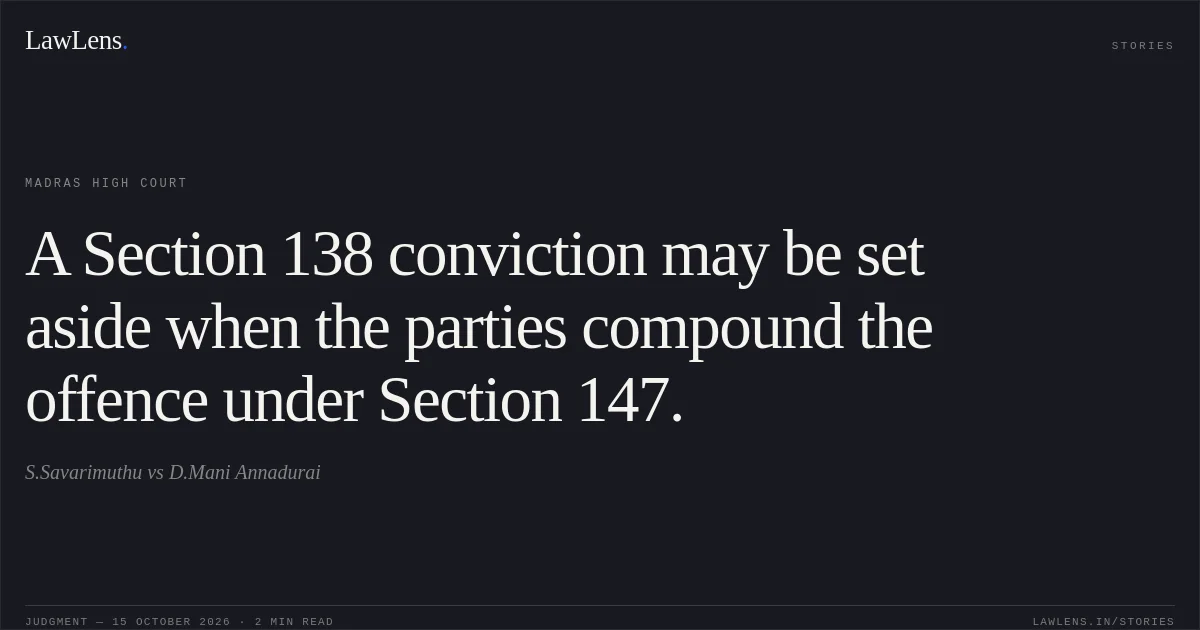
The Court disposed of the revision in terms of the compromise, set aside the conviction and sentence under Section 138, and held that the petitioner stood acquitted following compounding of the offence.
It further permitted the respondent to apply to the Trial Court to withdraw the ₹1,71,300 deposited by the petitioner and directed the Trial Court to release that amount to the respondent if such an application was filed.
Source reference: p.17, para. 29Acts & Sections Cited
14 provisions across 5 statutes referred to in this judgment. Each provision opens on LawLens.
Negotiable Instruments Act, 18814
Code of Criminal Procedure, 19735
Indian Penal Code, 18601
Bharatiya Nagarik Suraksha Sanhita, 20232
Bharatiya Nyaya Sanhita, 20232
Original Court PDF
S.SavarimuthuvsD.Mani Annadurai
Click to open original judgment
Original judgment, available to read, download and summarize on LawLens.in


