Facts
Late S. Sankaran filed a complaint under Section 138 of the Negotiable Instruments Act, 1881, alleging that the respondent had issued a cheque for ₹5,00,000 towards repayment of a loan, which was dishonoured for insufficient funds.
Source reference: pp. 2–3, paras. 3–4The Trial Court convicted the respondent and sentenced him to six months’ simple imprisonment and to pay ₹6,50,000 as compensation.
Source reference: p. 3, para. 5The respondent’s appeal was allowed, setting aside the conviction and sentence. Sankaran’s legal heirs challenged that appellate judgment.
Source reference: p. 4, para. 6During the High Court appeal, the parties settled for ₹4,30,000; ₹1,30,000 had been deposited before the Trial Court, ₹1,50,000 had been paid to the first appellant by demand draft, and the respondent undertook to pay the remaining ₹1,50,000 by 25 October 2026.
Source reference: pp. 8–9, paras. 12–14Issues
Whether the parties’ settlement permitted compounding of the offence under Section 138 of the Negotiable Instruments Act and acquittal of the respondent.
Source reference: pp. 9–10, paras. 15–18Whether the settlement sums already paid or deposited could be released to the appellants, and what direction should govern payment of the balance.
Source reference: pp. 9–10, paras. 13–16, 19Law Applied
Section 138 of the Negotiable Instruments Act criminalises dishonour of a cheque for insufficiency of funds, subject to the statutory requirements.
Source reference: no citationSection 147 of the Negotiable Instruments Act is the statutory provision permitting compounding of offences under that Act, although the judgment does not expressly cite it.
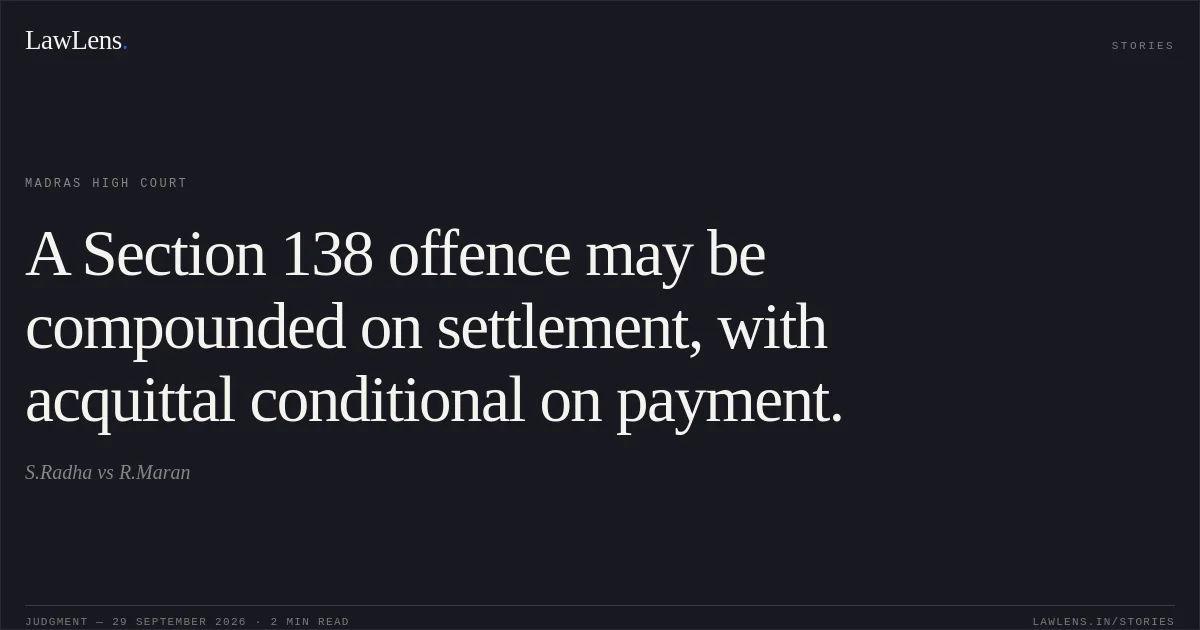
Source reference: no citationThe Court recorded that an offence under Section 138 is compoundable and, on the parties’ settlement, compounded the offence.
Source reference: p. 10, para. 17Reasoning
The Court did not revisit the evidentiary merits of the respondent’s acquittal on appeal; instead, it acted on the parties’ amicable settlement and the respondent’s undertaking.
Source reference: pp. 5–9, paras. 7–14Given the acknowledged compoundable nature of the Section 138 offence, it recorded the demand-draft payment, directed release of the Trial Court deposit with any accrued interest, and required payment of the outstanding ₹1,50,000 by the stipulated date.
Source reference: pp. 9–10, paras. 15–17The undertaking was made part of the order, with the order to stand cancelled if the balance was not paid by the deadline.
Source reference: p. 10, para. 19Holding
The Court compounded the Section 138 offence and acquitted the respondent.
It permitted the appellants to withdraw the ₹1,30,000 deposited before the Trial Court, with accrued interest, and recorded receipt of the ₹1,50,000 demand draft.
Source reference: pp. 9–10, paras. 15–20The respondent was directed to pay the remaining ₹1,50,000 by 25 October 2026; the Court stated that its order would stand cancelled upon default.
Source reference: pp. 9–10, paras. 15–20The criminal appeal was disposed of, with no further order made concerning the Sessions Court’s judgment.
Source reference: pp. 9–10, paras. 15–20Acts & Sections Cited
4 provisions across 3 statutes referred to in this judgment. Each provision opens on LawLens.
Bharatiya Nagarik Suraksha Sanhita, 20231
Code of Criminal Procedure, 19732
Negotiable Instruments Act, 18811
Original Court PDF
S.RadhavsR.Maran
Click to open original judgment
Original judgment, available to read, download and summarize on LawLens.in