Facts
The appellant had brought a complaint under Section 138 of the Negotiable Instruments Act, alleging dishonour of a cheque.
Source reference: p.1–2The trial court convicted the respondent and sentenced him to one year’s simple imprisonment and payment of Rs.11,50,000 as compensation.
Source reference: p.1–2The Sessions Court set aside the conviction, prompting the appellant to appeal to the High Court.
Source reference: p.1–2During the High Court proceedings, the respondent admitted that Rs.6,10,000 remained payable after a prior payment of Rs.25,000, and stated that Rs.2,00,000 had already been deposited before the trial court.
Source reference: p.4–6He undertook to pay the remaining Rs.4,10,000; the appellant accepted the proposal.
Source reference: p.4–6Issues
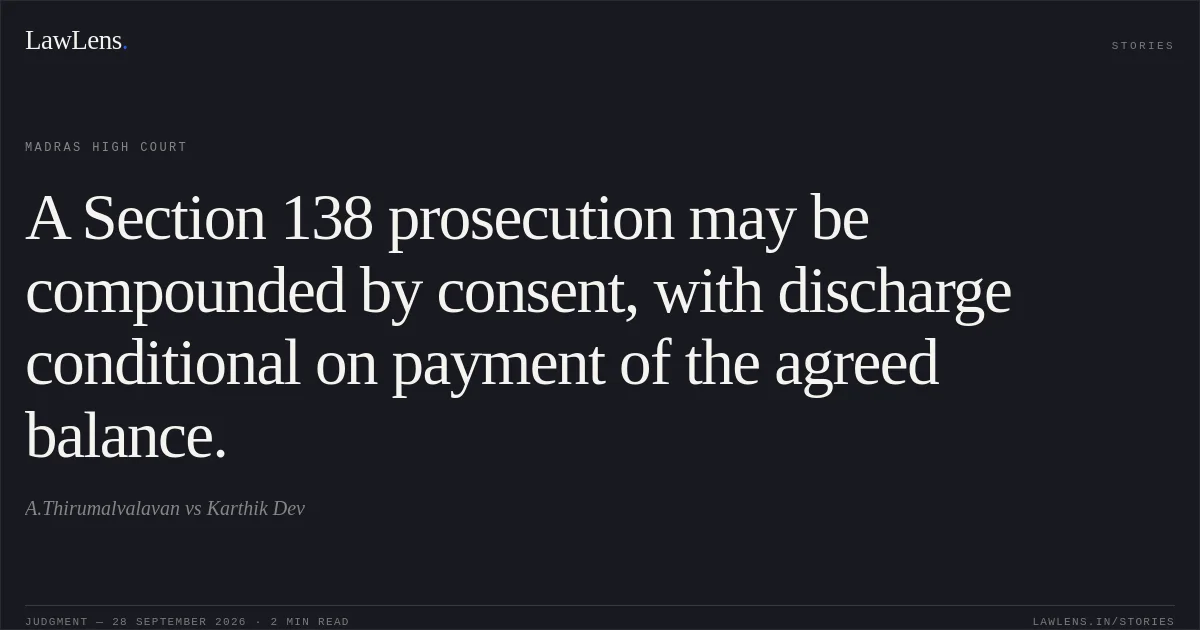
Whether the parties’ compromise and the respondent’s undertaking to pay the admitted balance justified compounding the Section 138 offence and disposing of the appeal.
Source reference: p.5–7Whether the respondent could be discharged subject to payment of the balance, with the appeal to revive if he failed to comply.
Source reference: p.7Law Applied
Section 138 of the Negotiable Instruments Act criminalises the dishonour of a cheque in the circumstances specified by that provision.
Source reference: p.1Section 147 of the Act permits offences under the Act to be compounded.
Source reference: p.7The appeal was brought under Section 419 of the Bharatiya Nagarik Suraksha Sanhita.
Source reference: p.1The judgment does not cite Section 147 or discuss its requirements expressly; it records that the Court accepted the parties’ compromise and compounded the case.
Source reference: p.7Reasoning
The Court did not determine the disputed merits of the cheque transaction or the evidentiary issues raised in the appeal.
Source reference: p.5–7Instead, it relied on the respondent’s affidavit admitting the outstanding liability of Rs.6,10,000, the existing Rs.2,00,000 deposit, and his undertaking to pay the remaining Rs.4,10,000.
Source reference: p.5–7The appellant accepted that arrangement, enabling the Court to resolve the appeal on the basis of compromise.
Source reference: p.5–7Holding
The Court accepted the compromise and compounded the case.
It permitted the appellant to withdraw the Rs.2,00,000 deposited before the trial court, with accrued interest if any, and directed the respondent to pay the remaining Rs.4,10,000 by 26 October 2026.
Source reference: p.7The Court set aside the respondent’s conviction and discharged him, but ordered that, in the event of non-payment or other violation, its order would stand recalled and the appeal would revive for disposal on the merits.
Source reference: p.7Acts & Sections Cited
2 provisions across 2 statutes referred to in this judgment. Each provision opens on LawLens.
Bharatiya Nagarik Suraksha Sanhita, 20231
Negotiable Instruments Act, 18811
Original Court PDF
A.ThirumalvalavanvsKarthik Dev
Click to open original judgment
Original judgment, available to read, download and summarize on LawLens.in