01Facts
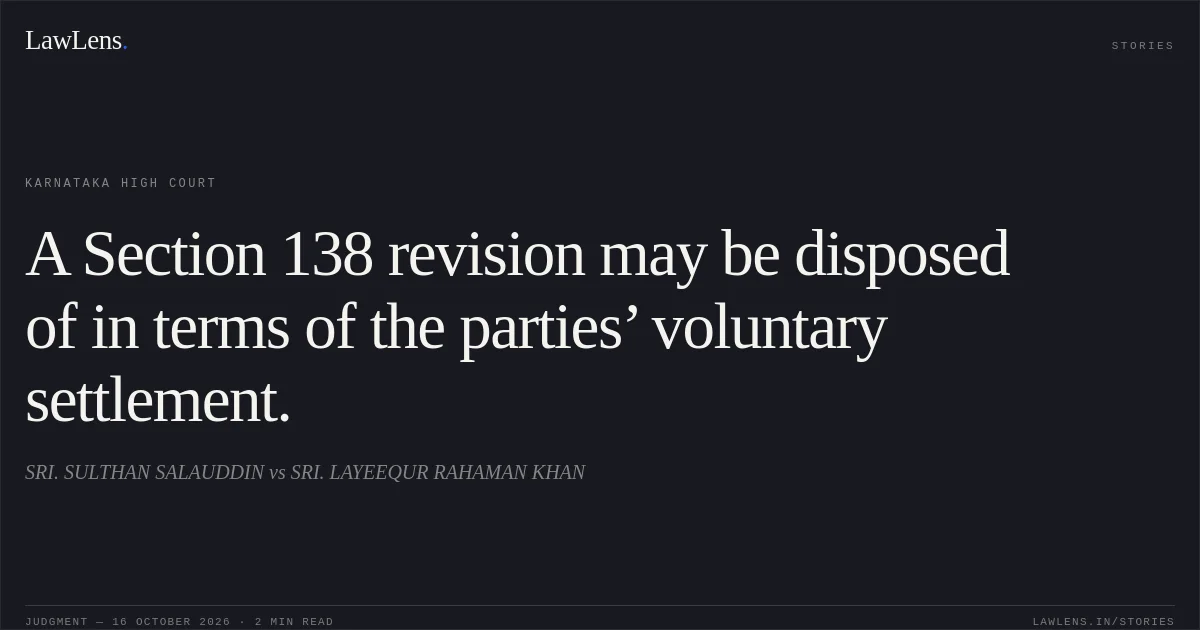
The petitioner sought revision of the dismissal of his criminal appeal, which had affirmed his conviction under Section 138 of the Negotiable Instruments Act in C.C. No. 18818/2019.
pp. 1–2With the parties’ consent, the High Court took the petition up for final disposal.
p. 2 · ¶ 1–4Both parties appeared through counsel and filed a joint memo stating that they had settled their disputes.
p. 2 · ¶ 1–4The respondent reported receiving a cheque for Rs. 14,60,000 towards full and final settlement.
p. 6 · ¶ 502Issues
i.1. Whether the Court should accept the parties’ settlement and dispose of the revision petition in accordance with their joint memo.
p. 2 · ¶ 3–4 · p. 6 · ¶ 5–7ii.2. Whether the respondent should be permitted to withdraw the amounts deposited before the trial Court and in RFA No. 997/2025.
p. 7 · ¶ 7(ii)03Law Applied
The revision petition was presented under Sections 397 and 401 of the Code of Criminal Procedure, with the petition also referring to Sections 438 and 442 of the Bharatiya Nagarik Suraksha Sanhita; the underlying conviction was under Section 138 of the Negotiable Instruments Act.
pp. 1–2The Court cited no precedent or specific statutory rule governing settlement. It accepted the joint memo after finding, on enquiry and perusal of the memo and record, that the settlement was voluntary and lawful.
p. 6 · ¶ 6Provisions in the judgment · 5 · Linked ones open on LawLens
Code of Criminal Procedure, 1973 Section 397Section 401
Bharatiya Nagarik Suraksha Sanhita, 2023 Section 438Section 442
Negotiable Instruments Act, 1881 Section 138
04Reasoning
The Court recorded that both parties were present and represented by counsel, had jointly requested disposal in terms of their settlement, and that the respondent reported receipt of the agreed cheque.
p. 2 · ¶ 2–3 · p. 6 · ¶ 5Having found the settlement voluntary and lawful, the Court accepted the memo and disposed of the revision accordingly.
p. 6 · ¶ 6 · p. 7 · ¶ 7(i)It also permitted withdrawal of the deposited amounts. The order does not expressly set aside the conviction or state that the offence was compounded.
p. 7 · ¶ 705Holding
The High Court disposed of the revision petition in terms of the joint memo.
p. 7 · ¶ 7The High Court permitted the respondent to withdraw the amounts deposited before the trial Court and in RFA No. 997/2025.
p. 7 · ¶ 7Original Court PDF
SRI. SULTHAN SALAUDDINvsSRI. LAYEEQUR RAHAMAN KHAN
Click to open original judgment
Original judgment, available to read, download and summarize on LawLens.in