Facts
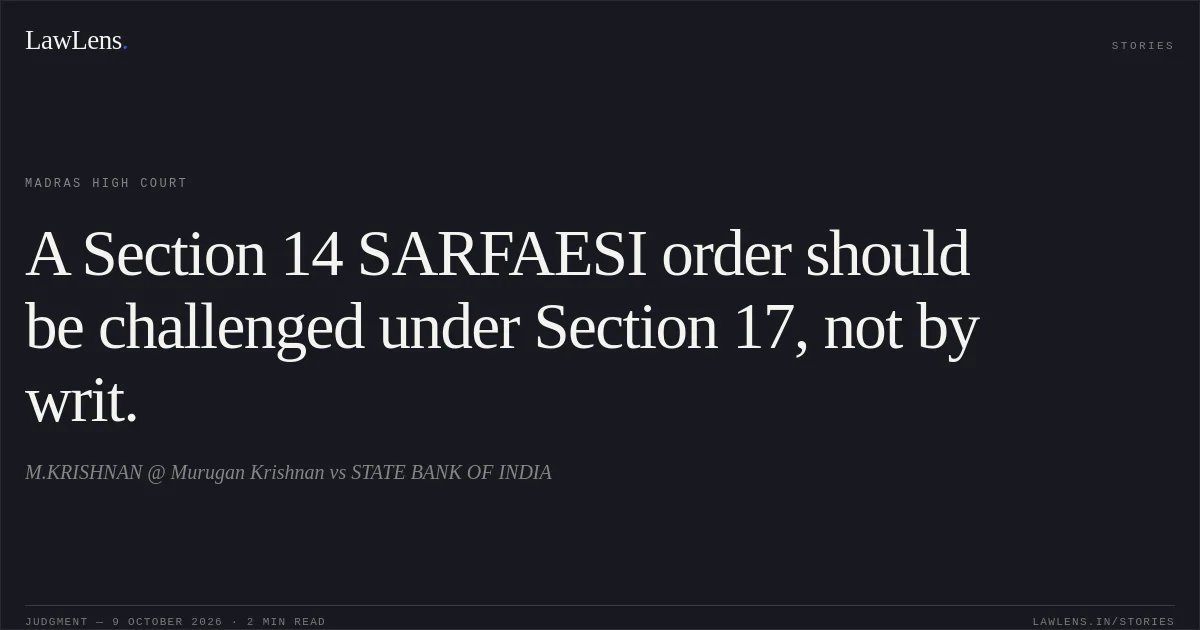
The petitioner-borrower challenged the Chief Metropolitan Magistrate, Egmore’s order dated 18 February 2026 under Section 14 of the SARFAESI Act, seeking to quash that order and consequential proceedings under Sections 13 and 14, and to restrain the Bank from taking possession of his property.
Source reference: p. 2The High Court considered whether the writ petition could be entertained in light of the statutory remedy under Section 17 of the Act.
Source reference: pp. 2–6Issues
1. Whether a writ petition under Article 226 is maintainable to challenge an order passed under Section 14 of the SARFAESI Act when a remedy under Section 17 is available before the Debts Recovery Tribunal?
Source reference: pp. 2–62. Whether the petitioner’s challenge to the Section 14 order and consequential possession proceedings should be pursued before the appropriate statutory forum?
Source reference: pp. 2, 6Law Applied
Under the SARFAESI Act, an aggrieved person may challenge action under Sections 13(4) or 14 by applying under Section 17 before the Debts Recovery Tribunal; where that remedy is effective, High Courts ordinarily decline to exercise jurisdiction under Article 226.
Source reference: pp. 3–6The Court relied on Phoenix ARC (P) Ltd. v. Vishwa Bharati Vidya Mandir, (2022) 5 SCC 345, which reaffirmed this principle, including the guidance in United Bank of India v. Satyawati Tondon, (2010) 8 SCC 110, and Kanaiyalal Lalchand Sachdev v. State of Maharashtra, (2011) 2 SCC 782.
Source reference: pp. 3–6Reasoning
The petitioner sought to challenge a Magistrate’s order under Section 14 and the related SARFAESI enforcement proceedings. Applying the cited Supreme Court authorities, the Court held that Section 17 provides an effective statutory remedy against action under Section 14 and that such a challenge should ordinarily be taken to the Debts Recovery Tribunal rather than pursued through a writ petition.
Source reference: pp. 2–6It therefore declined to examine the merits of the petitioner’s challenge in the writ proceedings.
Source reference: pp. 2–6Holding
The High Court dismissed the writ petition as not maintainable in view of the available remedy under Section 17, while leaving it open to the petitioner to pursue his rights before the appropriate forum.
It made no order as to costs and closed the connected miscellaneous petitions.
Source reference: p. 7Acts & Sections Cited
3 provisions across 1 statute referred to in this judgment. Each provision opens on LawLens.
Securitisation and Reconstruction of Financial Assets and Enforcement of Security Interest Act, 20023
Original Court PDF
M.KRISHNAN @ Murugan KrishnanvsSTATE BANK OF INDIA
Click to open original judgment
Original judgment, available to read, download and summarize on LawLens.in