Facts
The petitioner sought a mandamus directing respondents 1 to 4 to consider his representation dated 10 September 2026 concerning the proposed erection of high-tension transmission poles and wires over his patta land in Survey No. 365/17 at Eppothumvendran Village.
Source reference: para. 3, para. 5He alleged that he had not consented to or entered into a way-leave agreement with the fifth respondent, which had used a portion of the land for transmission infrastructure.
Source reference: para. 4, para. 6The Court heard the petition at the admission stage, dispensing with notice to the fifth respondent because no adverse order was proposed against it.
Source reference: para. 2Issues
Whether the fifth respondent could lay transmission lines and erect poles or towers over the petitioner’s land without his consent.
Source reference: para. 6–7Whether the petitioner was entitled to a direction requiring the authorities to act on his grievance, and what remedy was available to him.
Source reference: para. 3, para. 8–9Law Applied
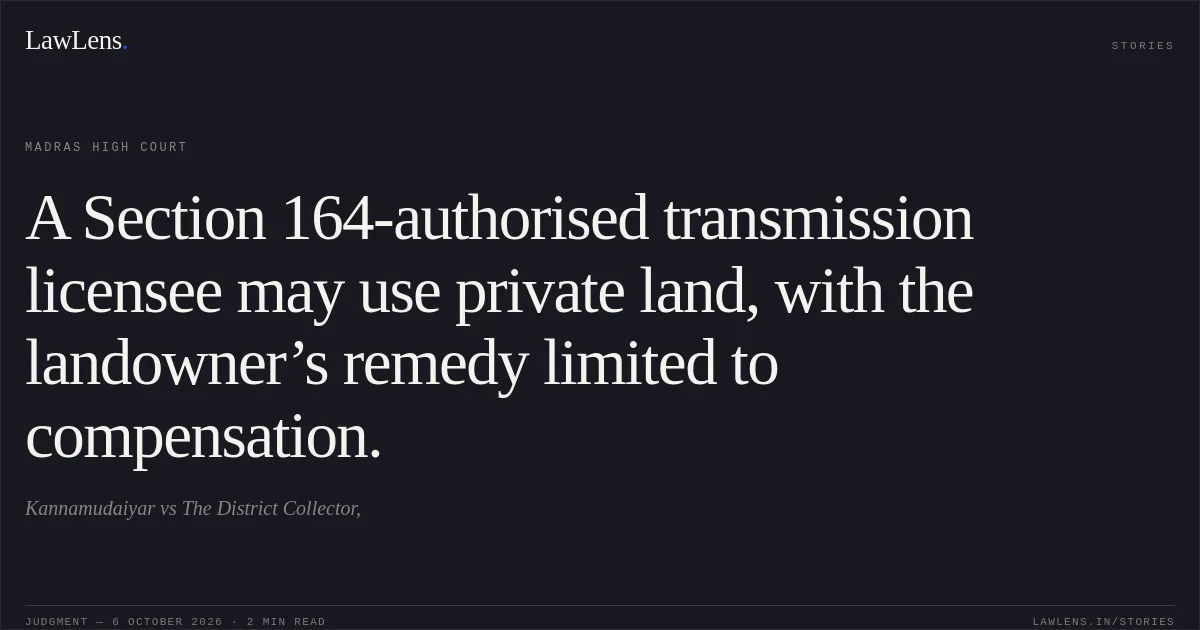
The Court relied on Section 164 of the Electricity Act, 2003, read with Sections 10 and 16 of the Indian Telegraph Act, 1885. It held that the fifth respondent was entitled to lay transmission lines over the petitioner’s land and use it for erecting poles and towers under those provisions.
Source reference: para. 7The Court stated that the petitioner’s remedy was to seek compensation for loss or damage caused and for use of the land.
Source reference: para. 8Reasoning
Although the petitioner disputed the work on the basis that he had given no consent or executed a way-leave agreement, the Court held that the fifth respondent’s statutory authority under the Electricity Act and Telegraph Act permitted it to lay the lines and erect the structures.
Source reference: para. 6–7It therefore identified compensation for loss, damage, and use of the land—not prevention of the works—as the petitioner’s available remedy. The Court directed the petitioner to submit a fresh representation to the District Collector, who must consider it after notice to the fifth respondent and an opportunity of hearing to all concerned.
Source reference: para. 8–9Holding
The Court disposed of the writ petition, directing the petitioner to submit a fresh representation to the first respondent, the District Collector.
The Collector was directed to pass appropriate orders in accordance with law after giving notice to the fifth respondent and a hearing to all concerned. No costs were awarded.
Source reference: para. 8–10Acts & Sections Cited
3 provisions across 2 statutes referred to in this judgment. Each provision opens on LawLens.
Indian Telegraph Act, 18852
Electricity Act, 20031
Original Court PDF
KannamudaiyarvsThe District Collector,
Click to open original judgment
Original judgment, available to read, download and summarize on LawLens.in