Facts
The prosecution alleged that the appellant repeatedly visited the deceased’s home and telephoned her, pressuring her to have an illicit relationship with him. It alleged that, unable to tolerate the resulting harassment, the deceased consumed rat poison and died by suicide on 11 July 2012
Source reference: p. 2–3, para. 3Although the charge-sheet was filed under Section 302 IPC, the Sessions Court framed a charge under Section 306 IPC and convicted the appellant, sentencing him to five years’ imprisonment and a fine of ₹10,000
Source reference: p. 3–4, para. 4; p. 4, para. 6In the appeal, the appellant challenged the conviction, arguing that the prosecution had failed to establish the ingredients of abetment
Source reference: p. 4–5, paras. 7–8Issues
Whether the appellant had established grounds to interfere with the judgment of conviction and order on sentence
Source reference: p. 5–6, para. 10Whether the prosecution evidence established the appellant’s guilt under Section 306 IPC
Source reference: p. 6–9, paras. 11–18Law Applied
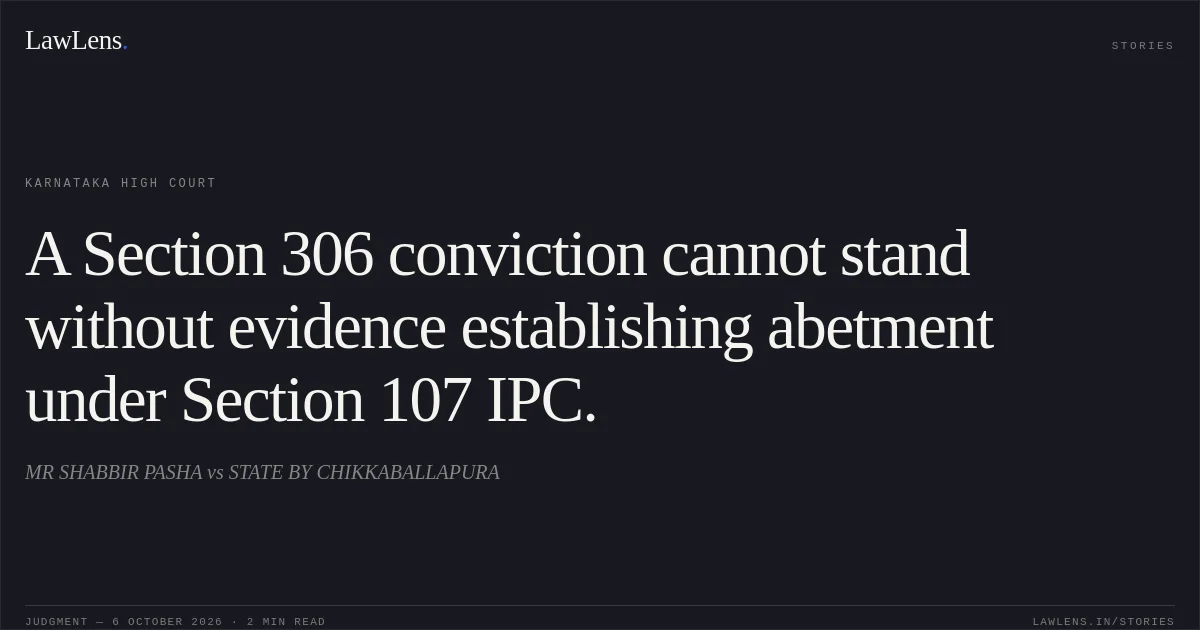
Section 306 IPC concerns abetment of suicide, and the judgment considered whether the prosecution had established the required ingredients of abetment under Section 107 IPC
Source reference: p. 4–5, para. 7The Court did not set out a broader test or cite precedent; it assessed whether the evidence on record substantiated the prosecution’s allegation of abetment
Source reference: p. 8–9, para. 18Reasoning
The husband, examined as PW1, denied the allegation and the contents of his complaint; the father-in-law, PW2, denied making the statement attributed to him; and PW3, an inquest panch witness, did not support the prosecution
Source reference: p. 7–8, paras. 13–15Although these witnesses were treated as hostile, the prosecution elicited no favourable evidence from them to substantiate its case
Source reference: p. 9, para. 18The Court therefore found no evidentiary basis for the conviction and held that the trial court had convicted the appellant without proper reasons
Source reference: p. 9, para. 18Holding
The High Court allowed the appeal, set aside the conviction and sentence dated 18 September 2015, and acquitted the appellant of the offence under Section 306 IPC
Any fine deposited was to be returned in accordance with law, the appellant’s bail bond was cancelled, and the trial court records were directed to be returned
Source reference: p. 10, order clauses (iv)–(v)Acts & Sections Cited
6 provisions across 2 statutes referred to in this judgment. Each provision opens on LawLens.
Indian Penal Code, 18603
Code of Criminal Procedure, 19733
Original Court PDF
MR SHABBIR PASHAvsSTATE BY CHIKKABALLAPURA
Click to open original judgment
Original judgment, available to read, download and summarize on LawLens.in