Facts
The informant alleged that, after her marriage to the petitioner on 31 July 2002, he assaulted and mistreated her, including during a trip to Digha; she also alleged later cruelty and demands for money by her in-laws.
Source reference: pp. 2–3, paras. 3–4She left the matrimonial home in May 2003, and a case was registered under Section 498A IPC and other provisions.
Source reference: pp. 2–3, paras. 3–4The trial court acquitted the petitioner’s parents but convicted him under Section 498A IPC and sentenced him to two years’ rigorous imprisonment and a fine.
Source reference: p. 5, paras. 7–8The appellate court affirmed the conviction.
Source reference: p. 5, paras. 7–8The petitioner challenged those decisions in revision, relying, among other things, on proceedings for restitution of conjugal rights and the subsequent dissolution of the marriage by decree of divorce.
Source reference: pp. 5–6, para. 9Issues
1. Whether the concurrent conviction of the petitioner under Section 498A IPC was sustainable on the evidence on record.
Source reference: p. 7, paras. 11–122. Whether the prosecution proved the charge beyond reasonable doubt despite the absence of medical evidence or other proof of assault or physical or mental cruelty.
Source reference: p. 7, para. 11Law Applied
The court considered Section 498A IPC, under which the petitioner had been convicted, and applied the criminal-law requirement that the prosecution prove the charge beyond reasonable doubt.
Source reference: p. 7, paras. 11–12The judgment cites no judicial precedents or elaborates a separate statutory test.
Source reference: no citationReasoning
The High Court concluded that the courts below had not properly appreciated the case circumstances, including the petitioner’s restitution-of-conjugal-rights proceedings and the later decree dissolving the marriage on the informant’s divorce petition.
Source reference: p. 7, para. 11It also noted that the prosecution had produced no medical evidence or other proof of assault or physical or mental cruelty.
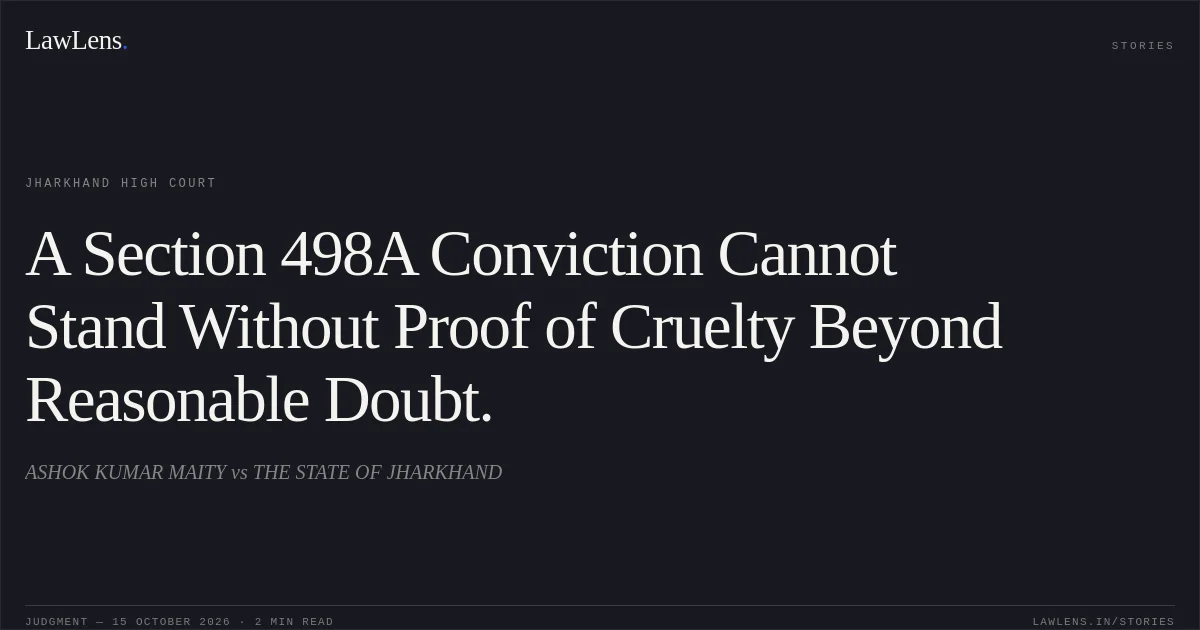
Source reference: p. 7, para. 11Finding the case to reflect a longstanding matrimonial dispute and the charge not proved beyond reasonable doubt, the court held the conviction unsustainable.
Source reference: p. 7, para. 11Holding
The High Court set aside the conviction and sentence under Section 498A IPC, acquitted the petitioner, and allowed the revision.
As the petitioner was on bail, it directed that he be discharged from his bail bond and that the sureties also be discharged.
Source reference: p. 7, para. 14Acts & Sections Cited
6 provisions across 4 statutes referred to in this judgment. Each provision opens on LawLens.
Indian Penal Code, 18601
Code of Criminal Procedure, 19731
Hindu Marriage Act, 19552
Original Court PDF
ASHOK KUMAR MAITYvsTHE STATE OF JHARKHAND
Click to open original judgment
Original judgment, available to read, download and summarize on LawLens.in