Facts
Respondent Surendra Dhariwal alleged that police personnel, including petitioners Ranidan Singh and Jagdish Kumar, seized cash and electronic articles from his Delhi shop while arresting him in a separate criminal case, and later demanded a bribe for returning the articles.
Source reference: para. 2(a)–(f), 9–9.5The ACB conducted demand-verification meetings on 15 and 16 January 2022, recording conversations, and registered FIR No. 14/2022 for offences under Section 7 of the Prevention of Corruption Act, 1988, and Sections 201, 384 read with Section 120-B IPC
Source reference: para. 2(a)–(f), 9–9.5The High Court had previously quashed the FIR for want of prior approval under Section 17A of the PC Act; the Supreme Court set that order aside and remanded the petitions for consideration on grounds other than Section 17A.
Source reference: para. 2.1–2.3The petitioners then sought quashing, principally arguing that the FIR and verification material disclosed no demand or solicitation of an undue advantage and that the complaint was malicious
Source reference: para. 3–3.5Issues
1. Whether the FIR and demand-verification material prima facie disclosed that either petitioner obtained, accepted, or attempted to obtain an undue advantage, as required for an offence under Section 7 of the PC Act
Source reference: para. 8–8.9, 9.42. Whether the material disclosed the alleged offences under Sections 201, 384 and 120-B IPC, or whether the proceedings were liable to be quashed as manifestly mala fide under Section 482 CrPC
Source reference: para. 10.5–10.6, 11–12Law Applied
Section 7 of the PC Act, as amended in 2018, criminalises a public servant’s obtaining, accepting or attempting to obtain an undue advantage with the requisite connection to improper or dishonest performance of, or forbearance from performing, a public duty
Source reference: para. 8For an alleged obtainment, demand must be established; for acceptance following an offer, the offer and acceptance must be established; and an attempt to obtain may be complete upon solicitation, without actual receipt
Source reference: para. 8.2–8.9Neeraj Dutta v. State (NCT of Delhi), (2023) 4 SCC 731, permits proof of demand by direct or circumstantial evidence but requires the prosecution to establish the relevant facts
Source reference: para. 8.5–8.6Under Section 482 CrPC, the court may quash proceedings where, among other circumstances, the allegations and supporting material do not disclose an offence, or the proceedings are manifestly mala fide; the categories in State of Haryana v. Bhajan Lal, 1992 Supp (1) SCC 335, are illustrative
Source reference: para. 7.1–7.5The court also relied on State of A.P. v. Golconda Linga Goswamy, (2004) 6 SCC 522, recognising that the court may examine the material to determine whether an offence is prima facie made out, without ordinarily assessing evidentiary reliability
Source reference: para. 7.3–7.4Reasoning
The court examined the recorded conversations and the FIR’s account of the verification meetings.
Source reference: para. 9.6–9.8, 9.10–9.15It found that the 15 January conversation with Jagdish disclosed no demand and that the seized articles were returned without payment; the FIR itself stated that the alleged demand could not be verified in that meeting
Source reference: para. 9.6–9.8As to Ranidan, the recorded exchange showed him telling the complainant not to discuss money, which the court viewed as a refusal rather than an admission or solicitation; it also found no prima facie evidence that retaining a CPU was linked to an improper performance of public duty
Source reference: para. 9.10–9.15The court considered the negative final report in a separate FIR concerning the events of 16 January as a circumstance inconsistent with the prosecution account, and found no independent material supporting demand
Source reference: para. 9.13, 10.1–10.2It further concluded that the circumstances—including the complainant’s recent arrest and charge-sheet in a case investigated by the petitioners, followed by his complaint after release on bail—indicated animosity and supported the plea of mala fides
Source reference: para. 11.3The alleged delivery necessary to establish extortion was not shown, and the material did not establish the alleged removal or destruction of evidence
Source reference: para. 10.5–10.6Holding
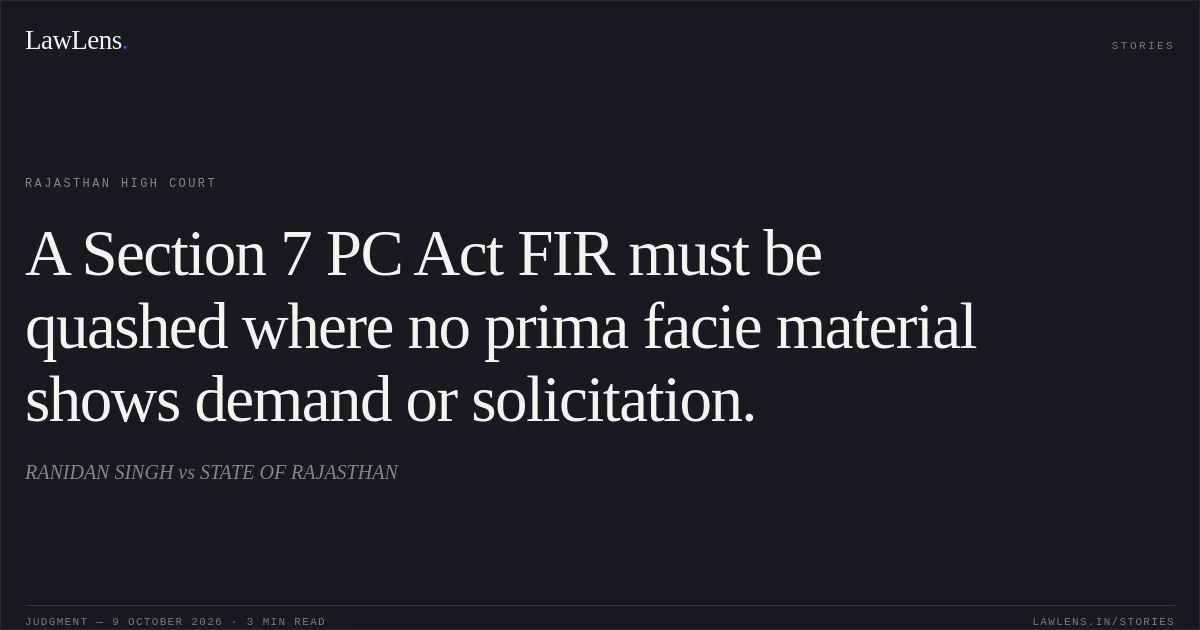
The High Court held that the FIR and verification material did not prima facie disclose demand, solicitation, acceptance or attempted obtainment of an undue advantage, or the other alleged offences; it also found the proceedings attended by mala fides.
Applying the principles in Bhajan Lal, the court allowed both petitions and quashed FIR No. 14/2022 and all consequential proceedings
Source reference: para. 12–14Acts & Sections Cited
11 provisions across 4 statutes referred to in this judgment. Each provision opens on LawLens.
Code of Criminal Procedure, 19733
Indian Penal Code, 18602
Prevention of Corruption Act, 19885
Bharatiya Nagarik Suraksha Sanhita, 20231
Original Court PDF
RANIDAN SINGHvsSTATE OF RAJASTHAN
Click to open original judgment
Original judgment, available to read, download and summarize on LawLens.in