Facts
The applicant sought interim protection pending arbitration, including an injunction against dealing with scheduled properties and an order requiring security of ₹151,61,44,565, failing which attachment before judgment.
Source reference: p. 1–2, 4He relied on a disputed promissory note dated 20 August 2024, said to contain an arbitration clause, and stated that he had issued a notice invoking arbitration under Section 21 on 31 March 2026.
Source reference: p. 6The respondents alleged that earlier disputes had been fully and finally settled under a compromise recorded by the NCLT in 2023, and denied execution of the promissory note as forged.
Source reference: p. 7The scheduled properties stood in the name of the second respondent company, which was not a signatory to the promissory note.
Source reference: p. 9–10The Court considered the applicant’s Section 9 request and the respondents’ applications to vacate the ad-interim injunction granted on 13 May 2026.
Source reference: p. 3–4Issues
1. Whether interim relief could be granted on the basis of the disputed promissory note without determining the parties’ underlying factual disputes in a Section 9 proceeding.
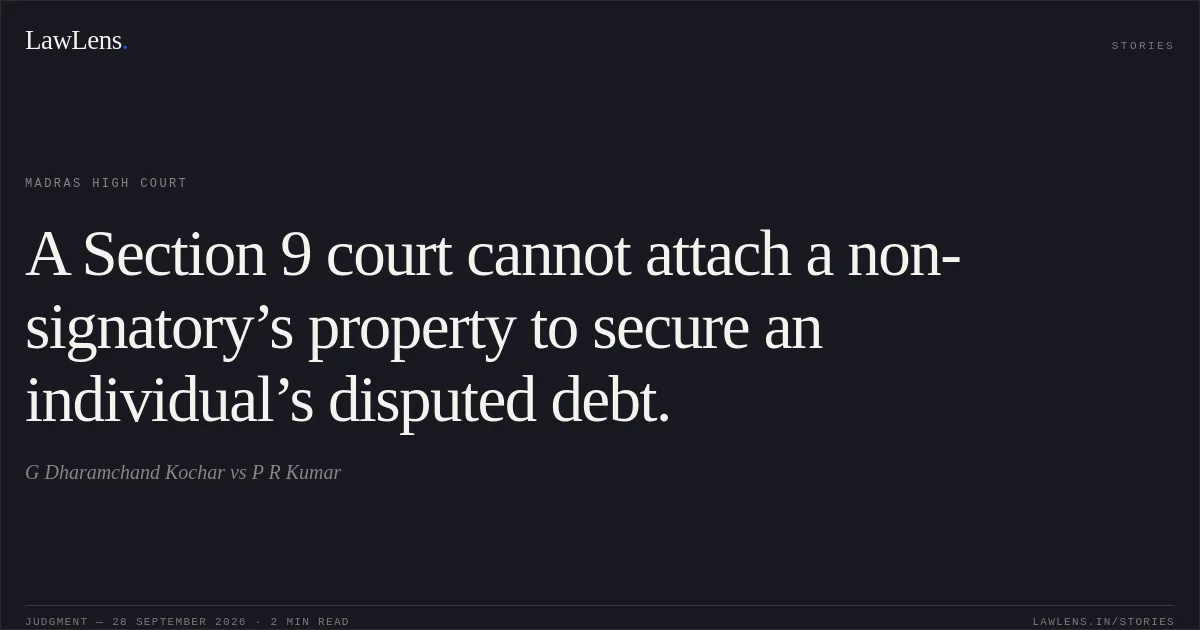
Source reference: p. 8–102. Whether the scheduled properties, which stood in the name of the second respondent company and not the signatory first respondent, could be restrained or attached in these proceedings.
Source reference: p. 103. Whether, in the circumstances, the first respondent should be directed to furnish security for the applicant’s claim.
Source reference: p. 10Law Applied
The Court applied the principle governing an application under Section 9 of the Arbitration and Conciliation Act, 1996: the Court must reach prima facie satisfaction when considering interim measures, but cannot conduct a mini-trial on disputed issues that are for the arbitral tribunal to decide.
Source reference: p. 9The Court also proceeded on the basis that interim relief against property belonging to a separate, non-signatory entity could not be granted where the Court was not prepared to pierce the corporate veil.
Source reference: p. 10The judgment does not identify or apply any other statutory provision or precedent as the basis of its decision.
Source reference: p. 10Reasoning
The Court noted the parties’ admitted commercial relationship but treated the alleged settlement, the alleged discharge of debts, and the authenticity and effect of the promissory note as disputed matters for the arbitrator, particularly because the NCLT order and compromise document had not been placed before it.
Source reference: p. 8–10It therefore did not resolve those disputes in the interim proceedings.
Source reference: p. 8–10Because the second respondent company owned the scheduled properties and was not a signatory to the promissory note, the Court declined to restrain or attach those properties or to require security through them.
Source reference: p. 10To protect the applicant’s claim while leaving the merits to arbitration, it instead directed the first respondent to furnish a bank guarantee.
Source reference: p. 10Holding
The Court vacated the ad-interim order dated 13 May 2026 and directed the first respondent to furnish a bank guarantee for ₹151,61,44,565 within 12 weeks of receiving the order.
The direction will stand suspended if the applicant does not take the necessary steps to appoint an arbitrator within eight weeks.
Source reference: p. 11The applications were disposed of with no order as to costs.
Source reference: p. 11Acts & Sections Cited
2 provisions across 1 statute referred to in this judgment. Each provision opens on LawLens.
Arbitration and Conciliation Act, 19962
Original Court PDF
G Dharamchand KocharvsP R Kumar
Click to open original judgment
Original judgment, available to read, download and summarize on LawLens.in