01Facts
The complainant alleged that he lent the accused ₹8,00,000 in cash; after repayment of ₹5,00,000, the accused issued a self-cheque for the remaining ₹3,00,000.
¶ 3, 18The cheque was dishonoured for insufficient funds, and the complainant initiated proceedings under Section 138 of the Negotiable Instruments Act, 1881 (NI Act).
¶ 3, 18The trial court convicted the accused and imposed a fine of ₹4,33,000, of which ₹4,30,000 was payable to the complainant; the appellate court affirmed the conviction and sentence.
¶ 5–6In revision, the accused challenged the concurrent findings, relying on alleged inconsistencies in the complainant’s evidence, an asserted prior notice, and the contention that the complainant was not a holder in due course because the cheque was a self-cheque.
¶ 9–1002Issues
i.1. Whether the concurrent findings of conviction disclosed perversity, gross error, or another ground warranting interference in revisional jurisdiction.
¶ 11ii.2. Whether the complainant could maintain the Section 138 NI Act complaint as holder in due course of the self-cheque, and whether the accused had rebutted the statutory presumptions under Sections 118 and 139 of the NI Act.
¶ 19–2503Law Applied
Section 138 of the NI Act applies where a cheque is issued in discharge, wholly or partly, of a legally enforceable debt or liability and the statutory requirements concerning presentation, dishonour, demand notice, and non-payment are satisfied.
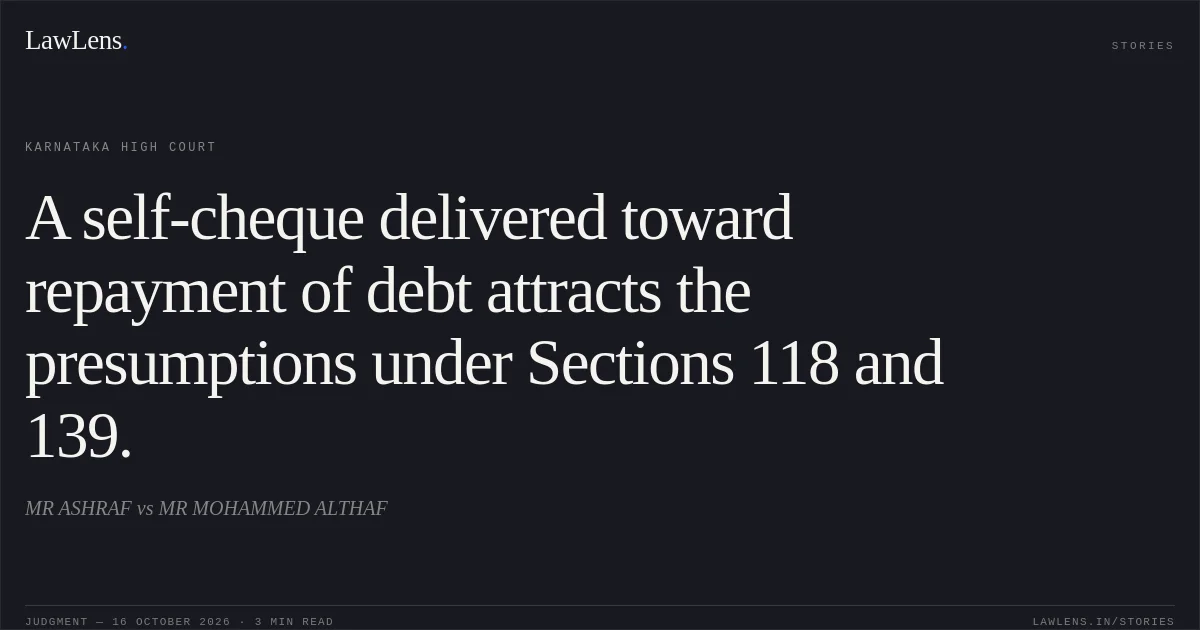
¶ 15Sections 118 and 139 raise rebuttable presumptions concerning consideration and the existence of a legally enforceable debt or liability.
¶ 16, 25Under Section 9, a holder in due course includes a person who, for consideration, becomes the possessor of a cheque payable to bearer, or the payee or indorsee of a cheque payable to order, subject to the statutory conditions.
¶ 20Revisional jurisdiction under Sections 397 and 401 Cr.P.C. is supervisory, not a second appeal; interference with concurrent findings is warranted only in exceptional cases, including where findings are perverse, grossly erroneous, based on irrelevant or no material, or reached through arbitrary or capricious exercise of discretion.
¶ 13–14The Court relied on Kuntegowda v. Thurubaiah, Criminal Appeal No. 3654 of 2026, 2026 SCC OnLine SC 1485, and the principles discussed in State of Kerala v. Puttumana Illath Jathavedan Namboodiri, (1999) 2 SCC 452.
¶ 13–14Provisions in the judgment · 8 · Linked ones open on LawLens
Code of Criminal Procedure, 1973 Section 200Section 313Section 397Section 401
Negotiable Instruments Act, 1881 Section 9Section 118Section 138Section 139
04Reasoning
The Court held that the accused’s asserted notice of 2 May 2016 and accompanying documents were only photocopies, were not put to the complainant in cross-examination, and were neither marked nor proved; they therefore could not support the defence.
¶ 19The complainant’s signature on the reverse of the cheque, together with the accused’s signatures on it, supported the finding that the complainant possessed the self-cheque for consideration; its being a self-cheque did not, by itself, defeat the complaint or the statutory presumptions.
¶ 23The alleged inconsistency about how long the complainant had known the accused was not material, and the accused’s cross-examination did not otherwise raise a probable defence.
¶ 26–29The accused had neither proved a reply to the statutory notice nor led defence evidence.
¶ 26–29The lower courts’ findings were therefore not shown to meet the threshold for revisional interference.
¶ 14, 2905Holding
The High Court answered the revisional question in the negative.
¶ 12, 30The High Court dismissed the revision petition, leaving undisturbed the trial court’s conviction and sentence as affirmed by the appellate court.
¶ 12, 30Original Court PDF
MR ASHRAFvsMR MOHAMMED ALTHAF
Click to open original judgment
Original judgment, available to read, download and summarize on LawLens.in