01Facts
The petitioner was named as an accused in Hunterganj P.S. Case No. 62 of 2013, registered under Sections 364(A)/34 of the Indian Penal Code and Sections 17(i) and 17(ii) of the Criminal Law Amendment Act.
The prosecution alleged that, on 13 June 2013, the informant and two others were abducted at gunpoint, taken to Dalkoma Pahar, and thereafter released following a demand for ₹10,00,000 from the informant’s employer.
¶ 3The police submitted the original charge-sheet, followed by a supplementary charge-sheet showing the petitioner as an absconder. Processes under Sections 82 and 83 Cr.P.C. were issued against him, although those processes were subsequently set aside pursuant to an order of the High Court.
¶ 6The petitioner did not surrender or appear before the concerned Magistrate. Instead, he directly filed a discharge petition under Section 227 Cr.P.C. before the Sessions Court, which rejected it on 18 April 2023.
¶ 5–8The High Court called for a report and found that the case had not yet been committed to the Sessions Court and that no Sessions Trial had been registered; it remained at the stage of the petitioner’s appearance before the Judicial Magistrate.
¶ 702Issues
i.Whether the Sessions Court could entertain and decide a petition under Section 227 Cr.P.C. before the criminal case had been committed to it and before registration of a Sessions Trial?
¶ 7–9ii.Whether the order dated 18 April 2023 rejecting the petitioner’s discharge application was legally sustainable when the petitioner had not appeared before the Magistrate and the Sessions Court lacked jurisdiction at that stage?
¶ 8–1103Law Applied
Section 227 Cr.P.C. empowers the Court of Session to discharge an accused only after the case has been committed to the Sessions Court and the Sessions Court is seized of the matter.
¶ 8–11Under Section 209 Cr.P.C., a Magistrate must commit a case exclusively triable by the Court of Session after complying with the applicable procedural requirements.
¶ 8–11Until such commitment and appearance before the competent court, the Sessions Court cannot exercise jurisdiction under Section 227 Cr.P.C.
¶ 8–11The Court further applied the principle that a party must follow the prescribed procedural stage and cannot directly invoke the jurisdiction of a superior trial court while the matter remains pending before the Magistrate.
¶ 8–11Provisions in the judgment · 4 · Linked ones open on LawLens
Indian Penal Code, 1860 Section 34
Code of Criminal Procedure, 1973 Section 82Section 83Section 227
04Reasoning
The High Court found that the petitioner had not surrendered before, or been granted bail by, the competent court despite the rejection of his anticipatory bail application.
¶ 6–8More importantly, the case had neither been committed to the Sessions Court nor registered as a Sessions Trial; it remained at the stage of the petitioner’s appearance before the Judicial Magistrate.
¶ 6–8Consequently, the Sessions Judge had no occasion to exercise jurisdiction under Section 227 Cr.P.C. The discharge application was therefore premature and had been wrongly entertained and decided directly by the Sessions Court.
¶ 8–10By hearing and rejecting it, the Sessions Judge exceeded the court’s jurisdiction and failed to follow the prescribed procedural sequence.
¶ 8–1005Holding
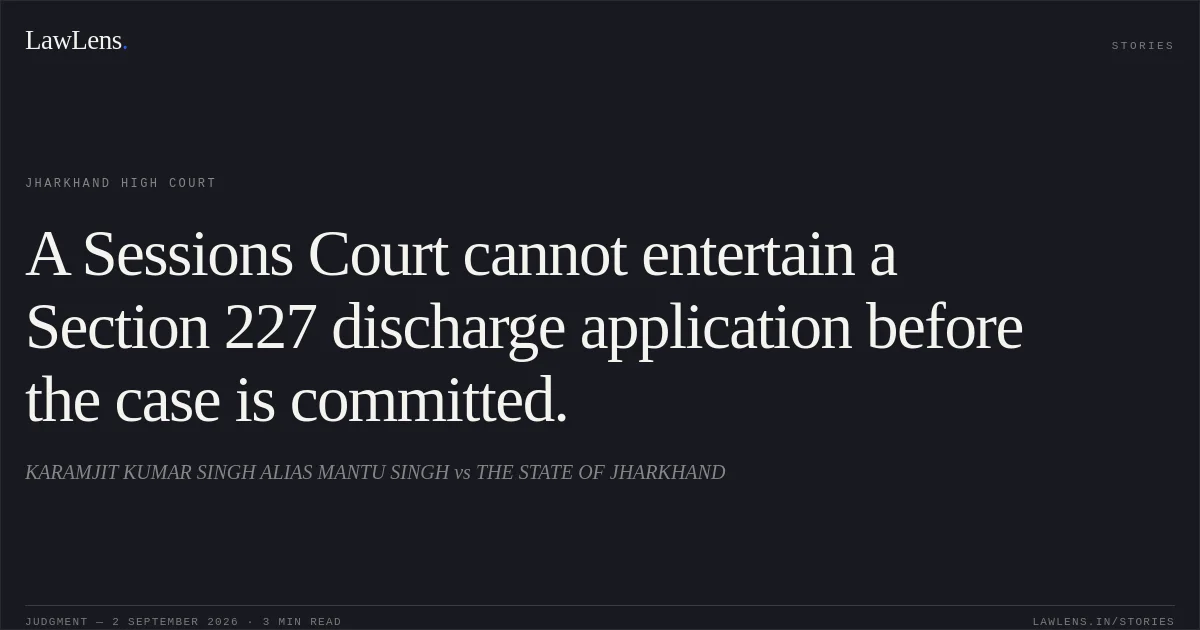
The High Court held that the Sessions Court could not entertain the petitioner’s Section 227 Cr.P.C. discharge application before commitment of the case and registration of a Sessions Trial.
¶ 10The order dated 18 April 2023 was accordingly set aside.
¶ 10The petitioner was directed to appear before the concerned Judicial Magistrate, after which the case was to proceed in accordance with law; following commitment, he could raise an appropriate discharge or other legal plea before the competent court.
¶ 11The criminal revision was disposed of, and pending interlocutory applications were also disposed of.
¶ 12–13Original Court PDF
KARAMJIT KUMAR SINGH ALIAS MANTU SINGHvsTHE STATE OF JHARKHAND
Click to open original judgment
Original judgment, available to read, download and summarize on LawLens.in