01Facts
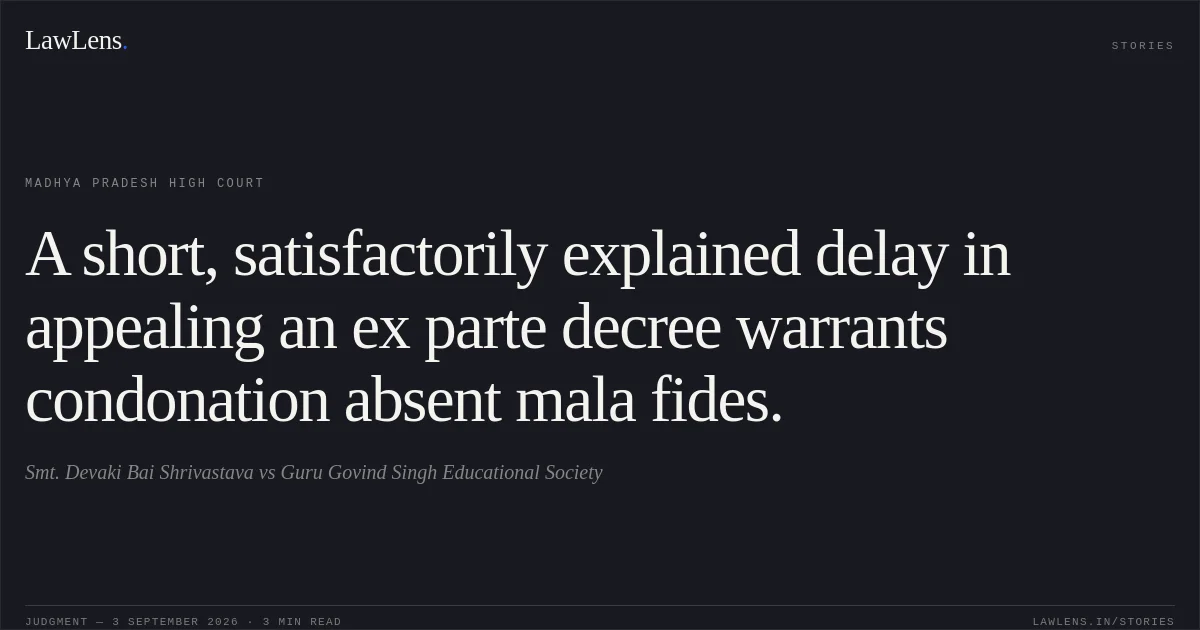
The appellant-defendant challenged the judgment and decree dated 11.07.2024 of the lower appellate court, which rejected her application under Section 5 of the Limitation Act for condonation of a 31-day delay in filing a first appeal under Section 96 CPC and consequently dismissed the appeal as time-barred.
¶ 1The trial court had passed an ex parte judgment and decree on 07.11.2022, and the appellant filed the first appeal on 13.01.2023.
¶ 6In support of condonation, she stated that, after contracting COVID-19 in 2021 and due to the lockdown, she could not contact her counsel or obtain information regarding the case.
¶ 6She claimed that she learned of the decree only after meeting her advocate-brother in the New Year of 2023 and thereafter filed the appeal without further delay.
¶ 6The respondent contended that the appellant had remained ex parte, had not filed a written statement, and ought to have pursued a remedy under Order IX Rule 13 CPC rather than filing a regular appeal.
¶ 402Issues
i.Whether the lower appellate court committed an error of law in rejecting the appellant’s application under Section 5 of the Limitation Act for condonation of delay and consequently dismissing the first appeal as barred by limitation.
¶ 2ii.Whether an appellant against an ex parte judgment and decree is entitled to pursue a regular appeal under Section 96 CPC, notwithstanding the availability of a remedy under Order IX Rule 13 CPC.
¶ 803Law Applied
Section 100 CPC governs the High Court’s jurisdiction in a second appeal on a substantial question of law.
¶ 1Section 5 of the Limitation Act permits condonation of delay where the applicant establishes “sufficient cause” for not filing the proceeding within the prescribed period.
¶ 1, 7A first appeal under Section 96 CPC is a permissible remedy against an ex parte decree, and the remedy under Order IX Rule 13 CPC for setting aside an ex parte decree is concurrent rather than exclusive.
¶ 8In considering condonation of delay, courts should adopt a liberal and justice-oriented approach where the delay is reasonably explained and is not actuated by mala fides.
¶ 9Provisions in the judgment · 3 · Linked ones open on LawLens
Code of Civil Procedure, 1908 Section 100Section 96
Limitation Act, 1963 Section 5
04Reasoning
The High Court held that the delay was only 31 days and that the appellant had provided a probable and reasonable explanation: her inability to contact counsel during the COVID-19 period and her prompt action after acquiring knowledge of the decree.
¶ 6, 9The appellant’s conduct during the trial, including her failure to file a written statement or appear before the trial court, was held immaterial to determining whether sufficient cause existed for the subsequent delay in filing the appeal.
¶ 7The lower appellate court also erred in treating Order IX Rule 13 CPC as the only appropriate remedy.
¶ 8Although that remedy was available, the appellant was entitled to choose the concurrent remedy of a first appeal under Section 96 CPC.
¶ 8Since there was no allegation or finding of mala fide conduct and the delay had been adequately explained, the refusal to condone it was legally unsustainable.
¶ 905Holding
The substantial question of law was answered in favour of the appellant and against the respondent.
¶ 10The High Court condoned the 31-day delay, set aside the judgment and decree of the lower appellate court, and remanded the matter to that court for decision of the first appeal on merits.
¶ 10The second appeal was allowed, with no order as to costs.
¶ 10–11Original Court PDF
Smt. Devaki Bai ShrivastavavsGuru Govind Singh Educational Society
Click to open original judgment
Original judgment, available to read, download and summarize on LawLens.in