Facts
On 13 March 1990, an altercation took place near the complainant’s jhuggi concerning the alleged construction of multiple jhuggies and local political rivalry.
Source reference: pp. 2–3, paras. 3–4The prosecution alleged that the respondents, armed with a sword, knife and lathis, assaulted Rahat Ali, Shahid Ali and other persons.
Source reference: pp. 2–3, paras. 3–4Digamber allegedly aimed a sword blow at Rahat Ali’s head, which Rahat Ali warded off with his right hand, suffering an incised injury and fracture.
Source reference: pp. 2–3, paras. 3–4, 23–27Tikka Ram allegedly attempted to inflict a knife blow on Mahesh’s abdomen; Mahesh moved to protect himself and sustained an injury on his leg.
Source reference: pp. 2–3, paras. 3–4, 23–27The respondents were charged under Sections 307/149 IPC, and Digamber was additionally charged under Section 27 of the Arms Act.
Source reference: p. 3, para. 4The Trial Court acquitted all the accused on 10 March 2000, principally relying on hostile independent witnesses, alleged material contradictions, and the possibility of false implication arising from political rivalry.
Source reference: pp. 3–5, para. 7During the appeal, respondents Sawan Kumar, Om Parkash and Hukum Singh died, and the appeal abated against them.
Source reference: p. 2, para. 2Issues
Whether the Trial Court erred in disbelieving the injured witnesses and in acquitting Tikka Ram and Digamber despite the ocular and medical evidence implicating them in the assault?
Source reference: pp. 9–16, paras. 19–36Whether the acts attributed to Tikka Ram and Digamber disclosed the requisite intention or knowledge for an offence under Section 307 IPC, notwithstanding that the injuries were not inflicted on the intended vital parts and were not fatal?
Source reference: pp. 17–19, paras. 40–44Whether the recovery or non-recovery of the alleged weapons affected the prosecution case?
Source reference: pp. 16–17, paras. 37–39Whether, after recording conviction, the respondents should be sentenced to imprisonment, considering their age, previous conduct, period already undergone and subsequent settlement with the complainant?
Source reference: pp. 19–21, paras. 46–50Law Applied
The Court applied the principle that an appellate court should exercise caution before interfering with an acquittal, but may do so where the Trial Court has ignored material evidence or reached perverse conclusions.
Source reference: p. 9, para. 20It relied on the settled rule that the testimony of an injured witness carries enhanced evidentiary value because the witness’s presence at the scene is ordinarily established by the injury itself; such testimony should not be discarded absent compelling reasons, particularly where corroborated by medical evidence, as stated in Akhtar v. State of Uttaranchal, (2009) 13 SCC 722, and State of M.P. v. Mansingh, (2003) 10 SCC 414.
Source reference: pp. 14–15, paras. 33–34A hostile witness’s testimony is not rendered wholly inadmissible, and the reliable and corroborated portions may still be relied upon.
Source reference: p. 15, para. 35Under Section 307 IPC, the prosecution must prove an intention or knowledge of the kind contemplated by Section 300 IPC together with an overt act towards the commission of murder; intention may be inferred from the weapon used, the manner and force of the assault, the body part targeted, the number of blows and surrounding circumstances, and the actual injury is not determinative.
Source reference: pp. 17–18, paras. 41–42Non-recovery or failure to connect a weapon scientifically is not fatal where reliable eyewitness evidence independently establishes guilt.
Source reference: pp. 16–17, para. 39For sentencing, the Court applied the reformative theory of punishment, including the principle that rehabilitation may be preferred over retribution where the offender has reformed and does not present a continuing threat, relying on Mohammad Giasuddin v. State of Andhra Pradesh, (1977) 3 SCC 287.
Source reference: pp. 20–21, paras. 48–50Reasoning
The Court found the evidence of Rahat Ali, Shahid Ali, Mahesh and Satish Kumar sufficient to establish the respondents’ presence, armed participation and individual acts.
Source reference: pp. 9–10, paras. 23–24Rahat Ali’s testimony specifically identified Digamber as the assailant who struck at his head with a sword; the injury to his hand was consistent with his account that he warded off the blow.
Source reference: pp. 9–10, paras. 23–24Shahid Ali’s testimony materially corroborated this version and attributed the knife assault on Mahesh to Tikka Ram.
Source reference: pp. 10–12, paras. 25–26Mahesh’s evidence and his MLC, which recorded a simple sharp-edged injury, independently corroborated Tikka Ram’s role; the fact that the blow landed on the leg rather than the abdomen was explained by Mahesh’s attempt to protect himself.
Source reference: p. 13, para. 27The evidence of Satish Kumar further corroborated the collective assault, while the credible portion of hostile witness Leela Dhar’s testimony was consistent with the medical evidence showing his injury.
Source reference: pp. 13–15, paras. 28–35The Trial Court’s reliance on inconsistencies concerning the number of blows and the precise manner of assault was held unjustified because those discrepancies did not undermine the core prosecution case.
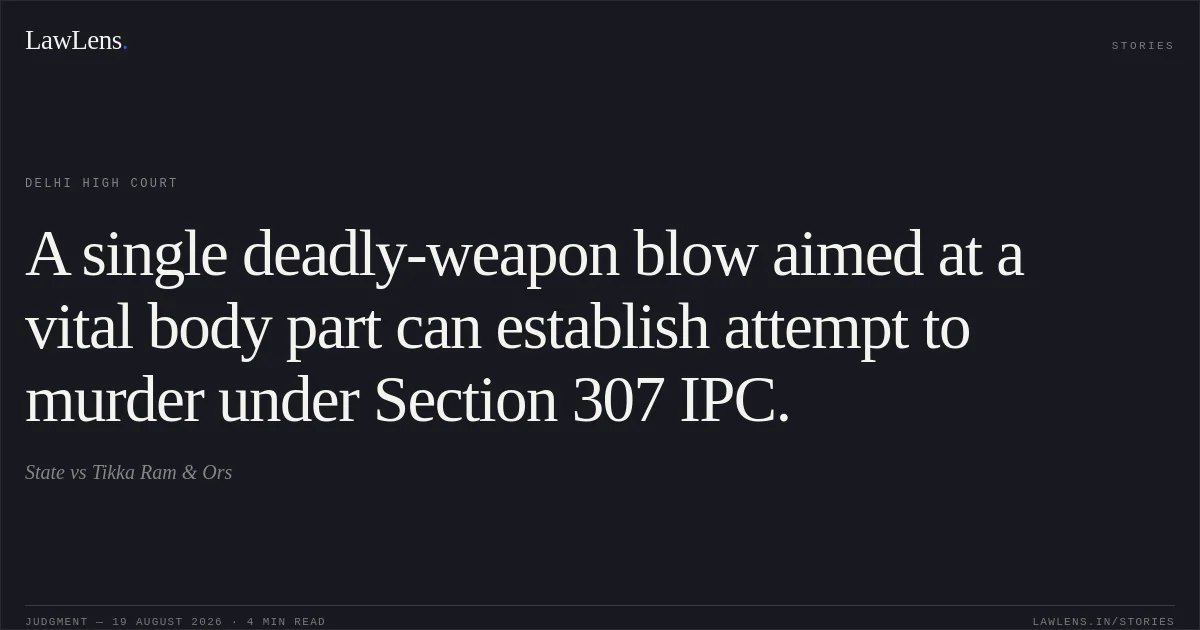
Source reference: pp. 17–19, paras. 40–44The Court held that the sword attack was directed at Rahat Ali’s head and Tikka Ram’s knife attack was aimed at Mahesh’s abdomen—both vital parts—so the fact that the blows were deflected or caused non-fatal injuries did not negate the requisite intention under Section 307 IPC.
Source reference: pp. 17–19, paras. 40–44Although the recovered sword was not scientifically linked to the injury, the eyewitness evidence independently proved the assault, making the recovery inconsequential.
Source reference: pp. 16–17, paras. 37–39The respondents’ participation was treated as a concerted assault attracting Section 34 IPC.
Source reference: p. 19, para. 44Holding
The High Court held that the acquittal of Tikka Ram and Digamber was based on an erroneous appreciation of the evidence and could not be sustained.
Their guilt was proved beyond reasonable doubt, and they were held liable under Sections 307/325/324/34 IPC.
Source reference: p. 19, para. 45Considering that the incident was over three decades old, the respondents’ age, absence of prior criminal antecedents or subsequent criminal conduct, period of incarceration exceeding two years, reformation, and amicable settlement with the complainant, the Court sentenced each respondent to the period already undergone, together with a fine of ₹20,000, with four weeks to deposit the fine; in default, each was directed to undergo six months’ rigorous imprisonment.
Source reference: pp. 19–21, paras. 46–50The appeal was accordingly disposed of, and the appeal against the deceased respondents stood abated.
Source reference: p. 22, paras. 51–52Acts & Sections Cited
9 provisions across 3 statutes referred to in this judgment. Each provision opens on LawLens.
Indian Penal Code, 18607
Arms Act, 19591
Code of Criminal Procedure, 19731
Original Court PDF
StatevsTikka Ram & Ors
Click to open original judgment
Original judgment, available to read, download and summarize on LawLens.in