Facts
Hansaben Chandubhai Patel died after sustaining extensive burn injuries allegedly caused by setting herself on fire with kerosene.
Source reference: p.2, para. 2The prosecution alleged that, on 27 January 1991, following an incident involving a buffalo, Respondent No. 1—her uncle-in-law—and Respondent No. 2—her brother-in-law—assaulted her and thereafter subjected her to physical and mental harassment, which drove her to suicide.
Source reference: p.2, para. 2The deceased’s grandmother-in-law, Original Accused No. 3, was also implicated, but the proceedings against her abated.
Source reference: p.1, para. 1The prosecution relied, inter alia, on the deceased’s statement recorded shortly after the incident, which stated that she suffered burns while preparing tea, and a subsequent dying declaration in which she attributed her suicide to beating by Respondent Nos. 1 and 2.
Source reference: p.6, para. 12The deceased’s husband did not support the prosecution, and the medical evidence disclosed only burn injuries, with no other internal or external injuries.
Source reference: p.6, para. 12The trial court acquitted the accused of offences under Sections 498A and 306 of the Indian Penal Code.
Source reference: p.1, para. 1The State preferred an appeal against acquittal under Section 378(1) and (3) of the Code of Criminal Procedure, 1973.
Source reference: p.2, paras. 5–6Issues
Whether the trial court was justified in acquitting Respondent Nos. 1 and 2 of the offences under Sections 498A and 306 IPC?
Source reference: p.5, para. 10(1)Whether the trial court properly appreciated the oral and documentary evidence led by the prosecution?
Source reference: p.5, para. 10(2)Whether the judgment of acquittal suffered from any illegality, irregularity, or perversity warranting appellate interference?
Source reference: p.5, para. 10(3)Law Applied
The Court applied Sections 498A and 306 IPC, read with Section 107 IPC, requiring proof of cruelty or harassment and, for abetment of suicide, proof of instigation, provocation, or intentional aid sufficiently connected with the suicide.
Source reference: p.7, para. 13The Court referred to the principles in Ramesh Kumar v. State of Chhattisgarh, 2001 (9) SCC 618, and Ram Pyarey v. State of Uttar Pradesh, 2025 (6) SCC 820, concerning the necessity of establishing cruelty and the ingredients of abetment.
Source reference: p.7, para. 14In an appeal against acquittal, the appellate court may reappreciate the evidence, but the accused enjoy a double presumption of innocence; where two reasonable views are possible, the acquittal should not ordinarily be disturbed.
Source reference: pp.9–11, paras. 19–20These principles were drawn from Chandrappa v. State of Karnataka, (2007) 4 SCC 415; Rajesh Prasad v. State of Bihar, (2022) 3 SCC 471; Babu Sahebagouda Rudragoudar v. State of Karnataka, (2024) 8 SCC 149; and Ramesh v. State of Karnataka, (2024) 9 SCC 169.
Source reference: pp.9–11, paras. 19–20Reasoning
The Court found material inconsistency between the deceased’s earliest statement, which attributed the burns to an accidental incident while preparing tea, and the later dying declaration alleging that beating by Respondent Nos. 1 and 2 led her to commit suicide.
Source reference: p.6, para. 12The husband did not support the prosecution, and the medical evidence did not corroborate the allegation of assault because no injuries other than burns were detected.
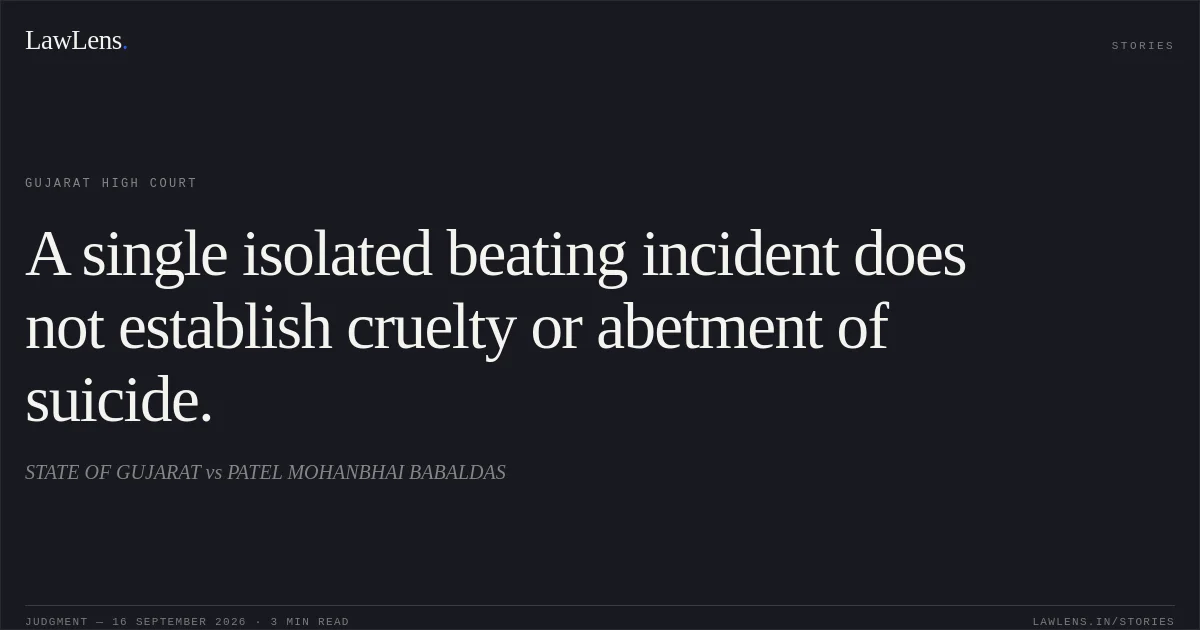
Source reference: p.6, para. 12Even if the later dying declaration were accepted, the Court held that a single isolated incident of beating did not establish the sustained cruelty, harassment, or instigation necessary to sustain convictions under Sections 498A and 306 IPC.
Source reference: p.6, para. 12The prosecution also failed to establish the essential ingredients of abetment under Section 107 IPC through clear and cogent evidence.
Source reference: p.7, para. 13Applying the restrictive standard governing appeals against acquittal, the Court concluded that the trial court’s view was a reasonable one and was neither perverse nor manifestly illegal.
Source reference: pp.8–11, paras. 16–20Holding
The High Court held that the prosecution failed to prove beyond reasonable doubt that Respondent Nos. 1 and 2 subjected the deceased to cruelty or harassment, or abetted her suicide.
The appeal against acquittal was therefore dismissed, and the trial court’s judgment acquitting the respondents under Sections 498A and 306 IPC was confirmed.
Source reference: p.12, paras. 21–23The bail bonds were cancelled, and the record and proceedings were directed to be returned to the trial court.
Source reference: p.12, paras. 21–23Acts & Sections Cited
5 provisions across 2 statutes referred to in this judgment. Each provision opens on LawLens.
Code of Criminal Procedure, 19732
Indian Penal Code, 18603
Original Court PDF
STATE OF GUJARATvsPATEL MOHANBHAI BABALDAS
Click to open original judgment
Original judgment, available to read, download and summarize on LawLens.in