Facts
The deceased went to the appellant’s house to demand wages for work on an under-construction house.
Source reference: pp. 2–5, paras. 2–15The prosecution alleged that the appellant struck him with a lathi, causing him to lose consciousness; the deceased died the following morning.
Source reference: pp. 2–5, paras. 2–15His son, the informant, and daughter testified to the assault, while another son testified that he learned of it from family members.
Source reference: pp. 2–5, paras. 2–15The post-mortem examination found an abrasion on the head and a fracture of the left parietal bone.
Source reference: pp. 2–5, paras. 2–15The trial court convicted the appellant under Section 302 IPC and sentenced him to life imprisonment and a fine.
Source reference: pp. 2–5, paras. 2–15On appeal, the High Court noted inconsistencies concerning the place of occurrence and the daughter’s account, as well as the non-examination of the investigating officer and non-seizure of the lathi and blood-stained clothes.
Source reference: pp. 2–5, paras. 2–15The Court nevertheless found the assault and its connection to the deceased’s death established, and considered whether the offence was murder or culpable homicide not amounting to murder.
Source reference: p. 6, para. 16Issues
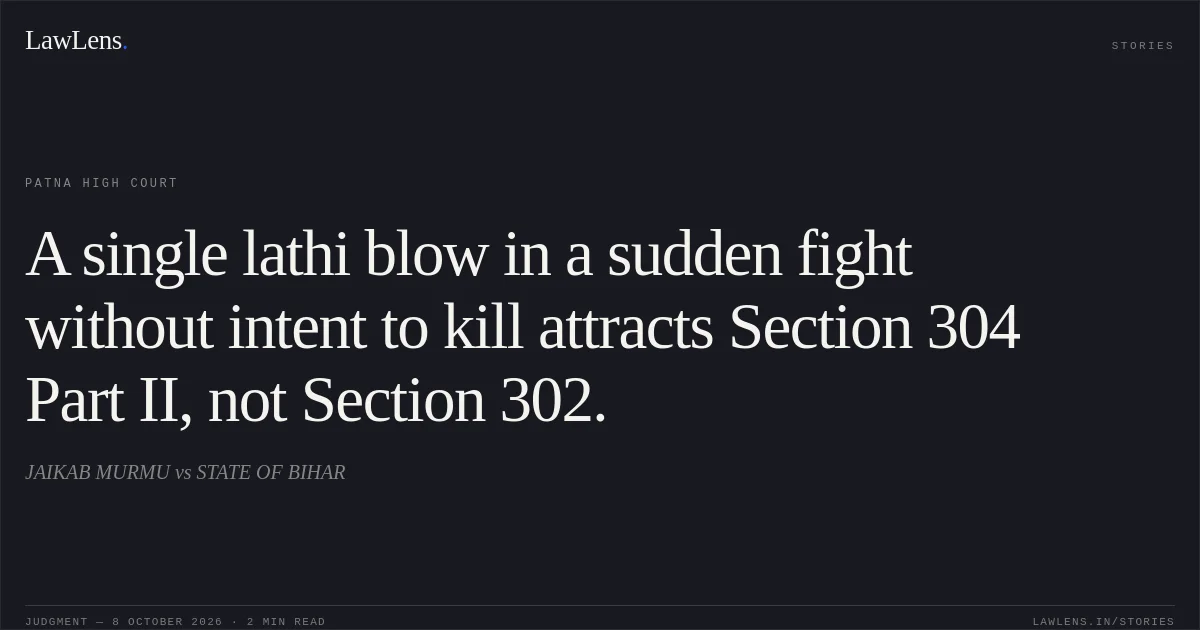
1. Whether the established assault and resulting death constituted murder punishable under Section 302 IPC, or culpable homicide not amounting to murder punishable under Section 304 IPC.
Source reference: p. 6, para. 162. Whether the circumstances of the assault supported reducing the conviction from Section 302 to Section 304 Part II IPC.
Source reference: pp. 7–9, paras. 17–20Law Applied
The Court considered Sections 302 and 304 Part II IPC and applied the distinction between culpable homicide amounting to murder and culpable homicide not amounting to murder.
Source reference: pp. 6–8, paras. 16–18Relying on Mohd. Rafiq @ Kallu v. State of Madhya Pradesh, (2021) 10 SCC 706, it assessed intention and the nature of the offence by considering circumstances including the weapon used, the part of the body struck, the force applied, whether the incident arose from a sudden quarrel or was premeditated, the presence of provocation or heat of passion, whether the accused took undue advantage or acted cruelly, and whether there was a single blow or several.
Source reference: pp. 6–8, paras. 16–18Reasoning
The Court treated the occurrence as established, relying on the evidence that the appellant assaulted the deceased and the post-mortem finding of a fatal head injury.
Source reference: p. 6, para. 16In assessing the offence, it noted that the appellant used a lathi, delivered a single blow during a sudden dispute over wages, and had no serious prior enmity with the deceased.
Source reference: pp. 7–9, paras. 17–20The Court also considered the absence of premeditation, the appellant’s act of pouring water on the deceased, and the absence of undue advantage or unusual brutality.
Source reference: pp. 7–9, paras. 17–20Applying the factors in Mohd. Rafiq @ Kallu, it concluded that the circumstances did not sustain a conviction under Section 302 and treated the offence as falling under Section 304 Part II IPC.
Source reference: pp. 7–9, paras. 17–20Holding
The appeal was allowed in part.
The Court set aside the conviction and life sentence under Section 302 IPC, convicted the appellant under Section 304 Part II IPC, and sentenced him to the period already undergone—seven years and six months.
Source reference: pp. 9–10, paras. 20–23It waived the fine, discharged the appellant from his bail bond, and directed that the lower-court records be returned.
Source reference: pp. 9–10, paras. 20–23Acts & Sections Cited
3 provisions across 2 statutes referred to in this judgment. Each provision opens on LawLens.
Indian Penal Code, 18602
Code of Criminal Procedure, 19731
Original Court PDF
JAIKAB MURMUvsSTATE OF BIHAR
Click to open original judgment
Original judgment, available to read, download and summarize on LawLens.in