Facts
On 3 August 2008, complainant Santosh Mishra, a police constable on Chetak Mobile duty, reached North Karaudia, Sidhi, with soldier Kailash Prasad after receiving information regarding vandalism and assault.
Source reference: para. 2The prosecution alleged that the appellant and three co-accused, armed with tangis, attacked them.
Source reference: para. 2The appellant allegedly struck Santosh Mishra on the head and back, while the co-accused attacked Kailash and the motorcycle.
Source reference: para. 2An FIR was registered for offences under Sections 307, 353 and 332 read with Section 34 of the IPC.
Source reference: para. 2The Trial Court convicted the appellant under Section 307/34 IPC for the injuries caused to Kailash Rawat and Santosh Mishra, sentencing him to five years’ rigorous imprisonment and fine of Rs. 500 for each count.
Source reference: para. 1In appeal, the appellant principally challenged his conviction relating to Santosh Mishra, contending that the injury was simple, located behind the left shoulder, and did not justify conviction for attempt to murder.
Source reference: para. 3Issues
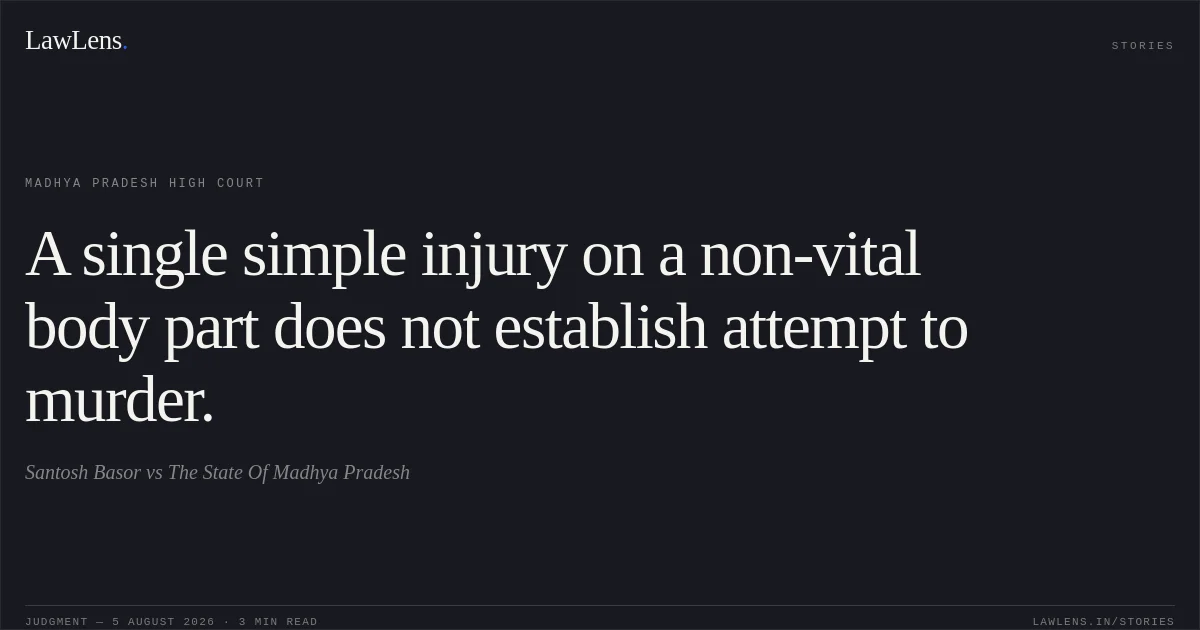
Whether the appellant’s act of causing a single simple injury to Santosh Mishra on a non-vital part of the body constituted an offence under Section 307 IPC, or only voluntarily causing hurt under Section 323 IPC?
Source reference: paras. 3, 6–8Whether the sentence imposed for the offence relating to the injury caused to Kailash should be reduced in light of the appellant’s role and period of incarceration?
Source reference: paras. 3, 9–10Law Applied
Section 307 IPC requires proof of the requisite intention or knowledge to cause death, together with an overt act capable of causing death; the nature and location of the injury are relevant, though not invariably decisive, in determining that intention.
Source reference: paras. 6–10Section 323 IPC applies where the accused voluntarily causes simple hurt.
Source reference: paras. 6–10Section 34 IPC attributes joint liability where a criminal act is done by several persons in furtherance of their common intention.
Source reference: paras. 6–10The Court also considered the appellate power to alter the conviction and sentence under the applicable procedural law.
Source reference: paras. 6–10The judgment referred to the corresponding provisions of the Bharatiya Nyaya Sanhita, 2023, although the order contains inconsistent references to Sections 109 and 115(2) of the BNS.
Source reference: paras. 6–10Reasoning
The medical evidence of Dr. R.G. Kotia established that the injury sustained by Santosh Mishra was simple in nature, and the evidence disclosed only one injury on a non-vital part of the body.
Source reference: paras. 6–8The Court held that the prosecution evidence did not sufficiently establish that the appellant either inflicted an injury with the intention or knowledge required for Section 307 IPC, or shared the requisite intention to commit murder in relation to that injury.
Source reference: paras. 6–8Accordingly, the act could not, in the circumstances, sustain a conviction for attempt to murder, but did constitute voluntarily causing hurt under Section 323 IPC.
Source reference: paras. 6–8Considering the appellant’s limited role, the nature of the injury, and approximately three and a half years already undergone in custody, the Court found that a sentence equivalent to the period already undergone would meet the ends of justice for the offence concerning Santosh Mishra.
Source reference: para. 9In relation to Kailash, however, the Court maintained the conviction and reduced the sentence from five years to four years.
Source reference: paras. 9–10Holding
The appeal was partly allowed.
The appellant’s conviction under Section 307 IPC in relation to the injury caused to Santosh Mishra was set aside and altered to conviction under Section 323 IPC; the sentence was reduced to the period already undergone, with the fine maintained.
Source reference: paras. 8–10The conviction concerning the injury caused to Kailash was not set aside, but the sentence was reduced from five years to four years.
Source reference: paras. 9–10As the appellant was in custody, he was directed to be released forthwith upon completion of the four-year sentence, if not required in any other case.
Source reference: para. 11Acts & Sections Cited
9 provisions across 3 statutes referred to in this judgment. Each provision opens on LawLens.
Bharatiya Nagarik Suraksha Sanhita, 20231
Indian Penal Code, 18605
Bharatiya Nyaya Sanhita, 20233
Original Court PDF
Santosh BasorvsThe State Of Madhya Pradesh
Click to open original judgment
Original judgment, available to read, download and summarize on LawLens.in