Facts
The petitioner challenged a notice dated 20 November 2019 and consequential proceedings in Criminal Case No. 33 of 2019, initiated under Sections 3/4 of the U.P. Control of Goondas Act, 1970, before the District Magistrate, New Tehri.
Source reference: para. 2The gang chart relied upon three criminal cases: Case Crime No. 14 of 2016 and Case Crime No. 01 of 2018 under Section 60 of the U.P. Excise Act, and Case Crime No. 04 of 2017 under Sections 323, 353, 504 and 506 IPC.
Source reference: para. 3The two Excise Act cases had been compounded.
Source reference: para. 4In the third case, the petitioner was convicted under Sections 353 and 504 IPC, sentenced to eleven days’ simple imprisonment and fines, and acquitted under Section 506 IPC.
Source reference: para. 4The petitioner contended that these materials did not establish that he was a “Goonda” under Section 2(b) of the Act, while the State failed to produce any additional material or antecedents demonstrating habitual criminality.
Source reference: paras. 4–5Issues
1. Whether the petitioner could be treated as a “Goonda” under Section 2(b) of the U.P. Control of Goondas Act, 1970, on the basis of the three criminal cases referred to in the gang chart.
Source reference: paras. 3–4, 7–102. Whether the notice dated 20 November 2019 and proceedings under Sections 3/4 of the Act could continue in the absence of material establishing the requisite habituality or three convictions contemplated by Section 2(b)(iii).
Source reference: paras. 7–10Law Applied
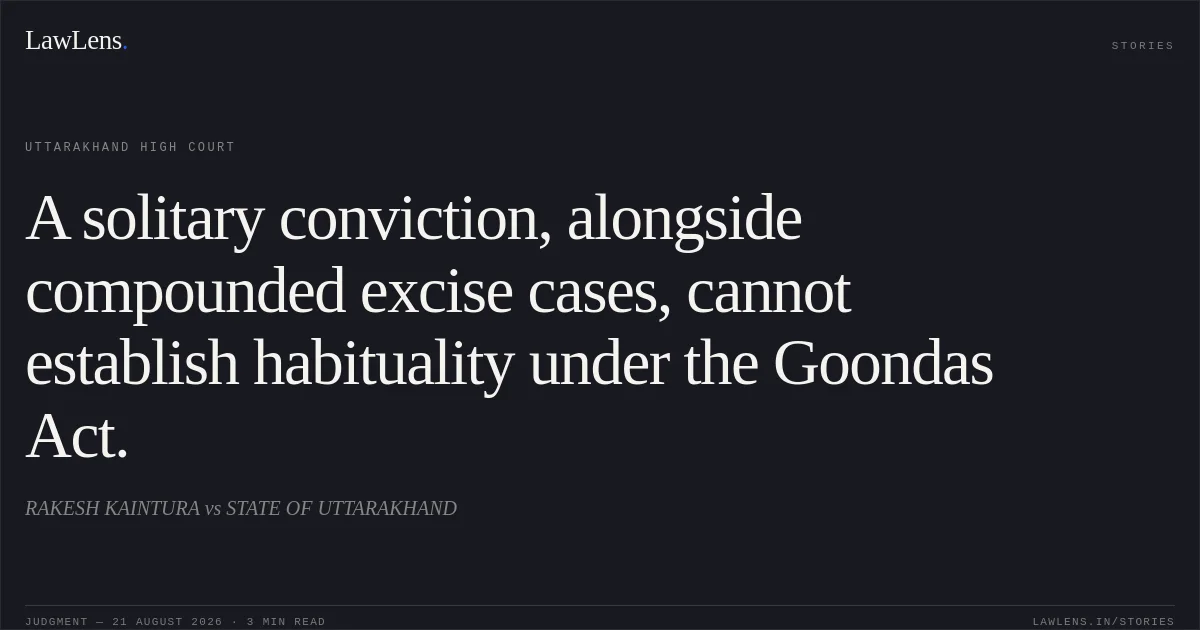
Section 2(b)(i) of the U.P. Control of Goondas Act, 1970 requires that a person habitually commit, attempt to commit, or abet specified offences; “habitually” denotes repetition or continuity and cannot be established by a solitary criminal incident.
Source reference: para. 7Section 2(b)(iii) separately covers a person convicted not less than three times for offences punishable under the U.P. Excise Act, 1910, the Public Gambling Act, 1867, or specified provisions of the Arms Act.
Source reference: paras. 7–8The Court relied on Faheem v. State of U.P. & Others, 2021 SCC OnLine All 1543, for the principle that a single criminal case does not make a person a “Goonda” and that frequent commission of similar acts is necessary to establish habituality.
Source reference: para. 7Proceedings under the Act are preventive in nature and have serious civil consequences; therefore, its statutory requirements must be strictly satisfied.
Source reference: para. 10Reasoning
The two cases under Section 60 of the U.P. Excise Act had been compounded and, in any event, there was no material showing that the petitioner had been convicted three times as required under Section 2(b)(iii).
Source reference: para. 8The remaining case resulted only in convictions under Sections 353 and 504 IPC, with an acquittal under Section 506 IPC; standing alone, it did not establish the habituality required under Section 2(b)(i).
Source reference: para. 9Since the State produced no other antecedents or material demonstrating repeated commission of the relevant offences, the gang chart was insufficient to satisfy the statutory foundation for proceedings under Section 3.
Source reference: para. 10The Court therefore held that the proceedings could not be sustained merely on the basis of a mechanically prepared gang chart.
Source reference: para. 10Holding
The Court answered the issues in favour of the petitioner.
It held that the available material neither established three qualifying convictions under Section 2(b)(iii) nor the habituality required under Section 2(b)(i) of the U.P. Control of Goondas Act, 1970.
Source reference: paras. 8–10The Criminal Writ Petition was allowed, and the notice dated 20 November 2019 together with the entire consequential proceedings in Criminal Case No. 33 of 2019, arising out of Challani Report Case No. 8 of 2019 and pending before the District Magistrate, New Tehri, was quashed.
Source reference: paras. 11–12Acts & Sections Cited
4 provisions across 1 statute referred to in this judgment. Each provision opens on LawLens.
Indian Penal Code, 18604
Original Court PDF
RAKESH KAINTURAvsSTATE OF UTTARAKHAND
Click to open original judgment
Original judgment, available to read, download and summarize on LawLens.in