01Facts
The appellants preferred an appeal under Section 14A(2) of the Scheduled Castes and Scheduled Tribes (Prevention of Atrocities) Act, 1989, challenging the order dated 17.07.2026 by which the Special Court, Dewas, dismissed their bail application.
¶ 1–2The case arose from Crime No. 324/2026 registered at Police Station Khategaon for offences under Sections 140(2), 108, 115(2) and 3(5) of the Bharatiya Nyaya Sanhita, 2023, and Sections 3(2)(v) and 3(2)(v-a) of the SC/ST Act.
¶ 1–2The prosecution alleged that the deceased, Arjun, and his wife owned a one-acre property at village Dawtha.
¶ 4The accused allegedly sought to obtain the property and repeatedly threatened the deceased.
¶ 4On 19.05.2026, they allegedly intercepted, assaulted and forcibly took him to the Tehsil office, where he was compelled to execute documents transferring the property.
¶ 5The deceased thereafter consumed poison on 20.05.2026 and died during treatment.
¶ 6The appellants claimed false implication, omnibus allegations, absence of instigation or intentional aid, and parity with co-accused who had been granted bail.
¶ 7–9The State opposed bail, relying on specific and direct evidence recorded in the case diary.
¶ 10The High Court particularly considered a video transcript recorded by the deceased before consuming poison, in which he named the accused and attributed his suicide to their alleged coercion, assault and harassment.
¶ 12–1602Issues
i.1. Whether the appellants were entitled to regular bail under Section 14A(2) of the SC/ST Act in view of the allegations of abetment of suicide, coercive property transfer and offences under the SC/ST Act.
¶ 1–2, 16–20ii.2. Whether the video transcript attributed to the deceased constituted sufficient prima facie material connecting the appellants’ alleged conduct with the deceased’s suicide.
¶ 12–18iii.3. Whether the appellants’ contentions concerning false implication, omnibus allegations, parity with co-accused and absence of the ingredients of abetment justified interference with the Special Court’s order refusing bail.
¶ 8–9, 19–2003Law Applied
The Court applied Section 14A(2) of the Scheduled Castes and Scheduled Tribes (Prevention of Atrocities) Act, 1989, which provides for an appeal against an order granting or refusing bail in proceedings involving offences under the Act.
¶ 1The alleged offences included Sections 140(2), 108, 115(2) and 3(5) of the Bharatiya Nyaya Sanhita, 2023, along with Sections 3(2)(v) and 3(2)(v-a) of the SC/ST Act.
¶ 2At the bail stage, the Court assessed whether the materials disclosed a prima facie case and whether the circumstances justified release; it treated the deceased’s video transcript, the alleged coercive acts, the proximate connection with the suicide, and the appellants’ criminal antecedents as relevant considerations.
¶ 12–18The Court rejected the appellants’ reliance on the alleged absence of the ingredients of Section 107 IPC at the preliminary stage.
¶ 19Provisions in the judgment · 6 · Linked ones open on LawLens
Scheduled Castes and the Scheduled Tribes (Prevention of Atrocities) Act, 1989 Section 3
Bharatiya Nyaya Sanhita, 2023 Section 140Section 108Section 115Section 3
Indian Penal Code, 1860 Section 107
04Reasoning
The Court found the video transcript to be the most significant material against the appellants.
¶ 12In it, the deceased specifically named the accused, stated that he had been abducted from Tirapti Chauraha, and asserted that he was forced through fear and assault to execute the property documents.
¶ 12–14Although the transcript referred to separate emotional distress concerning a woman named Rani, the Court held that the immediate and principal cause of the suicide was attributed to the appellants’ conduct.
¶ 15The alleged continuous threats, abduction, assault and forced execution of property documents were held to constitute prima facie harassment and coercion having a proximate link with the suicide.
¶ 16The Court further considered the appellants’ criminal antecedents and the gravity of the allegations involving property grabbing, abetment of suicide and offences under the SC/ST Act.
¶ 17–18Accordingly, the defences of false implication, parity and absence of abetment could not be conclusively examined at the bail stage and did not displace the prima facie case.
¶ 1905Holding
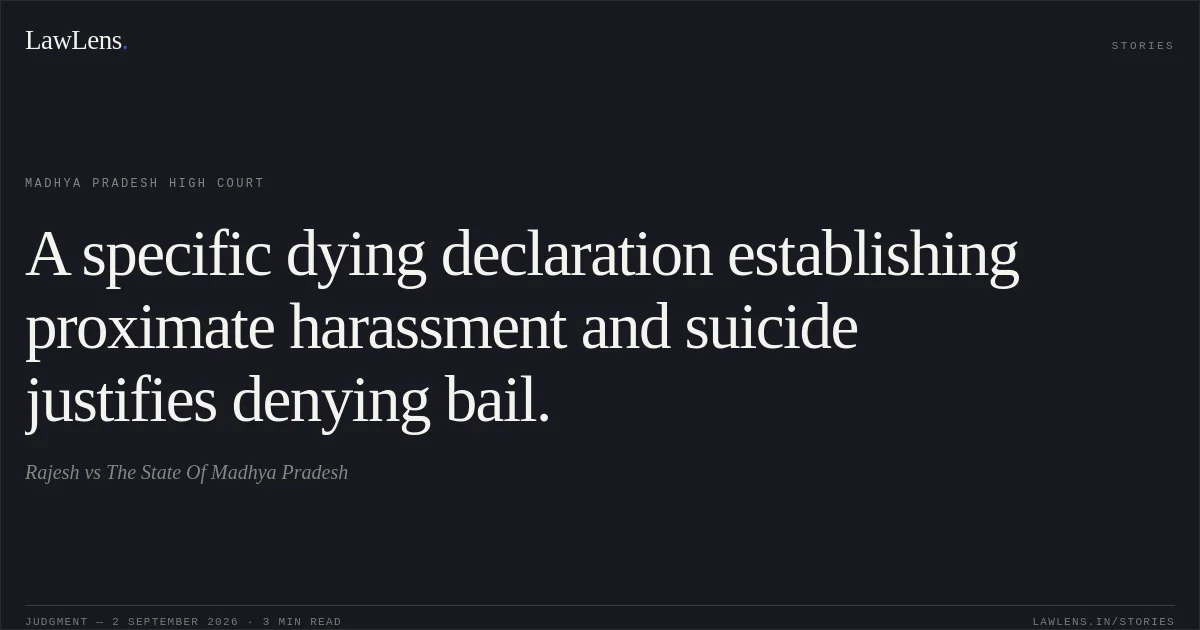
The High Court held that the material on record, particularly the deceased’s video transcript and the allegations of coercion, assault and forced property transfer, provided specific and grave prima facie evidence against the appellants.
¶ 18–20It found no illegality, perversity or jurisdictional error in the Special Court’s refusal to grant bail.
¶ 18–20The criminal appeal was dismissed, the order dated 17.07.2026 in Bail Application No. 839/2026 was affirmed, and a copy of the judgment was directed to be transmitted to the Trial Court.
¶ 21–22Original Court PDF
RajeshvsThe State Of Madhya Pradesh
Click to open original judgment
Original judgment, available to read, download and summarize on LawLens.in