Facts
The parties, both Christians, married on 28 December 2018 according to Christian rites and customs.
Source reference: paras. 1–4They lived together for approximately two to three months, after which the wife alleged that the husband and his father subjected her to cruelty and demanded ₹10,00,000 for establishing a school.
Source reference: paras. 30–36She left the matrimonial home on 31 August 2019 while five months pregnant. A female child was born on 3 December 2019.
Source reference: paras. 37–43The husband alleged that the wife had withdrawn from his society without reasonable cause and instituted a petition under Section 32 of the Divorce Act, 1869, seeking restitution of conjugal rights.
Source reference: paras. 1–4The Family Court, Bokaro, decreed restitution of conjugal rights in favour of the husband on 14 September 2022, with the decree signed on 21 September 2022.
Source reference: paras. 1–4The wife challenged that decision under Section 19(1) of the Family Courts Act, 1984.
Source reference: paras. 1–4Issues
1. Whether the appellant-wife had withdrawn from the society of the respondent-husband without reasonable cause within the meaning of Section 32 of the Divorce Act, 1869?
Source reference: para. 44(i)2. Whether the decree of restitution of conjugal rights granted by the Family Court was legally and factually justified?
Source reference: para. 44(ii)3. Whether the Family Court’s judgment suffered from perversity and non-consideration of material evidence, warranting appellate interference under Section 19(1) of the Family Courts Act, 1984?
Source reference: para. 44(iii)Law Applied
The Court applied Section 19(1) of the Family Courts Act, 1984, under which an appeal lies to the High Court on both facts and law, enabling the appellate court to reappreciate the entire evidence.
Source reference: paras. 13–14Section 32 of the Divorce Act, 1869 permits restitution of conjugal rights where one spouse has withdrawn from the society of the other without reasonable excuse, provided the court is satisfied about the truth of the petition and finds no legal ground to refuse relief.
Source reference: paras. 46–50The Court applied the civil standard of proof based on preponderance of probabilities under Section 3 of the Indian Evidence Act, 1872.
Source reference: paras. 15–17It relied on Jagdish Singh v. Madhuri Devi, (2008) 10 SCC 497, for the principle that a first appellate court may reappraise and reappreciate the entire evidence.
Source reference: para. 14It relied on A. Jayachandra v. Aneel Kaur, (2005) 2 SCC 22, for the proposition that matrimonial disputes are decided on the civil standard rather than proof beyond reasonable doubt.
Source reference: para. 17The Court further applied the principles in Arulvelu v. State, (2009) 10 SCC 206, and Damodar Lal v. Sohan Devi, (2016) 14 SCC 197, holding that a finding is perverse where relevant evidence is ignored, irrelevant material is relied upon, or the conclusion is one that no reasonable judicial mind could reach.
Source reference: paras. 19–22Reasoning
The Court found that the wife’s testimony regarding repeated demands for ₹10,00,000, mental torture, physical assault, and being left at her parental home during pregnancy was materially corroborated by her father’s evidence.
Source reference: paras. 53–57The Family Court had selectively relied on the husband’s assertions and had failed to assess the evidence as a whole, particularly the wife’s explanation for living separately and the existence of criminal proceedings arising from the alleged cruelty and dowry demands.
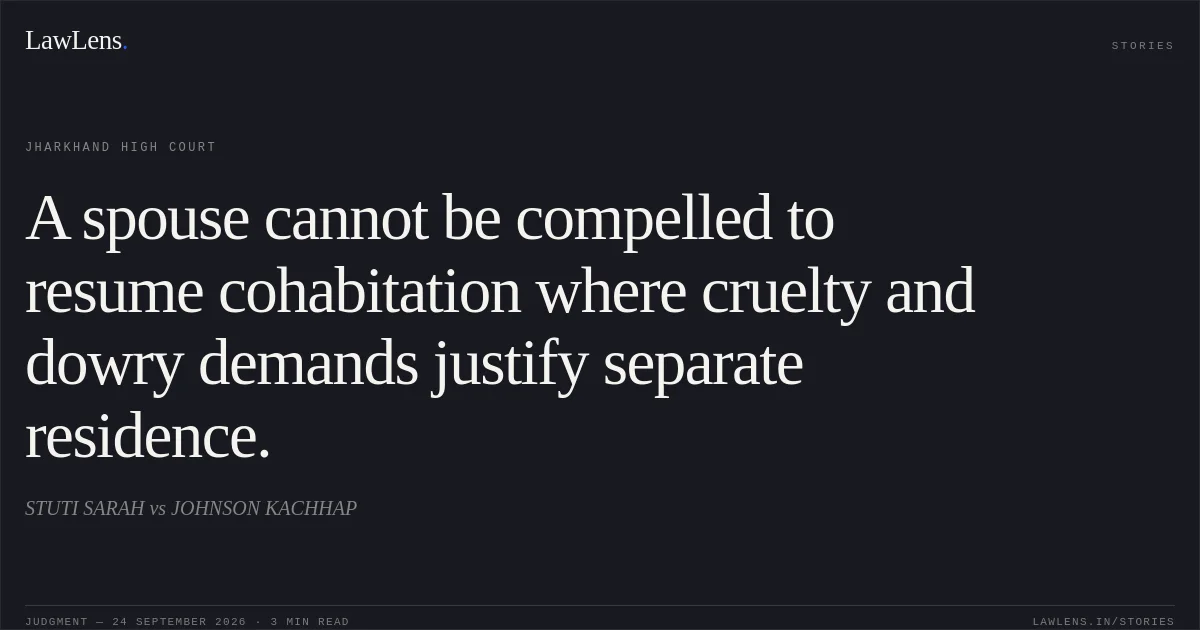
Source reference: paras. 59–65The High Court held that withdrawal from the matrimonial home is not without reasonable cause where the surrounding circumstances make cohabitation harsh, unsafe, or inconsistent with the spouse’s dignity and self-respect.
Source reference: paras. 62–64The wife’s allegations, viewed on the preponderance of probabilities, established a reasonable basis for her separate residence.
Source reference: paras. 62–64The husband’s subsequent alleged second marriage, which was not rebutted by any affidavit, further undermined the bona fides and practical feasibility of his claim to resume matrimonial cohabitation.
Source reference: paras. 56–57, 66Accordingly, the Family Court’s failure to undertake a holistic assessment of the evidence rendered its decree perverse and legally unsustainable.
Source reference: paras. 65–68Holding
The High Court answered the issues in favour of the appellant-wife, holding that she had reasonable cause to withdraw from the husband’s society and that the decree for restitution of conjugal rights was unjustified.
It held that the Family Court had ignored material evidence concerning cruelty, dowry demands, mental torture, and the wife’s safety, resulting in a perverse judgment.
Source reference: paras. 67–70The appeal was allowed, and the Family Court’s judgment dated 14 September 2022 and decree signed on 21 September 2022 in Original Suit No. 546 of 2019 were quashed and set aside.
Source reference: paras. 67–70Any pending interlocutory application was disposed of.
Source reference: paras. 67–70Acts & Sections Cited
3 provisions across 3 statutes referred to in this judgment. Each provision opens on LawLens.
Family Courts Act, 19841
Divorce Act, 18691
Code of Civil Procedure, 19081
Original Court PDF
STUTI SARAHvsJOHNSON KACHHAP
Click to open original judgment
Original judgment, available to read, download and summarize on LawLens.in