Facts
The parties married under the Special Marriage Act, 1954, on 20 October 2010 and had two children. The wife alleged that her husband’s alcohol use, assaults, demands for money, and failure to support the family amounted to cruelty. She stated that he drove her and the children from the matrimonial home on 15 March 2018, after which they lived with her parents.
Source reference: para. 23–25She petitioned for divorce under Section 27(1)(b) and (d) of the Act. The Family Court proceeded ex parte but dismissed the petition; the wife appealed. The husband did not appear in the appeal despite service.
Source reference: para. 5–8; para. 26–27Issues
1. Whether the Family Court’s refusal to grant divorce on the grounds of cruelty and desertion under Section 27(1)(d) and (b) of the Special Marriage Act, 1954, warranted appellate interference.
Source reference: para. 282. Whether the evidence established cruelty and desertion sufficient to dissolve the marriage.
Source reference: para. 48; para. 65; para. 78–88Law Applied
Section 19(1) of the Family Courts Act, 1984, permits an appeal from a Family Court judgment on facts and law, and the first appellate court may reappraise the evidence.
Source reference: para. 37–38Civil matrimonial proceedings are determined on the balance of probabilities, not proof beyond reasonable doubt.
Source reference: para. 39–41Under Section 27(1)(d) of the Special Marriage Act, cruelty is assessed contextually; conduct must be sufficiently grave to make continued cohabitation unreasonable, and may be physical or mental.
Source reference: para. 48–64Under Section 27(1)(b), desertion requires separation and an intention permanently to end cohabitation, without the other spouse’s consent or reasonable cause; the statutory ground requires the prescribed period of desertion.
Source reference: para. 65–77A finding may be set aside as perverse where relevant evidence is ignored or the conclusion is irrational.
Source reference: para. 43–46Reasoning
The wife’s testimony described repeated intoxication, assaults, demands for money, and conduct affecting her and the children. The High Court held that the absence of a formal FIR did not, by itself, discredit her evidence, particularly where she had testified to informing the police.
Source reference: para. 79–82It found that the Family Court had failed to properly consider this material and that its finding on cruelty was therefore perverse.
Source reference: para. 82–83; para. 90The wife’s departure was found to have been compelled by the alleged cruelty and the need to protect herself and the children, rather than a voluntary abandonment of the marriage; the parties had lived separately since 2018.
Source reference: para. 84–88; para. 91The Family Court’s failure to assess the evidence and prolonged separation warranted appellate intervention.
Source reference: para. 93–94Holding
The High Court allowed the appeal, quashed the Family Court’s judgment and decree, and dissolved the marriage.
It held that the children’s inheritance rights remained unaffected and left it open to the wife to seek maintenance for them before the appropriate forum.
Source reference: para. 98; para. 100–101Acts & Sections Cited
6 provisions across 5 statutes referred to in this judgment. Each provision opens on LawLens.
Family Courts Act, 19842
Special Marriage Act, 19541
Limitation Act, 19631
Code of Civil Procedure, 19081
Hindu Marriage Act, 19551
Original Court PDF
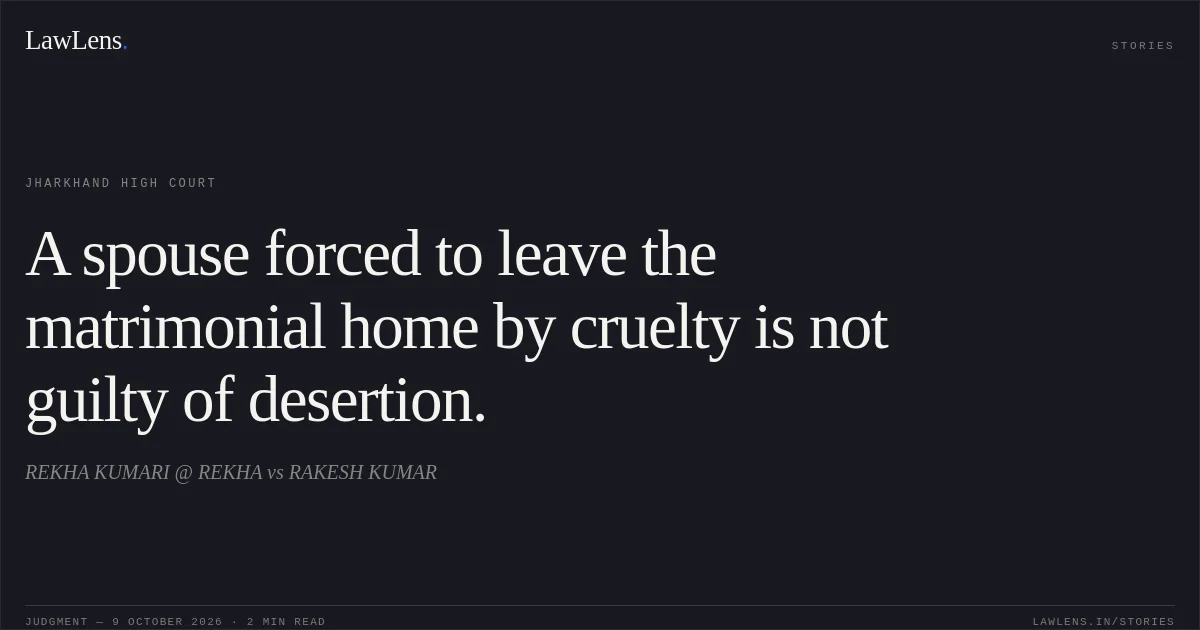
REKHA KUMARI @ REKHAvsRAKESH KUMAR
Click to open original judgment
Original judgment, available to read, download and summarize on LawLens.in