Facts
The appellant was convicted by the First Additional Sessions Judge, Nagod, for offences under Sections 498-A and 304-B of the Indian Penal Code, 1860 (IPC), and Section 4 of the Dowry Prohibition Act, 1961. He was sentenced to life imprisonment under Section 304-B IPC, with additional sentences for the other offences.
Source reference: para. 1The appellant married Sudha on 12 May 2017. The prosecution alleged that he demanded ₹50,000 and a motorcycle and harassed her over the demands. Sudha died by hanging on 7 August 2018, within seven years of the marriage.
Source reference: para. 2The High Court found that the evidence supported the existence of dowry-related cruelty but did not establish a specific incident of such cruelty proximate to her death.
Source reference: paras. 8–10Issues
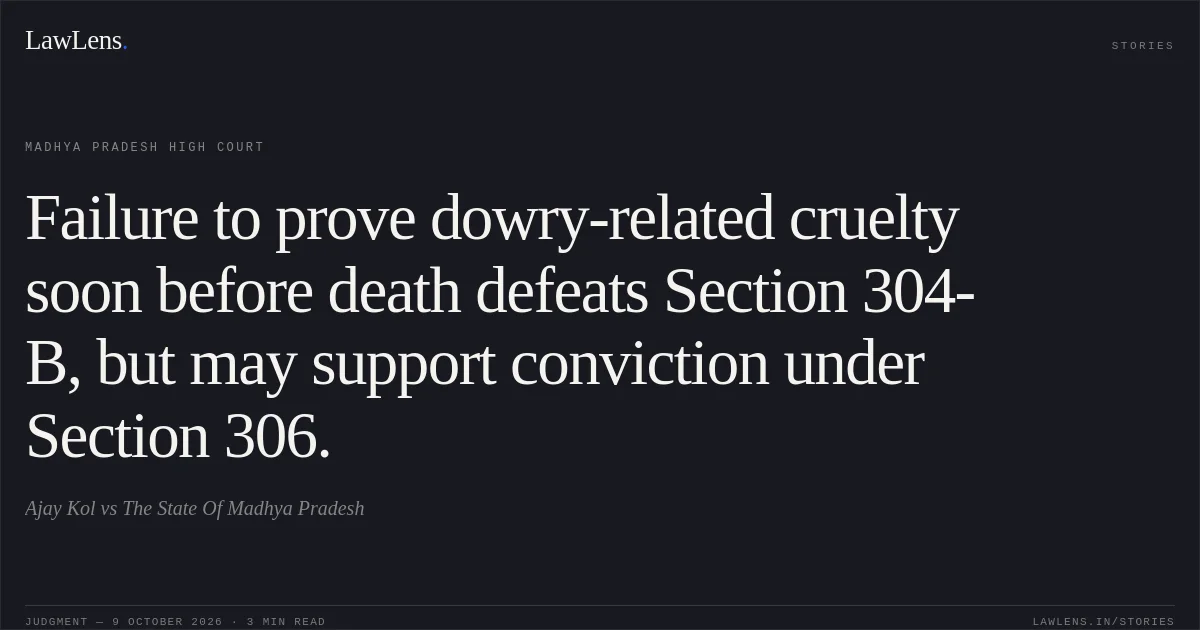
Whether the prosecution established that Sudha was subjected to dowry-related cruelty or harassment “soon before her death,” as required for an offence under Section 304-B IPC.
Source reference: paras. 12–16Whether the evidence established cruelty sufficient to sustain the conviction under Section 498-A IPC and Section 4 of the Dowry Prohibition Act.
Source reference: para. 18Whether, despite failure to establish the Section 304-B IPC charge, the appellant could be convicted under Section 306 IPC for abetting Sudha’s suicide.
Source reference: paras. 19–25Law Applied
Section 304-B IPC requires proof that a woman died otherwise than under normal circumstances within seven years of marriage and was subjected, soon before her death, to cruelty or harassment by her husband or his relative for, or in connection with, a dowry demand; “soon before” requires a proximate and live link between the harassment and death, not a fixed period.
Source reference: paras. 12–13Under Section 113-B of the Indian Evidence Act, 1872, the presumption of dowry death arises only once the foundational requirements of Section 304-B IPC are established.
Source reference: para. 16Section 498-A IPC criminalises specified forms of cruelty, including harassment to coerce an unlawful demand, while Section 4 of the Dowry Prohibition Act penalises demanding dowry.
Source reference: para. 18Section 113-A of the Evidence Act permits the court, having regard to all the circumstances, to presume abetment of suicide where a married woman commits suicide within seven years of marriage and was subjected to cruelty by her husband or his relative.
Source reference: para. 20Paranagouda v. State of Karnataka, 2023 INSC 933, addresses the required proximate connection for Section 304-B IPC; State of Rajasthan v. Girdhari Lal, (2013) 15 SCC 269, distinguishes the requirements of Sections 304-B and 306 IPC; and Narwinder Singh v. State of Punjab, (2011) 2 SCC 47, recognises that a conviction may be altered to an offence established by the evidence where no failure of justice is caused.
Source reference: paras. 13–14, 21, 24–25Reasoning
The marriage and death within seven years, and the suicidal nature of the death, were established. The mother’s and sister-in-law’s evidence also supported the dowry demands and cruelty, but neither identified a definite incident of dowry-related harassment sufficiently proximate to the death. The Section 304-B requirement was therefore unmet, and the Section 113-B presumption could not be invoked.
Source reference: paras. 7–10, 15–17The same evidence nevertheless established cruelty and harassment sufficient to sustain the convictions under Section 498-A IPC and Section 4 of the Dowry Prohibition Act.
Source reference: para. 18Given the suicide within seven years of marriage and the proved cruelty, the Court considered the circumstances sufficient to apply Section 113-A and find abetment of suicide under Section 306 IPC. It held that substituting that conviction caused no demonstrated prejudice to the appellant.
Source reference: paras. 20–25Holding
The Court set aside the conviction and sentence under Section 304-B IPC and substituted a conviction under Section 306 IPC.
It sentenced the appellant under Section 306 IPC to the period already undergone—stated to be more than eight years—and imposed a fine of ₹5,000, with three months’ rigorous imprisonment in default.
Source reference: paras. 26–29The convictions and sentences under Section 498-A IPC and Section 4 of the Dowry Prohibition Act were affirmed; all substantive sentences were to run concurrently. The appeal was disposed of with these modifications.
Source reference: paras. 26–29Acts & Sections Cited
2 provisions across 2 statutes referred to in this judgment. Each provision opens on LawLens.
Indian Penal Code, 18601
Dowry Prohibition Act, 19611
Original Court PDF
Ajay KolvsThe State Of Madhya Pradesh
Click to open original judgment
Original judgment, available to read, download and summarize on LawLens.in