Facts
The petitioner challenged Maidan P.S. Case No. 86 of 2021, arising from allegations that he led a demonstration that obstructed a footpath and breached applicable restrictions.
Source reference: para. 2After investigation, a charge-sheet was filed against him under Sections 188, 283 and 34 of the Indian Penal Code, 1860, read with Section 51(b) of the Disaster Management Act, 2005.
Source reference: para. 2The Magistrate took cognizance while the Article 226 petition was pending.
Source reference: paras. 2–6, 16–17The petitioner alleged, among other things, that the prosecution was mala fide and disclosed no offence; the Court did not examine those merits.
Source reference: paras. 2–6, 16–17Issues
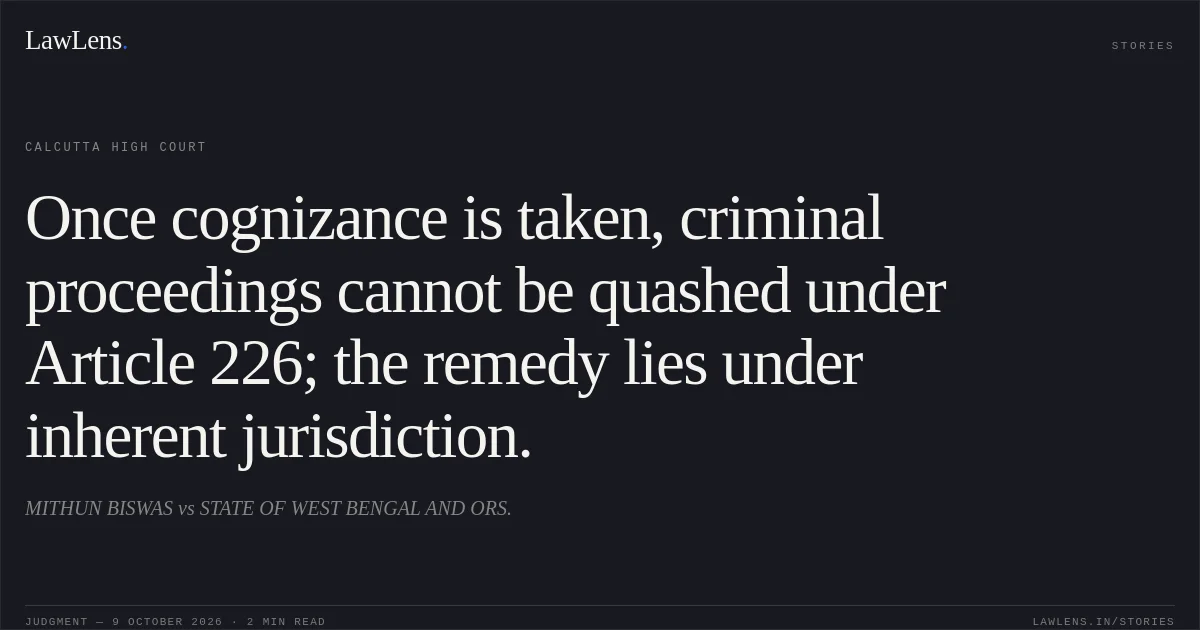
1. Whether the Court could entertain the Article 226 petition to quash the criminal proceedings after the Magistrate had taken cognizance.
Source reference: para. 102. Whether the petition could be treated as one under Article 227 or Section 482 of the Code of Criminal Procedure, 1973, despite having been filed under Article 226.
Source reference: paras. 13–14Law Applied
Under Neeta Singh v. State of U.P., once a competent criminal court takes cognizance during the pendency of an Article 226 challenge to an FIR, the intervening judicial order prevents the High Court from proceeding with that writ petition.
Source reference: para. 11Radhey Shyam v. Chhabi Nath holds that judicial orders of subordinate courts are not amenable to Article 226; the appropriate supervisory jurisdiction is Article 227, while criminal proceedings may be challenged through the applicable statutory or inherent jurisdiction.
Source reference: para. 12Under Neeta Singh and Pradnya Pranjal Kulkarni v. State of Maharashtra, a petition’s nomenclature and substance matter, and a court cannot convert an Article 226 petition into an Article 227 petition unless the judge has the requisite assignment; after cognizance, the inherent power under Section 528 of the Bharatiya Nagarik Suraksha Sanhita, 2023 remains available where properly invoked.
Source reference: paras. 13–14Rajendra Bihari Lal v. State of U.P. confirms that Article 226 may be invoked to quash an FIR and charge-sheet before cognizance, but after cognizance the remedy lies under Section 528 BNSS.
Source reference: para. 15The judgment also preserves the possible application of Section 482 CrPC, depending on which procedural code applies.
Source reference: para. 19Reasoning
The Court found that the charge-sheet had been filed and, critically, the Magistrate had taken cognizance before the writ petition was disposed of.
Source reference: paras. 10–17Applying the cited authorities, it held that the intervening cognizance order prevented it from proceeding under Article 226.
Source reference: paras. 10–17Nor could it simply recast the petition under Article 227 or the inherent jurisdiction, given the principles governing the petition’s form and the judge’s assignment.
Source reference: paras. 10–17The petitioner’s arguments about the protest, the alleged absence of an offence and mala fides went to the merits and were left open for an appropriate proceeding.
Source reference: paras. 10–17Holding
The Court dismissed the Article 226 petition as not maintainable in light of the Magistrate’s intervening order taking cognizance.
It clarified that the dismissal did not preclude the petitioners from challenging the charge-sheet and cognizance order under Section 482 CrPC or Section 528 BNSS, as applicable, or from seeking discharge at the appropriate stage.
Source reference: paras. 19–21The Court expressed no opinion on the merits and made no order as to costs.
Source reference: paras. 19–21Acts & Sections Cited
6 provisions across 4 statutes referred to in this judgment. Each provision opens on LawLens.
Indian Penal Code, 18603
Disaster Management Act, 20051
Code of Criminal Procedure, 19731
Bharatiya Nagarik Suraksha Sanhita, 20231
Original Court PDF
MITHUN BISWASvsSTATE OF WEST BENGAL AND ORS.
Click to open original judgment
Original judgment, available to read, download and summarize on LawLens.in