Facts
Employees of Sri Srikanteshwaraswamy Temple, Nanjangud, had obtained orders directing payment of salary and allowances in accordance with the Fifth Pay Commission recommendations, subject to the outcome of appeals pending before the Supreme Court.
Source reference: pp. 6–8In earlier intra-court appeals, a Division Bench held that salaries paid for work performed could not be recovered merely because the Supreme Court might later rule that the employees’ retirement age was 60 years.
Source reference: pp. 6–8Relying on that decision, the Single Judge quashed a Commissioner’s notice dated 31 December 2008 and directed payment of salary in accordance with the Fifth Pay Commission recommendations, as revised from time to time, subject to the Supreme Court proceedings.
Source reference: p. 8The Temple’s Executive Officer appealed.
Source reference: p. 8The Division Bench questioned his standing, and he relied on an application he had filed in the pending Supreme Court civil appeal.
Source reference: pp. 8–9Issues
1. Whether the Temple’s Executive Officer had locus standi to appeal against the Single Judge’s orders concerning payment of the employees’ salaries.
Source reference: pp. 8–102. Whether the Executive Officer and the State authorities were required to comply with the Single Judge’s directions after the appeals were disposed of.
Source reference: pp. 10–11Law Applied
The Court applied the general principle that an appeal may be pursued by a party with a sufficient legal interest in challenging the impugned order.
Source reference: pp. 9–10It reasoned that, where the State ultimately bears the salary burden, the Executive Officer—who is only an officer responsible for making the payments—cannot independently challenge the orders; the State, if aggrieved, must do so.
Source reference: pp. 9–10The judgment cites no specific statutory provision or named precedent as the basis for this locus standi principle.
Source reference: pp. 9–10Reasoning
The Executive Officer’s application to be impleaded in the Supreme Court proceedings did not establish an independent right to challenge the Single Judge’s orders in these appeals.
Source reference: pp. 9–10The Court considered that the State ultimately paid the employees’ salaries and that the Executive Officer’s role was to administer those payments.
Source reference: pp. 9–10Accordingly, any challenge to the salary directions had to be brought by the State if it was aggrieved; the Executive Officer lacked locus standi to bring it in his own capacity.
Source reference: pp. 9–10The Court also noted that the Single Judge’s directions followed the earlier Division Bench decision.
Source reference: pp. 7–8Holding
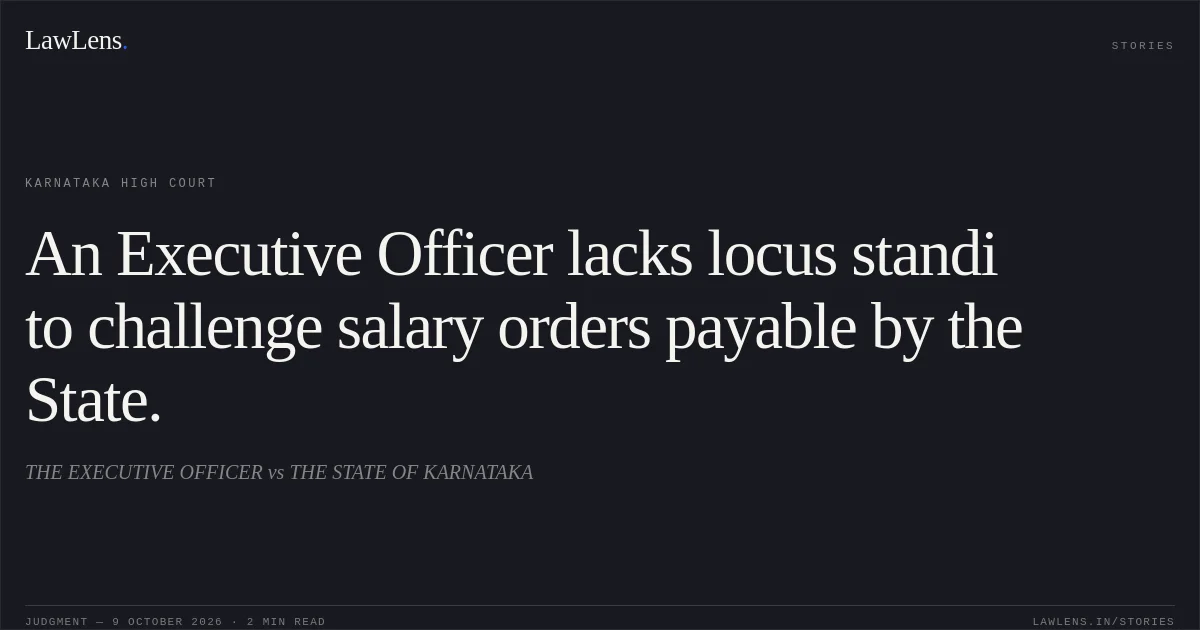
The Court held that the Executive Officer lacked locus standi to challenge the Single Judge’s orders.
The Court disposed of both writ appeals accordingly.
Source reference: p. 10It clarified that the Executive Officer, the State, and the Commissioner were required to comply with the Single Judge’s directions.
Source reference: pp. 10–11Acts & Sections Cited
1 provisions across 1 statute referred to in this judgment. Each provision opens on LawLens.
KARNATAKA HIGH COURT ACT, 19611
Original Court PDF
THE EXECUTIVE OFFICERvsTHE STATE OF KARNATAKA
Click to open original judgment
Original judgment, available to read, download and summarize on LawLens.in