Facts
The State appealed under Section 378(1)(3) of the Code of Criminal Procedure, 1973, against the acquittal of the accused of offences under Sections 397, 504, 506(2) and 114 of the Indian Penal Code, read with Section 28 of the Arms Act and Section 135 of the Bombay Police Act.
Source reference: para. 1The prosecution alleged that the accused hired the complainant’s rickshaw, assaulted him with a knife, threatened him with a dummy revolver, and took the rickshaw and his belongings.
Source reference: paras. 3.1–3.2The trial court acquitted the accused; the appeal had abated as against Respondent No. 2 and proceeded only against Respondent No. 1.
Source reference: paras. 2, 3.5–3.6Issues
Whether the trial court committed an error in acquitting the accused
Source reference: para. 6Whether the trial court erred in its appreciation of the prosecution evidence, and whether its acquittal was illegal or perverse
Source reference: para. 6Law Applied
The Court considered the charged offences under Sections 397, 504, 506(2) and 114 of the IPC, Section 28 of the Arms Act and Section 135 of the Bombay Police Act.
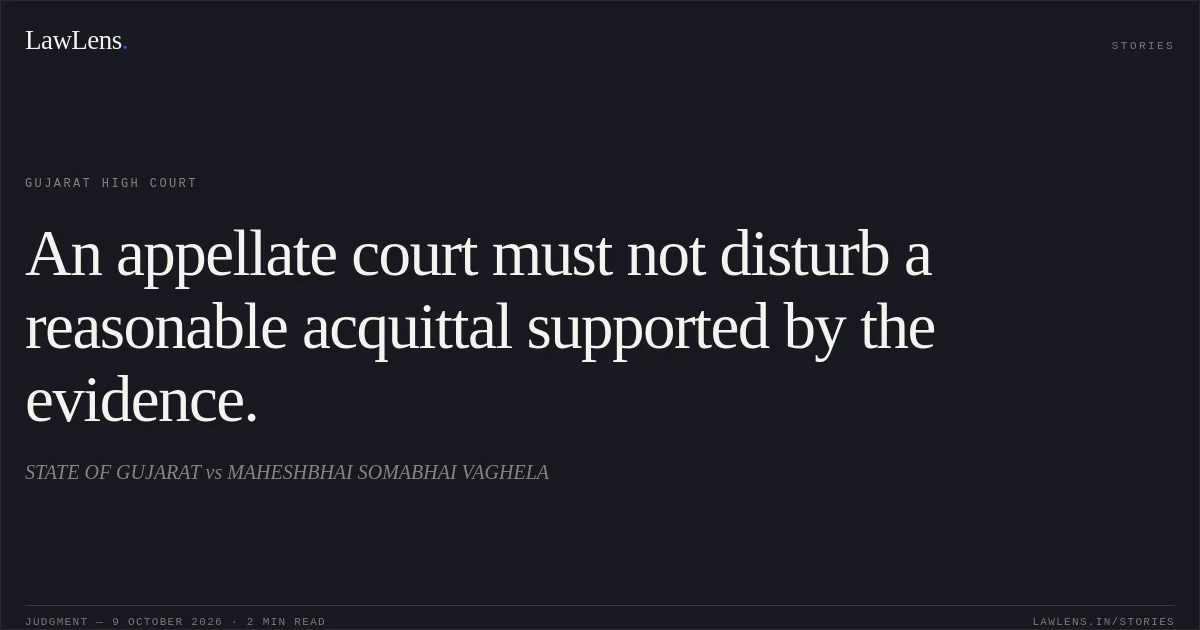
Source reference: para. 1On an appeal against acquittal, the appellate court has full power to review and reappreciate the evidence, but must bear in mind the double presumption of innocence in the accused’s favour; where two reasonable views are possible, the acquittal should not be disturbed.
Source reference: paras. 16–18The Court relied on Chandrappa v. State of Karnataka, (2007) 4 SCC 415; Rajesh Prasad v. State of Bihar, (2022) 3 SCC 471; Babu Sahebagouda Rudragoudar v. State of Karnataka, (2024) 8 SCC 149; and Ramesh v. State of Karnataka, (2024) 9 SCC 169.
Source reference: paras. 18–19Reasoning
The Court found no reliable evidence sufficiently connecting Respondent No. 1 to the offence. Several panch witnesses turned hostile, and the alleged eyewitness did not provide clinching support.
Source reference: paras. 8–9The identification parade had serious deficiencies; medical evidence contained discrepancies concerning the injuries, the complainant’s condition and his treatment; and the prosecution did not explain the registration of the FIR with a regular crime number rather than as a Zero FIR.
Source reference: paras. 8, 10–12On its review of the evidence, the Court concluded that the trial court’s reasons for acquittal were cogent and that its findings did not warrant appellate interference.
Source reference: paras. 13–14, 20–21Holding
The Court held that the prosecution had not proved the charges beyond reasonable doubt and that the trial court had committed no error of fact or law in acquitting the accused.
The appeal was dismissed and the acquittal confirmed; the bail bond was cancelled, and the record and proceedings were directed to be returned to the trial court.
Source reference: para. 22Acts & Sections Cited
7 provisions across 3 statutes referred to in this judgment. Each provision opens on LawLens.
Code of Criminal Procedure, 19732
Indian Penal Code, 18604
Arms Act, 19591
Original Court PDF
STATE OF GUJARATvsMAHESHBHAI SOMABHAI VAGHELA
Click to open original judgment
Original judgment, available to read, download and summarize on LawLens.in