Facts
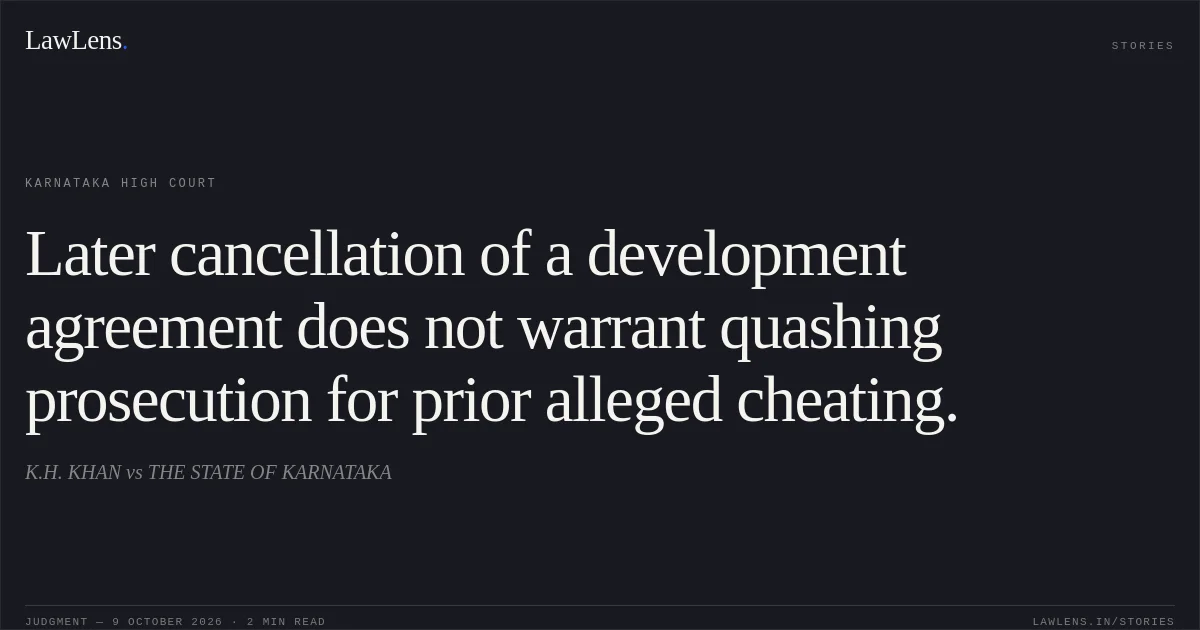
The petitioners, accused Nos. 4–6, were landowners who had entered into a joint development agreement and executed a power of attorney in favour of a developer, followed by an addendum.
Source reference: para. 3–5The developer later assigned the development work to another company.
Source reference: para. 3–5The complainant alleged that his daughter paid instalments towards a proposed apartment after seeing the project’s advertisement and receiving a welcome letter and demand for further payment, but construction did not proceed and the company’s site office closed.
Source reference: para. 3–5The petitioners maintained that they had neither received the complainant’s payments nor dealt with him, and that they terminated the development arrangements in 2012 after the developer’s alleged breach.
Source reference: para. 5–6After investigation, a charge sheet was filed against the petitioners and others. The petitioners sought to quash the proceedings under Section 482 of the Code of Criminal Procedure.
Source reference: para. 2, 6Issues
1. Whether the criminal proceedings against the petitioners should be quashed because they did not directly receive the complainant’s money and had no direct contractual relationship with him.
Source reference: para. 6, 8–102. Whether the petitioners’ later termination of the development arrangements, and their dispute with the developer, warranted quashing the proceedings concerning payments made before termination.
Source reference: para. 5, 9–10Law Applied
The petition invoked the High Court’s inherent jurisdiction under Section 482 of the Code of Criminal Procedure to quash the proceedings. The case concerned allegations of offences under Sections 406 and 420 of the Indian Penal Code; the petition also referred to Section 120-B read with Section 149 IPC.
Source reference: petition; para. 2The Court’s reasoning applied the principle that disputed questions— including whether the accused shared an intention to cheat, whether there was a conspiracy, and the effect of the parties’ competing claims—could be considered at trial rather than determined in the quashing petition.
Source reference: para. 10The judgment cited no precedent.
Source reference: no citationReasoning
The Court noted that the petitioners’ development agreement, power of attorney and addendum were undisputed, and that the complainant’s payments were made while those arrangements remained in force, before the petitioners’ termination notices in February 2012.
Source reference: para. 8–9The alleged payments, project representations and subsequent failure to proceed with construction were sufficient, in the Court’s view, for the prosecution to continue.
Source reference: para. 9–10The absence of direct payment to the petitioners and the asserted lack of contractual privity were matters for trial, as were the questions of conspiracy and intent at the time money was collected.
Source reference: para. 9–10The later termination and the petitioners’ separate case against the developer did not, at this stage, displace the complainant’s allegations.
Source reference: para. 10Holding
The Court held that the petitioners’ defences did not justify quashing the proceedings and that the allegations required trial.
It dismissed the criminal petition; the proceedings in C.C. No. 8921 of 2019 were not quashed.
Source reference: para. 11Acts & Sections Cited
4 provisions across 2 statutes referred to in this judgment. Each provision opens on LawLens.
Code of Criminal Procedure, 19731
Indian Penal Code, 18603
Original Court PDF
K.H. KHANvsTHE STATE OF KARNATAKA
Click to open original judgment
Original judgment, available to read, download and summarize on LawLens.in