Facts
The complainant alleged that, after visiting the Deputy Commissioner of Excise’s office on 1 December 2014, the petitioners abused and wrongfully confined him, threatened him, and one of them slapped him and attempted to take his mobile phone.
Source reference: pp. 3–7, 13–15Police investigated the complaint and filed a ‘B’ report.
Source reference: pp. 3–7, 13–15On the complainant’s protest, the Magistrate recorded sworn statements from the complainant and three witnesses, considered documents, and issued summons to the petitioners for offences under Sections 341, 504, 323 and 506 read with Section 34 of the IPC.
Source reference: pp. 3–7, 13–15The petitioners challenged the summons order and the proceedings under Section 482 Cr.P.C., contending, among other things, that the Magistrate had not properly considered the ‘B’ report or the evidence and that sanction under Section 197 Cr.P.C. was required.
Source reference: pp. 3–7, 13–15Issues
1. Whether the Magistrate’s order issuing summons was sustainable when the ‘B’ report, sworn statements and supporting documents had not been adequately considered.
Source reference: para. 13; pp. 17–182. Whether sanction under Section 197 Cr.P.C. was required at the stage of issuing process, given the allegations against the petitioners.
Source reference: paras. 4, 11, 15–16Law Applied
Under Section 482 Cr.P.C., the High Court may intervene where the process order warrants correction.
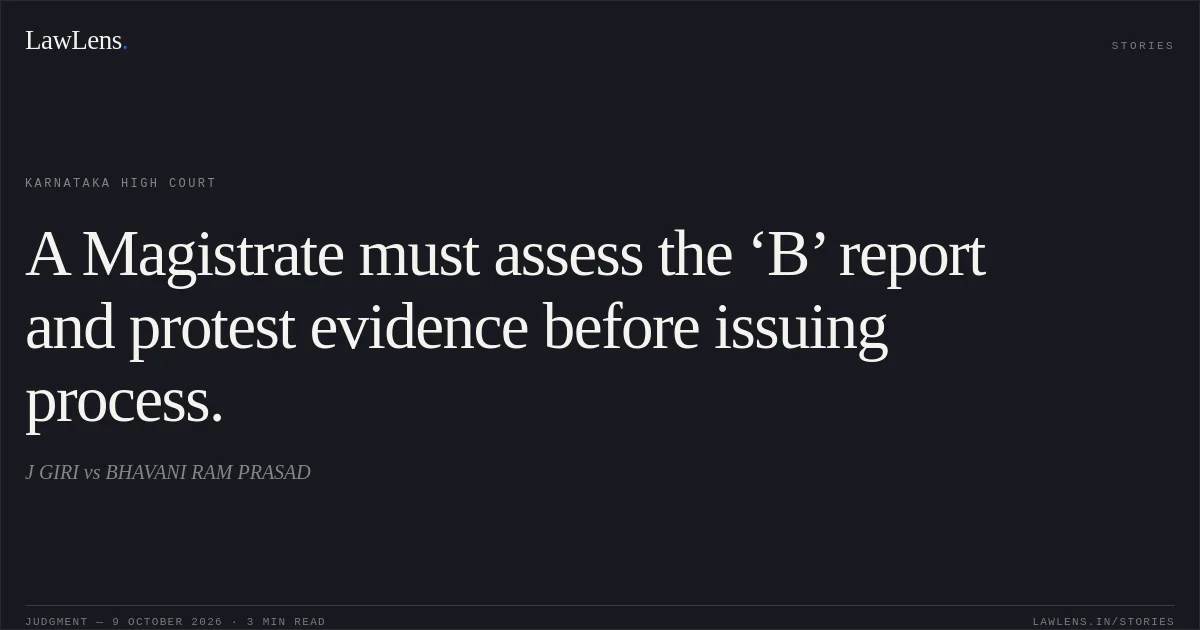
Source reference: paras. 6–7On receiving a police report concluding that no offence appears to have been committed, a Magistrate may accept the report and drop proceedings, disagree and take cognizance and issue process, or direct further investigation; the complainant’s protest material must be considered in deciding the appropriate course (*Bhagwant Singh v. Commissioner of Police*; *Dablu Kujur v. State of Jharkhand*).
Source reference: paras. 6–7The Court also referred to the guidance in *Amit Bansal v. State of Karnataka* that the ‘B’ report, sworn statements and documents should be considered together before deciding whether to accept the report, reject it or issue summons.
Source reference: para. 9Section 197 Cr.P.C. requires sanction for specified public servants where the alleged act bears the requisite connection to official duty; whether that protection applies depends on the nature of the allegations and their connection to the officer’s functions.
Source reference: paras. 11, 15–16The Court considered *Dr. S.M. Mansoori v. Surekha Parmar* and distinguished *G.C. Manjunath v. Seetaram* on the facts.
Source reference: paras. 11, 15–16Reasoning
The Court noted that the Magistrate referred to the complaint, witness examinations and documents, including the Joint Commissioner of Excise’s report, but did not adequately discuss the sworn statements and exhibits or address the ‘B’ report and the basis for proceeding despite it.
Source reference: paras. 14, 17Although the Magistrate had concluded that Section 197 sanction was unnecessary, the High Court did not finally determine the sanction question; it considered the complainant’s allegations and the *Mansoori* decision relevant, while distinguishing *G.C. Manjunath* on its facts.
Source reference: paras. 15–16The procedural deficiency therefore required the summons order to be set aside and the matter reconsidered, rather than a final determination of the complaint’s merits.
Source reference: para. 17Holding
The petition was allowed in part.
The summons order dated 30 June 2018 was set aside, and the matter was remanded to the Magistrate for the limited purpose of considering the ‘B’ report, the statements of CW1 to CW4 and the documentary evidence together, and passing a fresh order in accordance with the cited guidance within two months.
Source reference: para. 18Acts & Sections Cited
15 provisions across 3 statutes referred to in this judgment. Each provision opens on LawLens.
Code of Criminal Procedure, 19738
Indian Penal Code, 18606
KARNATAKA POLICE ACT, 1963.1
Original Court PDF
J GIRIvsBHAVANI RAM PRASAD
Click to open original judgment
Original judgment, available to read, download and summarize on LawLens.in