Facts
The petitioner was appointed as a Gram Rojgar Sahayak on a contractual basis on 1 November 2012, with successive extensions of his contract.
Source reference: para. 2In 2022, a villager complained that the petitioner resided approximately 60 kilometres from the Gram Panchayat headquarters and frequently kept his mobile phone switched off, allegedly causing inconvenience to villagers.
Source reference: para. 2The Collector, Guna obtained a fact-finding report from the Chief Executive Officer, following which a show-cause notice was issued to the petitioner on 25 March 2022. The petitioner submitted his reply on 31 March 2022.
Source reference: para. 2Thereafter, the Collector sought an opinion from the Chief Executive Officer, Janpad Panchayat Chachoda, and, without conducting a regular departmental enquiry or properly considering the petitioner’s reply, terminated his contractual services by order dated 13 June 2022.
Source reference: paras. 2, 19The petitioner’s appeals were rejected by orders dated 29 April 2024 and 17 March 2026. He challenged the termination order and the appellate orders under Article 226 of the Constitution.
Source reference: paras. 1, 20Issues
Whether the termination order, which attributed negligence and dereliction of duty to the petitioner, was stigmatic and could lawfully be passed without a charge-sheet and regular departmental enquiry?
Source reference: paras. 5–9, 19Whether the termination and appellate orders were liable to be quashed for violation of natural justice and failure to provide reasoned, speaking decisions?
Source reference: paras. 14–18Whether the petitioner was entitled to reinstatement and consequential monetary benefits?
Source reference: paras. 20–21Law Applied
A termination order that is founded on allegations of misconduct, negligence, dereliction of duty, or other blameworthy conduct is stigmatic and cannot ordinarily be issued without complying with the principles of natural justice, including a proper charge-sheet, reasonable opportunity of defence, and regular departmental enquiry.
Source reference: paras. 6–10The Court relied on Rahul Tripathi v. Rajeev Gandhi Shiksha Mission, 2001 (3) MPLJ 616; Jitendra v. State of M.P., 2008 (4) MPLJ 670; Malkhan Singh Malviya v. State of M.P., ILR (2018) MP 660; Rajesh Kumar Rathore v. High Court of M.P., W.P. No. 18657/2018, decided on 23 November 2021; and Devkaran Patidar v. State of M.P., W.P. No. 5856/2020, decided on 2 February 2024.
Source reference: paras. 7, 10–13The Court also applied the reasonable-opportunity principles stated in Khem Chand v. Union of India, AIR 1958 SC 300.
Source reference: para. 7Under the applicable Gram Rojgar Sahayak guidelines, termination on grounds involving irregularity or gross negligence in discharge of duty requires the relevant misconduct to be established in accordance with law.
Source reference: para. 12Further, administrative and quasi-judicial orders affecting rights must be reasoned and speaking orders; this principle was supported by State of Punjab v. Bandip Singh, (2016) 1 SCC 724, and Kranti Associates Pvt. Ltd. v. Masood Ahmed Khan, (2010) 9 SCC 496.
Source reference: paras. 14–18Reasoning
The termination order did not merely bring the petitioner’s contractual engagement to an end simpliciter; it recorded findings that he had repeatedly acted negligently, failed to reside at the headquarters, and thereby deprived villagers of the benefits of government schemes.
Source reference: para. 5These findings carried an adverse stigma and affected the petitioner’s future prospects.
Source reference: para. 5Although a fact-finding report and show-cause notice existed, the petitioner was not served with a formal charge-sheet, was not afforded an opportunity to participate in a regular departmental enquiry, and was not given the opportunity to test the material relied upon against him.
Source reference: paras. 6, 8, 19The Collector also failed to meaningfully consider the petitioner’s detailed reply before terminating his services.
Source reference: paras. 2, 19The Court further found that the termination order was non-speaking and that the appellate order did not demonstrate proper application of mind.
Source reference: para. 14Since the order was punitive in substance and stigmatic in effect, the respondents could not avoid the requirements of natural justice merely by describing the petitioner’s engagement as contractual.
Source reference: no citationThe absence of a lawful enquiry rendered the termination unsustainable.
Source reference: no citationThe Court therefore followed the consistent line of authorities directing reinstatement while preserving the employer’s liberty to initiate fresh proceedings in accordance with law.
Source reference: paras. 9–13, 20–21Holding
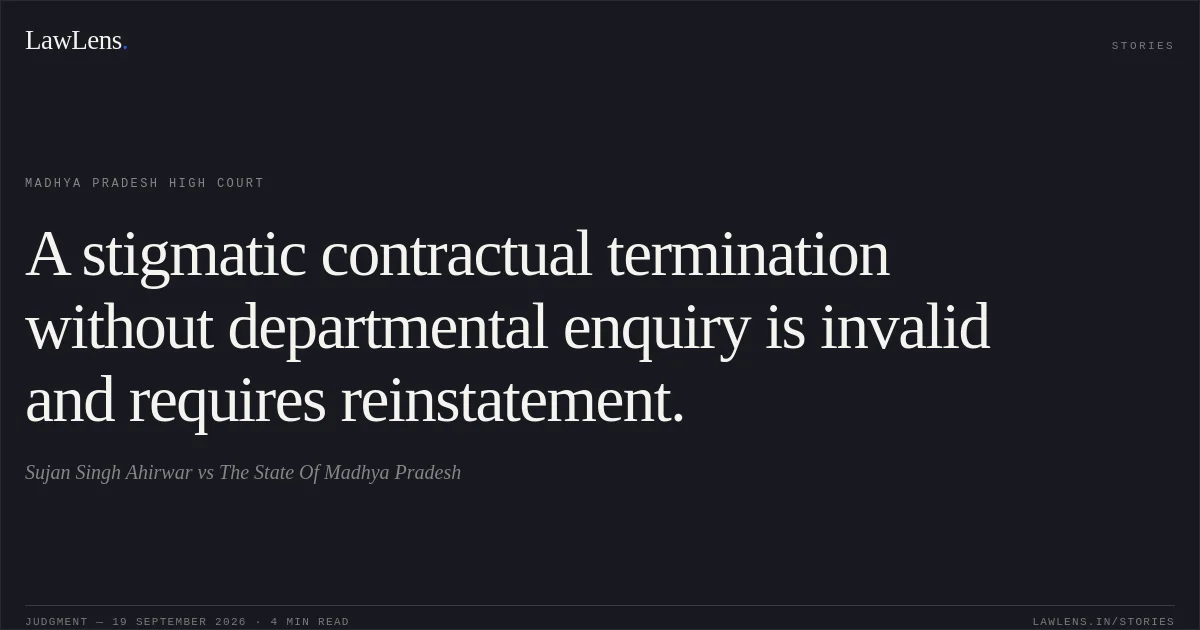
The Court held that the termination order dated 13 June 2022 was stigmatic, non-speaking, and violative of natural justice, as it was passed without a proper departmental enquiry.
The termination order, the appellate order dated 29 April 2024, and the second appellate order dated 17 March 2026 were quashed.
Source reference: para. 20The respondents were directed to reinstate the petitioner forthwith with all consequential benefits, but without back wages on the principle of “no work, no pay”.
Source reference: para. 21The respondents were granted liberty to take fresh action against the petitioner in accordance with law, if so advised.
Source reference: para. 21The writ petition was accordingly allowed and disposed of.
Source reference: paras. 21–23Original Court PDF
Sujan Singh AhirwarvsThe State Of Madhya Pradesh
Click to open original judgment
Original judgment, available to read, download and summarize on LawLens.in