Facts
The petitioner, a street vendor claiming to have carried on vending activities since before 2010 at Sarojini Nagar Market, stated that, despite possessing an NDMC identity card and supporting challans/receipts, he was excluded from an earlier survey conducted by the Town Vending Committee (“TVC”).
Source reference: para. 3, p. 2; para. 5, p. 2In W.P.(C) 11895/2025, the Division Bench had directed that the petitioner’s representation dated 19 July 2025 be treated as an objection to the provisional list of surveyed vendors and decided in accordance with law.
Source reference: para. 2, p. 2The petitioner alleged that the representation had not effectively secured his inclusion and sought directions to be included in a fresh NDMC survey notified on 24 July 2026 and commencing on 27 July 2026.
Source reference: paras. 1, 6–8, pp. 1–3The respondent submitted that the representation had already been dealt with by an order dated 3 December 2025, which referred the matter to the TVC for consideration under the applicable Street Vendors Act, Rules and Scheme, and that the fresh survey concerned Kashmiri migrants and old tehbazari vendors.
Source reference: paras. 9–11, p. 3Issues
Whether the petitioner, who claimed long-standing vending activity and exclusion from the earlier survey, should be included in the fresh survey being conducted by the NDMC.
Source reference: paras. 6–12, pp. 2–4Whether the petitioner’s entitlement to a Certificate of Vending should be determined by the TVC in accordance with the applicable statutory framework.
Source reference: para. 12, p. 4Law Applied
The Court applied the binding effect of the earlier judicial direction requiring consideration of the petitioner’s representation in accordance with law.
Source reference: para. 2, p. 2It also relied on the statutory framework governing street vendors—namely, the Street Vendors Act, the applicable Rules and Scheme—which places the TVC as the appropriate authority to consider and decide issues relating to vending status and issuance of a Certificate of Vending.
Source reference: para. 11, p. 3; para. 12, p. 4The petitioner invoked the constitutional protection of livelihood under Article 21, but the Court did not undertake an independent determination of that claim.
Source reference: para. 8, p. 3Reasoning
The Court noted that the petitioner’s earlier representation had been disposed of on the premise that the survey had already concluded, with the matter being referred to the TVC.
Source reference: paras. 10–12, p. 3Since the NDMC had commenced a new survey and the petitioner asserted over 16 years of vending activity supported by NDMC documents, the Court considered it appropriate to ensure that he was not excluded at the survey stage.
Source reference: paras. 5, 8, 12–13, pp. 2–4At the same time, the Court did not itself decide whether the petitioner was entitled to a Certificate of Vending; that substantive determination was left to the TVC under the governing statutory rules and scheme.
Source reference: para. 12, p. 4Holding
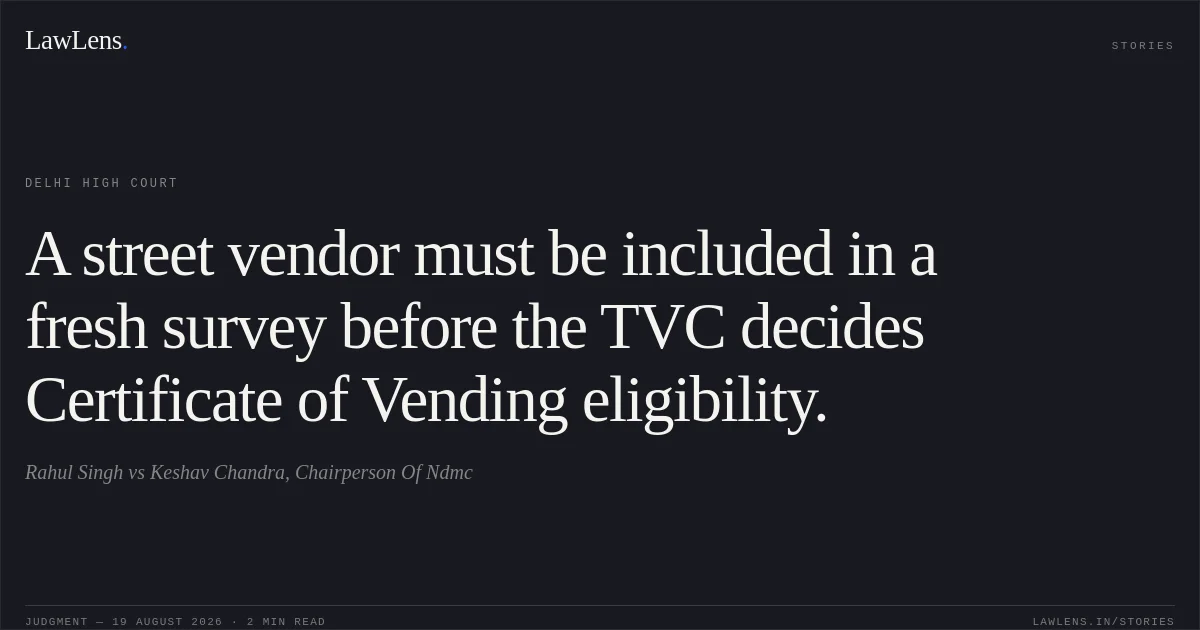
The Court directed the NDMC to duly include the petitioner’s name in the list of persons to be surveyed.
It further directed that the petitioner’s claim regarding issuance of a Certificate of Vending be decided by the TVC in accordance with the applicable statutory rules and regulations.
Source reference: para. 12, p. 4The contempt petition and pending application were disposed of, and the listed date of 15 October 2026 was cancelled.
Source reference: paras. 14–15, p. 4Original Court PDF
Rahul SinghvsKeshav Chandra, Chairperson Of Ndmc
Click to open original judgment
Original judgment, available to read, download and summarize on LawLens.in