Facts
The petitioner had executed an “Irrevocable General Power of Attorney” dated 25 March 2009 in favour of respondent No. 3.
Source reference: p. 1Alleging fraud and breach of trust, he published a notice of revocation on 14 August 2025 and issued a legal notice dated 18 August 2025.
Source reference: p. 1–3He thereafter presented a revocation deed dated 12 August 2025 before the Sub-Registrar for registration.
Source reference: p. 1–3The Sub-Registrar neither registered the document nor passed a reasoned order of refusal, asserting that the Registration Department’s checklist no longer contained an entry for “Cancellation of Instrument,” that the NGDRS portal had no separate category for “Revocation of Power of Attorney,” and that the petitioner should pursue civil remedies under Section 31 of the Specific Relief Act.
Source reference: p. 1–3The petitioner invoked Sections 201 and 202 of the Indian Contract Act, contending that the power of attorney was revocable because it did not create any independent interest in favour of respondent No. 3.
Source reference: p. 1Issues
1. Whether the Sub-Registrar could refuse or indefinitely withhold registration of the petitioner’s revocation of the power of attorney on the ground that the administrative checklist and NGDRS portal did not contain a separate category for such a document.
Source reference: p. 2–3, 5–82. Whether the Sub-Registrar was competent to determine the validity, irrevocability, or legal effect of the power of attorney, or whether his statutory inquiry was confined to the matters specified in Section 34(3) of the Registration Act, 1908.
Source reference: p. 3–53. Whether the mere description of the power of attorney as “irrevocable” prevented its revocation in the absence of an independent interest in the subject matter under Section 202 of the Indian Contract Act.
Source reference: p. 1, 6–74. Whether the petitioner was required to institute a civil suit under Section 31 of the Specific Relief Act before seeking registration of the revocation deed.
Source reference: p. 2–3, 7–8Law Applied
Section 34(3) of the Registration Act, 1908 limits the registering officer’s inquiry to ascertaining whether the document was executed by the person purporting to execute it, verifying the identity of the person appearing, and satisfying himself regarding the authority of any representative, assign, or agent.
Source reference: p. 3The registering officer has no adjudicatory power to determine title, validity, or the substantive legal effect of the document.
Source reference: p. 3–5Relying on K. Gopi v. Sub-Registrar, AIR 2025 SC (Civil) 1303, the Court held that a registering authority must register a document once the statutory and procedural requirements are satisfied and cannot decide whether the executant possesses title or transferable rights.
Source reference: p. 4–5Under Sections 201 and 202 of the Indian Contract Act, an agency is ordinarily terminable by the principal, and a power of attorney becomes irrevocable only where the agent has an interest in the subject matter of the agency.
Source reference: p. 6–7Following M.S. Ananthamurthy v. J. Manjula, 2025 INSC 273, the Court held that the use of the word “irrevocable” by itself does not make a power of attorney irrevocable.
Source reference: p. 6–7The Court also held that the deletion of the “Cancellation of Instrument” entry from an administrative checklist could not curtail the Sub-Registrar’s statutory jurisdiction.
Source reference: p. 5–6Reasoning
The Court found that Section 34(3) confined the Sub-Registrar’s role to a ministerial verification of execution, identity, and authority; it did not authorise him to examine whether the petitioner had legally revoked the power of attorney or whether respondent No. 3 possessed an interest under Section 202 of the Contract Act.
Source reference: p. 3–5The Government Order dated 2 January 2023 merely deleted an entry from an administrative checklist and could not be interpreted as removing a statutory power or prohibiting registration of revocation documents.
Source reference: p. 5–6The absence of a specific NGDRS category was likewise treated as a technical or administrative deficiency that could not justify refusal or delay where the document was otherwise legally registrable.
Source reference: p. 8The Court further held that requiring a civil suit for cancellation under Section 31 of the Specific Relief Act was misconceived because registration of the revocation did not involve adjudication of its ultimate validity.
Source reference: p. 3If the revocation were legally defective, the aggrieved party could challenge it separately in accordance with law.
Source reference: p. 3The Court also noted that the label “irrevocable” was not conclusive and that irrevocability depended on proof of an independent interest in the subject matter, which had not been shown on the petitioner’s case.
Source reference: p. 6–7Holding
The writ petition was allowed.
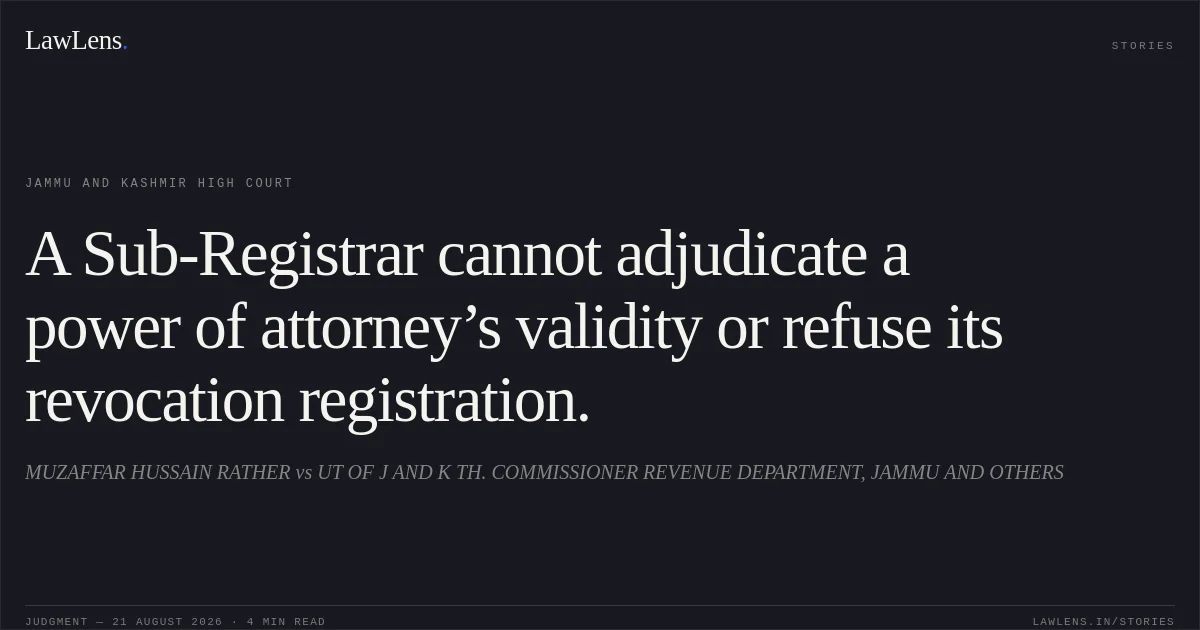
The Court held that the Sub-Registrar could not refuse or keep pending the petitioner’s revocation of the power of attorney merely because the relevant administrative checklist or NGDRS portal lacked a separate entry for “Revocation of Power of Attorney,” nor could he adjudicate the document’s substantive validity.
Source reference: p. 7–8Respondent No. 2 was directed to register the document within seven days of receiving the order, provided there was no other legal impediment.
Source reference: p. 8The petition was accordingly disposed of.
Source reference: p. 8Acts & Sections Cited
17 provisions across 3 statutes referred to in this judgment. Each provision opens on LawLens.
Indian Contract Act, 18722
Registration Act, 1908
Specific Relief Act, 19631
Original Court PDF
MUZAFFAR HUSSAIN RATHERvsUT OF J AND K TH. COMMISSIONER REVENUE DEPARTMENT, JAMMU AND OTHERS
Click to open original judgment
Original judgment, available to read, download and summarize on LawLens.in