Facts
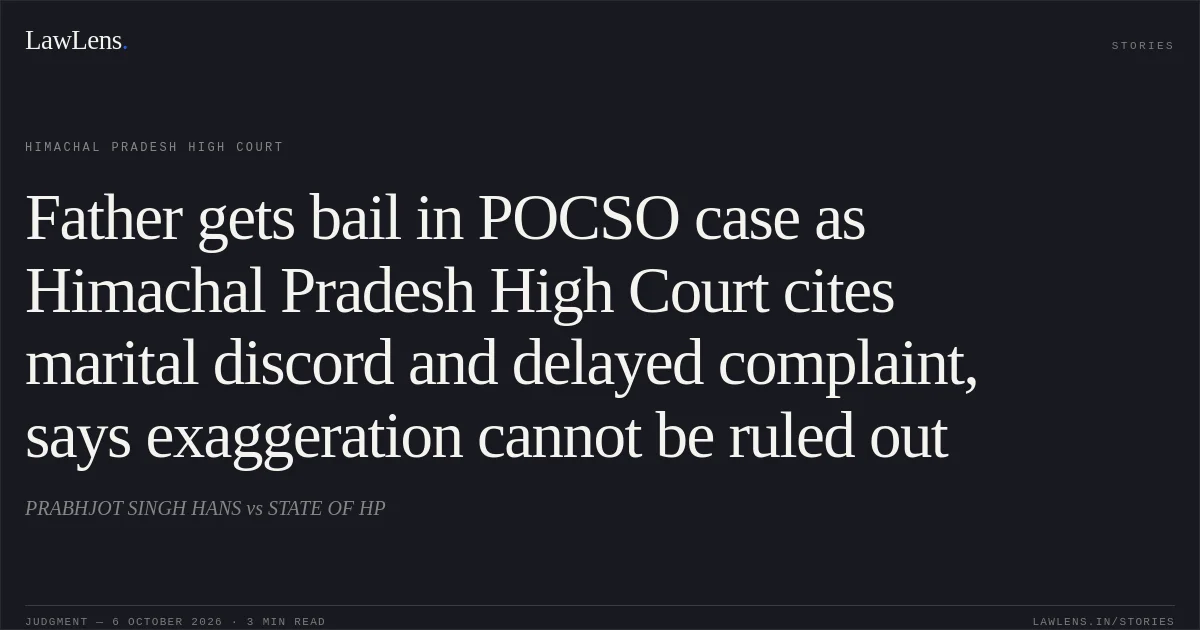
The petitioner sought post-arrest bail under Section 483 of the BNSS in a case alleging offences under Section 75 of the BNS and Section 12 of the POCSO Act.
Source reference: para. 1The allegation was that, on 19 April 2025, during a family visit to Timber Trail Hotel, the petitioner inappropriately touched his minor daughter and later apologised.
Source reference: para. 5The complainant lodged a complaint in November 2025; the matter was subsequently registered in Himachal Pradesh, and the child’s statements were recorded during the investigation, including before a Magistrate.
Source reference: paras. 2, 5–6The charge sheet had been filed, and the petitioner was in judicial custody.
Source reference: paras. 6–7, 22The petitioner relied on the parties’ matrimonial and custody disputes, the delay in reporting, and earlier proceedings in which the alleged incident had not been mentioned.
Source reference: paras. 12–15, 21His earlier applications for anticipatory bail had been dismissed.
Source reference: paras. 9, 17, 23Issues
1. Whether the petitioner should be released on regular bail, notwithstanding the seriousness of the allegations and the prior dismissal of his anticipatory-bail applications.
Source reference: paras. 16–17, 23–242. Whether the circumstances—including completion of the investigation, delay in reporting, and the parties’ matrimonial and custody disputes—supported granting bail subject to safeguards.
Source reference: paras. 21–22, 26–30Law Applied
Section 483 of the BNSS confers power to grant bail after arrest.
Source reference: no citationThe Court relied on the distinction between anticipatory bail and post-arrest bail, explaining that their governing considerations differ and that dismissal of an anticipatory-bail application does not, by itself, determine a subsequent regular-bail application.
Source reference: paras. 23–25Citing Gurbaksh Singh Sibbia v. State of Punjab, as discussed in Pokar Ram v. State of Rajasthan, the Court noted that bail discretion requires consideration of such matters as the nature and seriousness of the accusation, the circumstances of the case, the risk of absconding or witness interference, and the public interest.
Source reference: para. 25The Court also referred to Ishwar Chand Sharma v. State of Uttar Pradesh and R v. E, cited in the judgment in relation to alleged misuse of criminal proceedings in matrimonial disputes.
Source reference: paras. 18–20, 31Sections 29 and 30 of the POCSO Act were raised in argument concerning statutory presumptions; the judgment did not treat those presumptions as determinative of the bail application.
Source reference: paras. 9, 20Reasoning
The Court acknowledged the gravity of the allegations and the child’s recorded statements, but considered that the investigation was complete, the charge sheet had been filed, and the victim’s statement had been recorded repeatedly, including before a Magistrate.
Source reference: paras. 16–17, 22, 27–28It also took account of the substantial matrimonial and custody dispute, the delay in reporting, and the absence of any reference to the alleged harassment in earlier proceedings identified by the petitioner.
Source reference: paras. 21, 26, 29In light of those circumstances, the Court considered that exaggeration or a dispute-related motive could not be ruled out, while expressly limiting its observations to the bail decision.
Source reference: paras. 29–33It therefore found that the petitioner could be released subject to conditions intended to protect the witnesses and victim.
Source reference: para. 32Holding
The petition was allowed and the petitioner ordered to be released on bail on furnishing a bond of ₹1,00,000 with two sureties for the like amount, one being a local surety, to the satisfaction of the trial Court.
Conditions included non-interference with witnesses, appearance as directed, surrender of any passport and no departure from India without permission, and no contact with the victim or her mother until the victim’s statement was recorded at trial—and thereafter only with the Court’s express permission.
Source reference: para. 32The Court clarified that its observations were not an opinion on the merits.
Source reference: para. 33Acts & Sections Cited
15 provisions across 4 statutes referred to in this judgment. Each provision opens on LawLens.
Bharatiya Nagarik Suraksha Sanhita, 20232
Bharatiya Nyaya Sanhita, 20237
Protection of Children from Sexual Offences Act, 20124
Code of Criminal Procedure, 19732
Original Court PDF
PRABHJOT SINGH HANSvsSTATE OF HP
Click to open original judgment
Original judgment, available to read, download and summarize on LawLens.in