Facts
RITES Ltd. issued a tender for the extension and resurfacing of existing airstrips and allied works at Shravasti, Uttar Pradesh, while acting as agent and power-of-attorney holder of the Directorate of Civil Aviation, Government of Uttar Pradesh. Espan Infrastructure Ltd. participated in the tender and deposited an earnest money deposit of ₹7,54,000 through a demand draft. Its technical bid was rejected and the earnest money was forfeited. Espan thereafter instituted a suit for declaration and recovery of ₹9,92,391 before the District Court at Karkardooma, Delhi, impleading RITES through its Northern Region Office at Laxmi Nagar, Delhi.
Source reference: pp. 1–2; paras. 1–3RITES contested the territorial jurisdiction of the Delhi courts, asserting that the tender process, including submission, evaluation and forfeiture of the earnest money, had taken place at its Airport Division at Sector 44, Gurugram, Haryana. It further contended that its Laxmi Nagar office was merely a subordinate office and that Clause 13(b), conferring jurisdiction on New Delhi courts, was part of the contractual conditions and never became operative because no contract was awarded or executed.
Source reference: pp. 2–4; paras. 4–7The Trial Court rejected the objection, relying on the jurisdiction clause in the tender document and the alleged location of RITES’ registered office in New Delhi. RITES challenged that order in the present appeal.
Source reference: p. 4; para. 6Issues
Whether the Delhi courts possessed territorial jurisdiction under Section 20 CPC when the tender-related transactions and the entire alleged cause of action arose at Gurugram, Haryana, and RITES’ Delhi office was merely a subordinate office?
Source reference: pp. 5–7; paras. 10–12, 14–16Whether Clause 13(b) of the tender document conferred exclusive jurisdiction on the New Delhi courts in respect of a dispute arising before the award or execution of any contract?
Source reference: pp. 5–6; para. 13Law Applied
The Court applied Section 20(a) CPC and its Explanation, under which a corporation may be sued where it carries on business, subject to the principle that the mere existence of a registered or subordinate office does not confer jurisdiction where no part of the cause of action arose within that court’s territorial limits.
Source reference: pp. 7–8; paras. 15–16Relying on Patel Roadways Ltd. v. Prasad Trading Company, (1991) 4 SCC 270, A.B.C. Laminart (P) Ltd. v. A.P. Agencies, Salem, (1989) 2 SCC 163, and Jain Irrigation Systems Ltd. v. M/s Pragyawan Technologies Pvt. Ltd., 2024:DHC:7169, the Court held that where the entire cause of action arises at the office or place concerned with the transaction, the suit must be instituted before the competent court exercising jurisdiction over that place.
Source reference: pp. 7–8; paras. 15–16A contractual jurisdiction clause is enforceable only where it forms part of an operative agreement and cannot confer jurisdiction for a pre-contract dispute if the contract containing the clause was never concluded.
Source reference: pp. 5–6; para. 13The Court also applied Order VII Rule 10 CPC, requiring return of a plaint presented before a court lacking territorial jurisdiction.
Source reference: p. 8; para. 18Reasoning
The Court examined the tender document and found that every material stage of the transaction occurred at Gurugram: the tender documents and clarifications were handled there; the pre-bid meeting was scheduled there; the earnest money demand draft was payable at Gurugram; the bids were to be submitted and opened there; and the successful bidder was required to execute the contract at the Gurugram office.
Source reference: pp. 5–6; paras. 11–12Since the technical bid was rejected at the pre-award stage and no letter of acceptance or formal contract was issued, Clause 13(b), located in the Special Conditions of Contract, never became operative between the parties.
Source reference: p. 6; para. 13Further, the plaint did not invoke Delhi jurisdiction on the basis of RITES’ registered office, and the Delhi office was only a subordinate office through which no part of the tender transaction occurred.
Source reference: pp. 6–8; paras. 14–16Applying Section 20 CPC and the cited authorities, the Court held that the existence of an office in Delhi could not independently confer territorial jurisdiction.
Source reference: pp. 6–8; paras. 14–16Holding
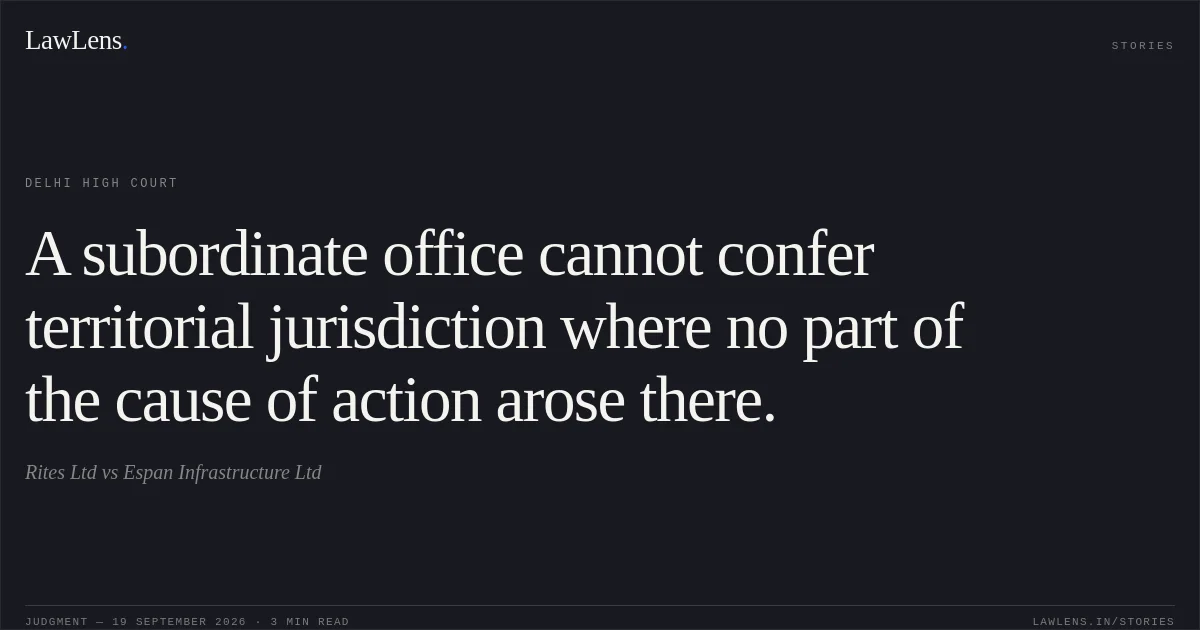
The Delhi High Court held that the Delhi courts lacked territorial jurisdiction because the entire cause of action arose at Gurugram, Haryana, and Clause 13(b) of the tender document was inoperative in the absence of any concluded contract.
The appeal was allowed, the Trial Court’s order dated 20 September 2018 was set aside, and the preliminary objection regarding territorial jurisdiction was upheld.
Source reference: p. 8; paras. 17–19The Trial Court was directed to return the plaint under Order VII Rule 10 CPC for presentation before the court of competent territorial jurisdiction. The pending application was also disposed of.
Source reference: p. 8; paras. 17–19Acts & Sections Cited
1 provisions across 1 statute referred to in this judgment. Each provision opens on LawLens.
Code of Civil Procedure, 19081
Original Court PDF
Rites LtdvsEspan Infrastructure Ltd
Click to open original judgment
Original judgment, available to read, download and summarize on LawLens.in