Facts
The petitioner sought review of the High Court’s order dated 20 July 2026 dismissing his writ appeal, which had followed the decision in another writ appeal.
Source reference: para. 1He relied on a subsequent High Court order dated 21 July 2026 in Central Board of Trustees, Employees Provident Fund v. Prakash Bhalachandra Keskar & Others, arguing that R.C. Gupta applied to his case and that the decisions revealed conflicting views.
Source reference: paras. 2–4He sought review and a reference to a larger Bench.
Source reference: paras. 2–4The respondents opposed review, contending that the earlier order correctly applied Sunil Kumar B. and that a subsequent decision did not establish an error apparent on the face of the record.
Source reference: para. 5Issues
Whether the subsequent High Court decision dated 21 July 2026 constituted a ground to review the order dated 20 July 2026.
Source reference: paras. 7–9Whether the petitioner established an error apparent on the face of the record or another sufficient ground for review, including by showing that R.C. Gupta rather than Sunil Kumar B. applied to his case.
Source reference: paras. 10, 16Law Applied
Section 114 and Order 47 Rule 1 of the Code of Civil Procedure permit review on specified grounds, including discovery of new and important matter, an error apparent on the face of the record, or another sufficient reason.
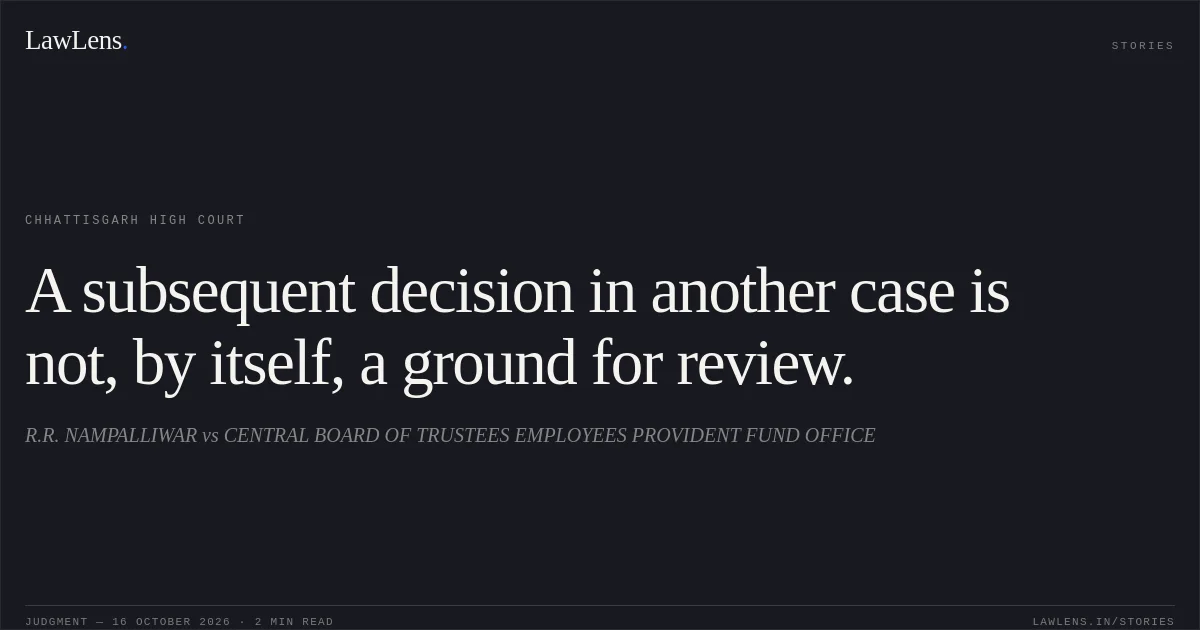
Source reference: para. 11The Explanation to Order 47 Rule 2 states that a subsequent decision of a superior court reversing or modifying a decision on a question of law is not, by itself, a ground for review.
Source reference: paras. 8, 11Under Parsion Devi v. Sumitri Devi, an error apparent must be self-evident; review cannot be used to rehear or correct an allegedly erroneous decision.
Source reference: para. 12Perry Kansagra v. Smriti Madan Kansagra and M/S Shanti Conductors (P) Ltd. v. Assam State Electricity Board affirm that review is not an appeal in disguise and cannot be used to reargue decided questions.
Source reference: paras. 13–14Beghar Foundation v. K.S. Puttaswamy holds that a subsequent decision or change in law, by itself, is not a ground for review.
Source reference: para. 15Reasoning
The Court treated the petitioner’s reliance on the 21 July 2026 decision as reliance on a subsequent event, which did not establish a review ground.
Source reference: paras. 7–9It also found that the petitioner had not shown that the order in the writ appeal on which his dismissal was based had itself been reviewed or was under review.
Source reference: para. 10The Court noted that the earlier appeal had been decided after consideration of R.C. Gupta, Sunil Kumar B. and the case materials; the petitioner’s disagreement with that decision did not demonstrate a self-evident error or justify rehearing the merits.
Source reference: para. 10Accordingly, the asserted difference between the decisions and request for a larger-Bench reference did not warrant review.
Source reference: paras. 4, 16Holding
The Court held that no apparent error, perceptible illegality, or other sufficient ground for review had been established.
It dismissed the review petition and declined to interfere with the order dated 20 July 2026.
Source reference: paras. 16–17Acts & Sections Cited
2 provisions across 1 statute referred to in this judgment. Each provision opens on LawLens.
Code of Civil Procedure, 19082
Original Court PDF
R.R. NAMPALLIWARvsCENTRAL BOARD OF TRUSTEES EMPLOYEES PROVIDENT FUND OFFICE
Click to open original judgment
Original judgment, available to read, download and summarize on LawLens.in