Facts
The appellant’s suit for declaration of title, possession and permanent injunction was dismissed by the Civil Judge, following which he filed a first appeal.
Source reference: para. 2During the appeal, respondents Rampur and Dasu died, and the appellant applied under Order 22 Rule 4 CPC to bring their legal representatives on record.
Source reference: para. 2The first appellate court dismissed the appeal as abated, noting that Dasu had died in 2010 and that no separate applications to set aside abatement and condone delay had been filed.
Source reference: para. 2The appellant challenged that order under Order 43 Rule 1(k) CPC.
Source reference: para. 1Issues
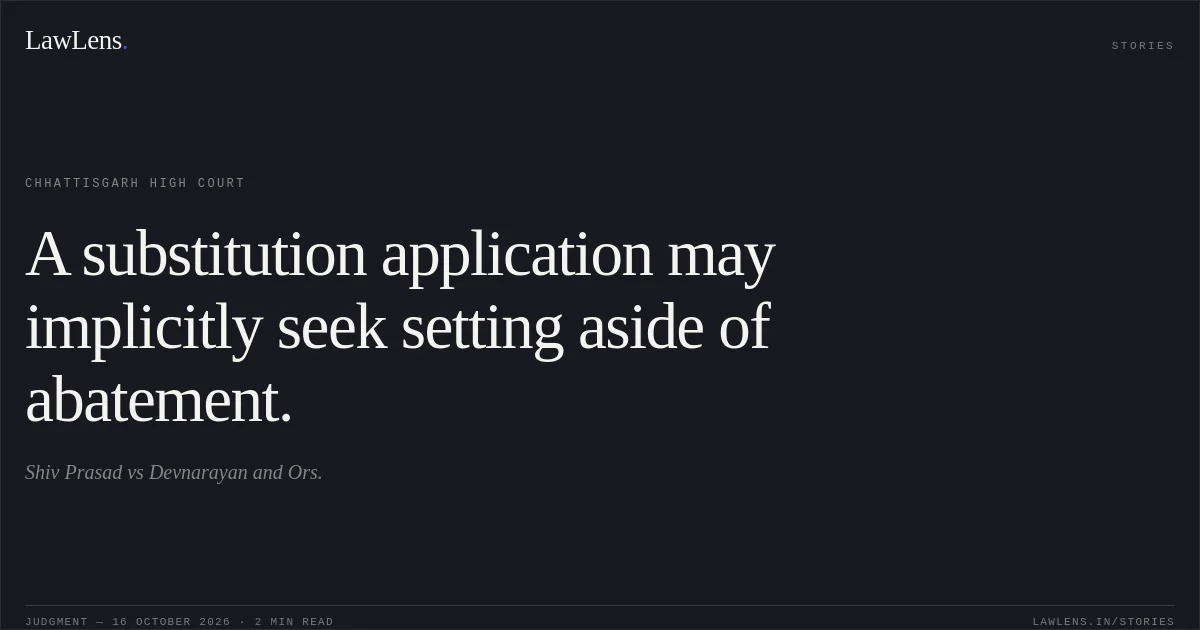
Whether the first appellate court was justified in dismissing the appeal as abated without considering whether the substitution application could be treated as including a prayer to set aside abatement.
Source reference: para. 5Whether the substitution application should be reconsidered, including the questions of setting aside abatement and condonation of delay, after hearing the parties.
Source reference: para. 6Law Applied
Order 43 Rule 1(k) CPC provides for an appeal against an order under Order 22 Rule 9 refusing to set aside abatement or dismissal.
Source reference: para. 5Under Order 22 Rules 4 and 9 CPC, substitution of a deceased party’s legal representatives and setting aside abatement are addressed; Section 5 of the Limitation Act, 1963 permits condonation of delay where sufficient cause is shown.
Source reference: para. 5In Om Prakash Gupta @ Lalloowa (Now Deceased) v. Satish Chandra (Now Deceased), 2025 SCC OnLine SC 291, relying on Mithailal Dalsangar Singh v. Annabai Devram Kini, (2003) 10 SCC 691, the Supreme Court held that a prayer to bring legal representatives on record may, in substance, be construed as a prayer to set aside abatement; courts should adopt a justice-oriented rather than overly technical approach.
Source reference: para. 5Reasoning
The appellant had already filed an application to substitute the deceased respondents’ legal representatives, but the first appellate court dismissed the appeal because separate applications to set aside abatement and condone delay were absent.
Source reference: para. 5Applying Om Prakash Gupta, the High Court held that the substitution application required consideration in light of the principle that a request for substitution may implicitly include a request to set aside abatement.
Source reference: para. 5The first appellate court therefore had to examine the application on that basis and consider the related questions of abatement and delay, rather than dismissing the appeal without that assessment.
Source reference: paras. 5–6Holding
The appeal was allowed, and the order dismissing Civil Appeal No. 11-A/12 as abated was set aside.
The appeal was restored to its original number and remitted to the first appellate court to consider the substitution application in accordance with law, including setting aside abatement and condonation of delay, after giving the parties an opportunity to be heard.
Source reference: paras. 6–7The appellant was also granted liberty to file appropriate applications, and the parties were directed to appear before that court on 16 December 2026.
Source reference: paras. 6–7Acts & Sections Cited
1 provisions across 1 statute referred to in this judgment. Each provision opens on LawLens.
Limitation Act, 19631
Original Court PDF
Shiv PrasadvsDevnarayan and Ors.
Click to open original judgment
Original judgment, available to read, download and summarize on LawLens.in