Facts
The Appellant joined the Respondent-management as a Guard on 01.01.1996.
Source reference: p.2, para. 5He alleged that his duties were subsequently changed to Thread Cutter and Layer Man without payment of additional wages and that, after he demanded extra wages, the Management obtained his signatures on blank papers and assaulted him on 15.07.2005, compelling him to write an apology.
Source reference: p.2, para. 5He further alleged that he was thereafter prevented from joining duty and was effectively terminated without notice, notice pay, retrenchment compensation, or a chargesheet.
Source reference: p.2, para. 6The Appellant filed a claim petition seeking reinstatement, continuity of service, and full back wages.
Source reference: p.2, para. 7The Labour Court dismissed the claim by award dated 13.07.2018, holding that the Appellant had remained unauthorisedly absent from 16.07.2005 and had deliberately abandoned his service.
Source reference: p.2, para. 7The learned Single Judge dismissed the Appellant’s writ petition on 28.03.2026, holding that the Labour Court’s findings were not perverse.
Source reference: p.2, para. 8The present intra-court appeal challenged that judgment.
Source reference: p.2, para. 8The delay of 30 days in filing and 18 days in re-filing the appeal was condoned.
Source reference: p.1, paras. 1–3Issues
Whether the Appellant’s absence from duty amounted to voluntary abandonment of service, or whether he had been prevented from joining duty by the Management.
Source reference: p.3, paras. 9–12Whether the Appellant’s demand notice dated 21.07.2005 was sufficient to establish his intention to resume service and negate abandonment.
Source reference: p.3, para. 12; p.4, para. 14Whether the Management’s communications sent through Under Postal Certificate, and allegedly to an incorrect address, invalidated the finding of abandonment.
Source reference: p.3, para. 10; p.5, para. 16Whether the Labour Court’s finding of abandonment was perverse and liable to interference in writ or intra-court appellate jurisdiction.
Source reference: p.5, paras. 17–19Law Applied
Voluntary abandonment of service is determined from the employee’s intention, which must be inferred from the surrounding circumstances and overall conduct; it is a question of fact.
Source reference: p.5, para. 17The Court relied on G.T. Lad & Ors. v. Chemical & Fibres of India Ltd., (1979) 1 SCC 590, which recognises that intention is essential to abandonment and that the issue must be decided on the facts of each case.
Source reference: p.5, para. 17Rule 18 of the Industrial Disputes (Central) Rules, 1957 governs notices, summons, processes, or orders issued by adjudicatory authorities, and does not prescribe the mode of service for communications issued by the Management.
Source reference: p.5, para. 16Findings of fact by the Labour Court are not to be disturbed in writ or intra-court appellate jurisdiction unless they are perverse or unsupported by the record.
Source reference: p.2, para. 8; p.5, para. 18Reasoning
The Court held that the Management had sent recall letters dated 18.07.2005 and 02.09.2005, as well as a chargesheet dated 10.10.2005, to the address furnished by the Appellant in his apology letter dated 15.07.2005.
Source reference: p.4, para. 13The Appellant neither responded to those communications nor reported for duty thereafter.
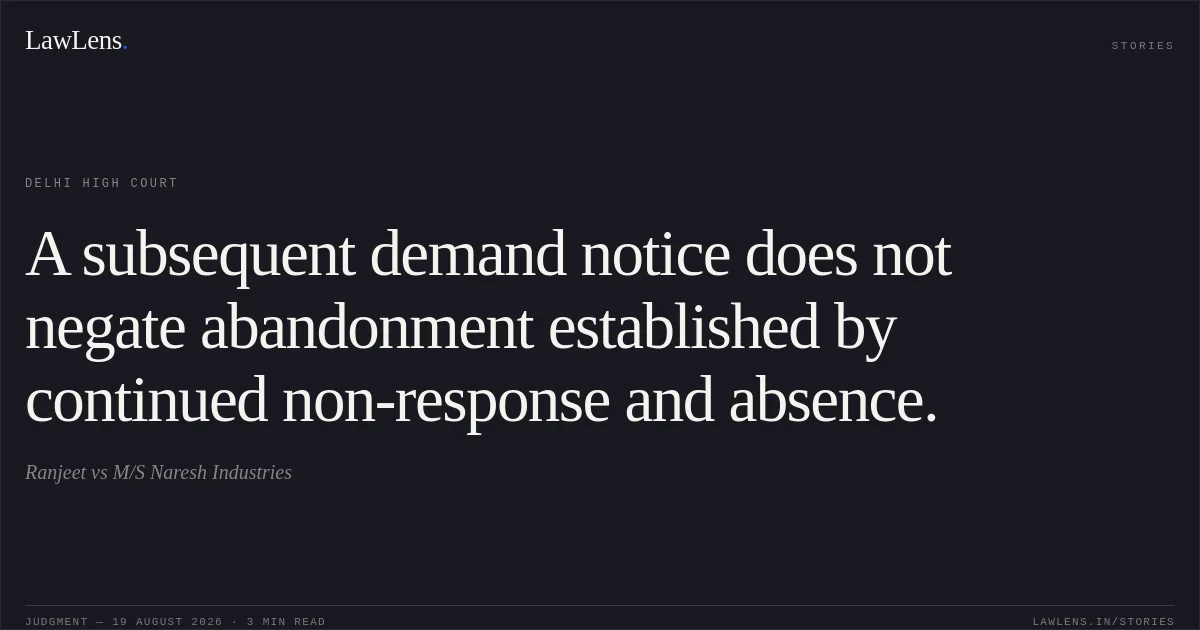
Source reference: p.4, para. 13Although the demand notice dated 21.07.2005 indicated an initial assertion of willingness to resume work, it had to be assessed alongside the Appellant’s subsequent conduct.
Source reference: p.4, para. 14His failure to answer the recall letters or make any further attempt to join duty demonstrated an intention to abandon service.
Source reference: p.4, para. 14The Enquiry Officer’s statement that certain communications were returned related to communications issued during the domestic enquiry and did not displace the evidence concerning the earlier recall letters.
Source reference: p.4, para. 15The objection regarding UPC service was rejected because Rule 18 did not apply to Management communications and, in any event, did not affect the factual finding of abandonment.
Source reference: p.5, para. 16The Court distinguished G.T. Lad, as that case concerned absence arising from a peaceful strike, whereas the present case depended on the Appellant’s individual conduct and failure to return to work.
Source reference: p.5, para. 17Accordingly, the Labour Court’s finding was a permissible finding of fact and was not perverse.
Source reference: p.5, paras. 18–19Holding
The Court answered the principal issues against the Appellant and upheld the finding that he had voluntarily abandoned his service after 16.07.2005.
The demand notice dated 21.07.2005 did not outweigh his subsequent failure to respond to the recall letters or report for duty.
Source reference: p.4, para. 14The Court found no ground to interfere with the Labour Court’s award dated 13.07.2018 or the learned Single Judge’s judgment dated 28.03.2026.
Source reference: p.6, paras. 19–20The appeal was dismissed, pending applications were disposed of, and no order as to costs was made.
Source reference: p.6, paras. 19–20Original Court PDF
RanjeetvsM/S Naresh Industries
Click to open original judgment
Original judgment, available to read, download and summarize on LawLens.in