Facts
The petitioner-detenue challenged Detention Order No. 17-DMK/PSA of 2025 dated 1 May 2025, passed by the District Magistrate, Kupwara under Section 8(1)(a)(i) read with Section 8(2)(ii) of the Jammu and Kashmir Public Safety Act, 1978, directing his preventive detention to prevent conduct prejudicial to the security of the Union Territory of Jammu and Kashmir.
Source reference: para. 1; p. 1The petitioner contended that the detention relied on stale incidents from 2018–2019, vague grounds, previously quashed or revoked detention orders, and criminal cases in which he had been granted bail or discharged from certain offences.
Source reference: para. 2; pp. 2–3The respondents maintained that the impugned detention was based on fresh and independent material, particularly FIR No. 67/2023, and that the earlier cases were relied upon only as antecedent background.
Source reference: para. 3; p. 3The record showed that the petitioner had previously been detained under the PSA on 18 September 2018, 28 January 2019, and 2 August 2019; the first two detention orders were quashed and the third was revoked by the Government on 12 April 2020.
Source reference: para. 9; p. 6Issues
Whether the impugned detention order was impermissibly founded on the same grounds as the petitioner’s earlier detention orders, which had been quashed or revoked, or whether it was based on fresh and independent material.
Source reference: paras. 9–11; pp. 6–8Whether the incidents of 2018–2019 and the subsequent FIR No. 67/2023 maintained a live and proximate link with the necessity for preventive detention.
Source reference: paras. 12–14; pp. 8–9Whether the petitioner’s release on bail, discharge from certain offences, or alteration of the charges invalidated the preventive detention order.
Source reference: paras. 15–16; pp. 9–10Whether the grounds of detention were vague or whether non-supply of documents violated the petitioner’s right to make an effective representation under Article 22(5) of the Constitution and Section 13 of the PSA.
Source reference: paras. 17–20; pp. 10–12Whether the detaining authority’s subjective satisfaction suffered from non-application of mind, reliance on irrelevant or stale material, or absence of a preventive—not punitive—purpose.
Source reference: paras. 21–24; pp. 12–14Law Applied
The Court applied Section 8 of the Jammu and Kashmir Public Safety Act, 1978, which authorises preventive detention where the competent authority is satisfied that detention is necessary to prevent conduct prejudicial to the security of the Union Territory or maintenance of public order.
Source reference: para. 7; p. 5Section 13 of the PSA, read with Article 22(5) of the Constitution, requires timely communication of intelligible grounds of detention and an effective opportunity to make a representation.
Source reference: paras. 7, 17–19; pp. 5, 10–12Judicial review of preventive detention is limited: the Court examines relevance of the material, application of mind, procedural compliance, and the existence of a rational nexus or live link, but does not reappraise the sufficiency of the material as an appellate or criminal court.
Source reference: para. 8; p. 5A subsequent detention must not be based merely on grounds already nullified by an earlier quashed detention order, though earlier conduct may be considered as antecedent background where fresh and independent material exists.
Source reference: paras. 10–11; pp. 7–8Preventive detention is distinct from punitive detention; bail or pending criminal proceedings do not, by themselves, bar preventive detention, provided the authority has a reasonable basis to apprehend future prejudicial conduct, as recognised in Haradhan Saha v. State of West Bengal, (1975) 3 SCC 198, and Kamarunnissa v. Union of India, (1991) 1 SCC 128.
Source reference: paras. 15–16; pp. 9–10The eventual success or failure of the criminal prosecution is not determinative of the legality of preventive detention.
Source reference: paras. 14–16; pp. 9–10Reasoning
The Court held that the impugned order was not a mere revival of the earlier detention orders because FIR No. 67/2023 and the material arising from its investigation and prosecution constituted subsequent and independent circumstances.
Source reference: paras. 10–13; pp. 7–9The earlier cases from 2018–2019 were treated as antecedent background rather than the sole basis of detention; consequently, the plea that those incidents were stale or lacked proximity was rejected when viewed alongside the later alleged conduct.
Source reference: paras. 11–14; pp. 7–9The petitioner’s bail, discharge from certain offences, and prosecution under altered statutory provisions did not establish that the underlying factual material was false, nor did they prevent the detaining authority from forming a preventive assessment regarding future conduct.
Source reference: paras. 15–16; pp. 9–10The grounds sufficiently disclosed the relevant criminal case, antecedents, material considered, and apprehension of future prejudicial activity, and were supplied or explained in a language understood by the petitioner.
Source reference: paras. 17–19; pp. 10–12Since no specific relied-upon document was identified as withheld in a manner prejudicing the petitioner’s representation, no violation of Article 22(5) or Section 13 was established.
Source reference: paras. 19–20; pp. 11–12The Court therefore declined to substitute its assessment for that of the detaining authority and found no non-application of mind, irrelevant material, vagueness, staleness, or absence of a live link.
Source reference: paras. 21–24; pp. 12–14Holding
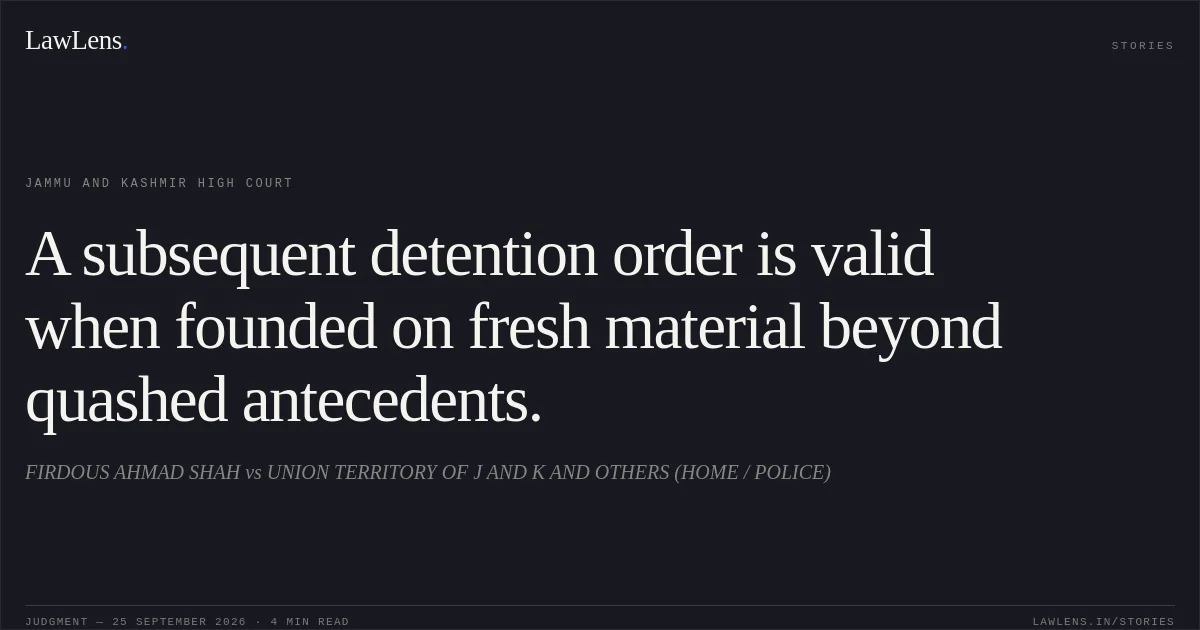
The High Court answered the issues against the petitioner. It held that the detention order was supported by fresh material, particularly FIR No. 67/2023, and was not merely based on the earlier quashed or revoked detention orders; the live-link requirement was satisfied; bail or discharge from some offences did not invalidate the detention; and the grounds and procedural safeguards complied with Article 22(5) and the PSA.
Detention Order No. 17-DMK/PSA of 2025 dated 1 May 2025 was upheld, the habeas corpus petition was dismissed, and the scanned detention record was directed to be returned through the respondents’ counsel.
Source reference: paras. 25–26; p. 14Acts & Sections Cited
6 provisions across 2 statutes referred to in this judgment. Each provision opens on LawLens.
Arms Act, 19592
Unlawful Activities (Prevention) Act, 19674
Original Court PDF
FIRDOUS AHMAD SHAHvsUNION TERRITORY OF J AND K AND OTHERS (HOME / POLICE)
Click to open original judgment
Original judgment, available to read, download and summarize on LawLens.in