Facts
The petitioners were arrested on 21.02.2026 in FIR No. 56 dated 21.02.2026, registered at Police Station Gharinda, Amritsar.
Source reference: para. 2The statutory period of 180 days under the applicable law expired on 20.08.2026 without presentation of the challan. On the same date, the prosecution moved an application under Section 36-A(4) of the NDPS Act seeking extension of time, but the application remained pending.
Source reference: para. 2The petitioners invoked their right to statutory/default bail on 22.08.2026. Their application was rejected on the basis of a statement that a 15-day extension had allegedly been granted on 21.08.2026.
Source reference: para. 3However, the record showed that no order had been passed on 21.08.2026; the extension application was actually allowed only on 26.08.2026, when a 15-day extension was granted.
Source reference: paras. 3, 8The Additional Sessions Judge dismissed the default-bail application as “infructuous” by order dated 24.08.2026. The petitioners challenged both orders before the High Court.
Source reference: paras. 1, 4Issues
Whether the petitioners acquired an indefeasible right to statutory/default bail when the 180-day period expired without presentation of the challan and no extension order was in existence when the right was invoked?
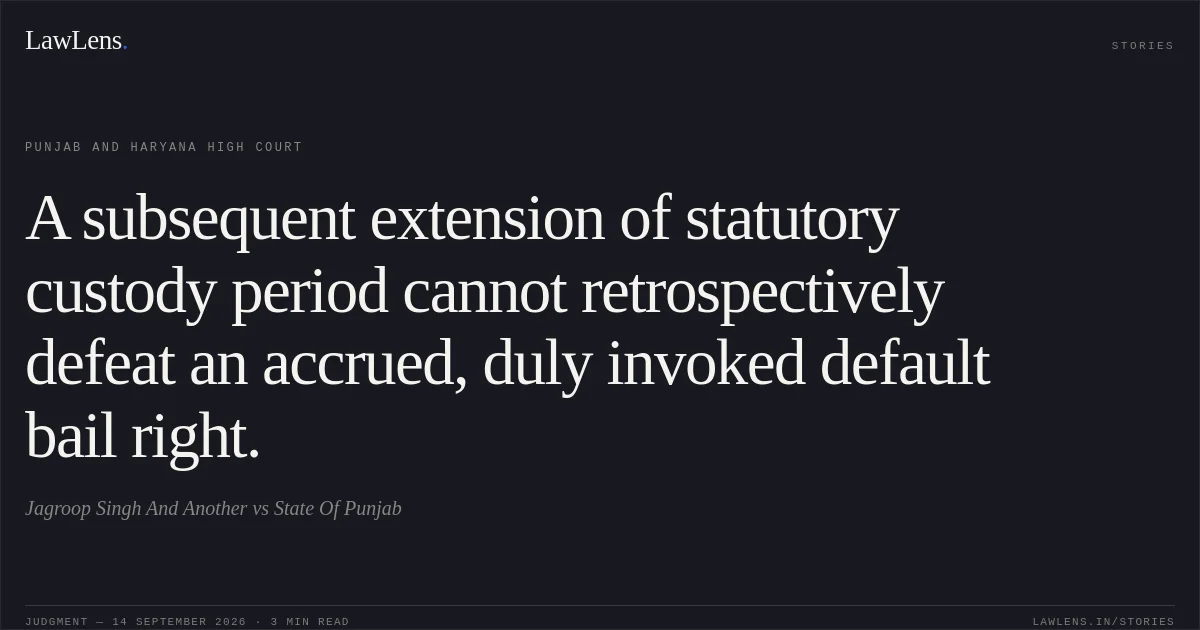
Source reference: paras. 8–10Whether a subsequent order dated 26.08.2026 extending the time for presentation of the challan could retrospectively defeat or extinguish the petitioners’ accrued right to default bail?
Source reference: paras. 4, 8–10Whether the orders dated 22.08.2026 and 24.08.2026 were unsustainable because they proceeded on the erroneous factual assumption that an extension had already been granted on 21.08.2026?
Source reference: paras. 3, 9–10Law Applied
The Court applied Section 187(3) of the BNSS governing the right to statutory/default bail upon expiry of the prescribed period without filing of the challan, along with Section 36-A(4) of the NDPS Act concerning extension of the period for investigation in NDPS cases.
Source reference: paras. 2, 4, 11The Court relied on the principle recognised in Sanjay Dutt v. State through CBI, (1994) 5 SCC 410, that upon expiry of the statutory period, and upon proper invocation of the right before filing of the charge-sheet, the accused acquires an indefeasible right to default bail.
Source reference: para. 9The Court further held that a subsequent extension order cannot retrospectively extinguish a right that had already accrued, particularly where the earlier refusal of bail was based on a factually nonexistent extension order.
Source reference: paras. 8–10Reasoning
The 180-day statutory period expired on 20.08.2026, and no challan had been presented by that date.
Source reference: paras. 2, 9Although the prosecution had applied for an extension on 20.08.2026, the application had not been allowed when the petitioners invoked default bail on 22.08.2026 or when the Trial Court rejected the application on 24.08.2026.
Source reference: paras. 3, 8The Trial Court’s reliance on an alleged order dated 21.08.2026 was demonstrably incorrect because the record established that the extension was granted only on 26.08.2026.
Source reference: paras. 3, 9Applying the rule in Sanjay Dutt, the High Court held that the petitioners’ indefeasible right to default bail had accrued upon expiry of the statutory period and its due invocation.
Source reference: para. 9The order dated 26.08.2026 could not operate retrospectively to defeat that accrued right.
Source reference: para. 9Consequently, the Trial Court orders were vitiated by a material factual and legal error.
Source reference: para. 10Holding
The High Court allowed the criminal revision petition and set aside the orders dated 22.08.2026 and 24.08.2026 rejecting the petitioners’ statutory/default-bail application.
It held that the petitioners were entitled to default bail under Section 187(3) of the BNSS and directed their release upon furnishing the requisite bail and surety bonds to the satisfaction of the competent Magistrate.
Source reference: para. 11Release was made subject to conditions including non-interference with witnesses or evidence, restriction on leaving India without permission, disclosure and verification of residential addresses and financial particulars, intimation of changes in address or mobile number, and regular appearance before the Trial Court.
Source reference: para. 11Violation of the conditions was made a ground for cancellation of bail and issuance of coercive process.
Source reference: para. 11Pending miscellaneous applications were disposed of accordingly.
Source reference: para. 12Acts & Sections Cited
1 provisions across 1 statute referred to in this judgment. Each provision opens on LawLens.
Bharatiya Nagarik Suraksha Sanhita, 20231
Original Court PDF
Jagroop Singh And AnothervsState Of Punjab
Click to open original judgment
Original judgment, available to read, download and summarize on LawLens.in
![Employees actually discharging higher-post duties may claim corresponding pay differences despite lacking formal promotion.. Dinesh Kumar Yadav vs M/o Railways. CAT - ['Allahabad']. LawLens](/stories/thumbnails/employees-actually-discharging-higher-post-duties-may-claim-corresponding-pay-differences-2188bef35b6a44a194c0614c616fb4a5.webp)
![Termination for criminal-case concealment cannot stand where the applicant’s name was deleted during investigation.. RAVI PAL vs POST UP CIRCLE. CAT - ['Allahabad']. LawLens](/stories/thumbnails/termination-for-criminal-case-concealment-cannot-stand-where-the-applicants-name-was-delet-3cc583ec9b6c4386912498527c678eb3.webp)