Facts
A C.T. Grade Teacher post was sanctioned in Kanhaiya Junior High School, Gorakhpur, subject to compliance with the applicable Scheduled Caste reservation policy.
Source reference: paras. 3–5The Management advertised the post, and the petitioner, a general-category candidate, was selected by the Selection Committee and appointed on 16 May 1988; he joined on 18 May 1988.
Source reference: paras. 3–5The Management forwarded the selection papers to the District Basic Education Officer (“DBEO”) for approval.
Source reference: paras. 6–8, 11The petitioner contended that approval stood deemed to have been granted under Rule 10(5)(iii) of the Uttar Pradesh Recognized Basic Schools (Junior High Schools) (Recruitment and Conditions of Service of Teachers) Rules, 1978, as no decision was communicated within the prescribed period.
Source reference: paras. 6–8, 11The DBEO’s case was that the post was reserved for a Scheduled Caste candidate, that eligible Scheduled Caste candidates had participated in the selection, and that the Management had nevertheless selected the petitioner without following the mandatory reservation condition.
Source reference: paras. 25–36The DBEO raised objections, declined approval, and ultimately rejected the petitioner’s appointment by order dated 31 December 1988.
Source reference: paras. 25–36The post was subsequently re-advertised on 1 February 1989 as a Scheduled Caste-reserved post.
Source reference: paras. 2, 9–20The petitioner challenged the disapproval order and the re-advertisement, and sought salary from the date of joining, together with consequential and retiral benefits.
Source reference: paras. 2, 9–20During the pendency of the writ petition, the petitioner continued in service under an interim order of the Court and later retired.
Source reference: paras. 23, 42–43The State contended that such continuance did not convert the allegedly invalid appointment into a substantive appointment or create an entitlement to retiral benefits.
Source reference: paras. 23, 42–43Issues
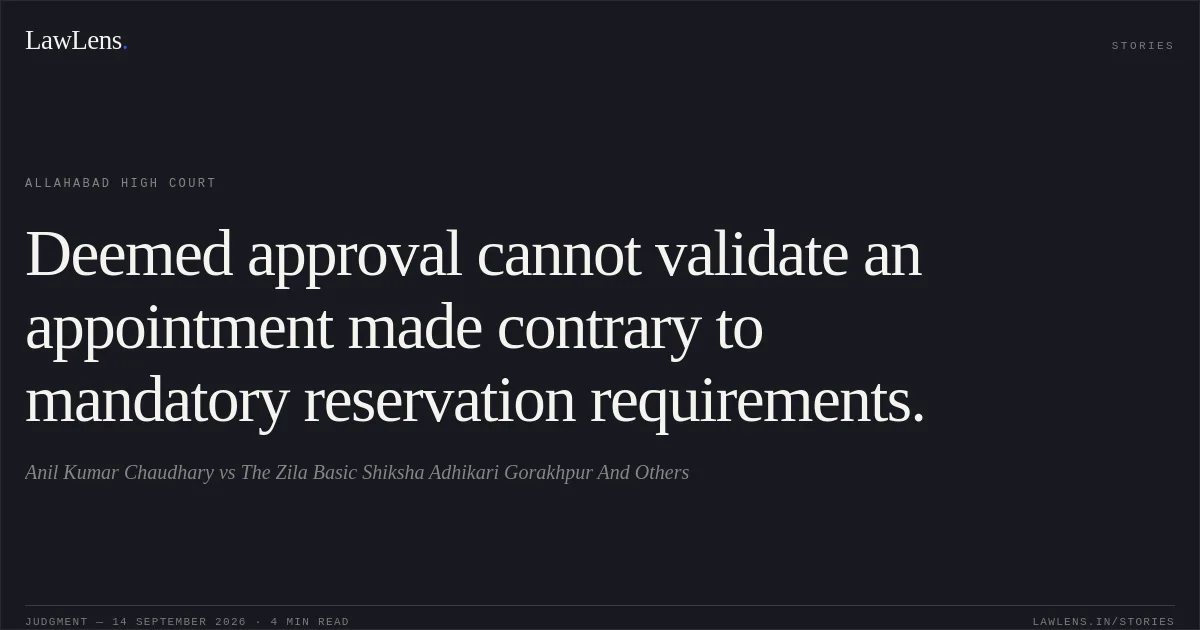
Whether the petitioner’s appointment, made contrary to the prescribed Scheduled Caste reservation requirement, acquired validity through deemed approval under Rule 10(5)(iii) of the Rules of 1978?
Source reference: paras. 44–49Whether the DBEO’s order dated 31 December 1988 disapproving the appointment was liable to be quashed for violation of natural justice or because the DBEO’s nominee had participated in the selection process?
Source reference: paras. 14–16, 46–49Whether the subsequent re-advertisement of the post was illegal on the ground that the post had already been filled by the petitioner?
Source reference: paras. 9–12, 18–20, 50Whether the petitioner was entitled to salary, retiral benefits, or post-retirement benefits by reason of his continuance in service under the interim order?
Source reference: paras. 44, 51–54Law Applied
The Court applied Rule 10(5)(iii) of the Uttar Pradesh Recognized Basic Schools (Junior High Schools) (Recruitment and Conditions of Service of Teachers) Rules, 1978, concerning approval of appointments and deemed approval upon expiry of the prescribed period, but held that a deeming provision cannot validate an appointment made in breach of mandatory recruitment and reservation requirements.
Source reference: paras. 7, 11, 47The Court further applied the principle that statutory reservation conditions attached to a sanctioned post must be complied with and cannot be unilaterally altered by the Management.
Source reference: paras. 25–28, 45–48Participation of an official nominee in a selection process does not cure a fundamental illegality in the selection.
Source reference: para. 48An opportunity of hearing cannot be invoked to sustain an appointment that is inherently contrary to the governing statutory procedure, particularly where the Management had already been confronted with and had replied to the relevant objections.
Source reference: para. 49Finally, an interim order is interlocutory and does not confer substantive validity or a vested right to service or retiral benefits where the underlying appointment is found unlawful.
Source reference: paras. 51–54The petitioner’s reliance on State of Punjab v. Rafiq Masih (White Washer), (2015) 4 SCC 334, concerning recovery of excess payments, did not affect the determination of the validity of his appointment.
Source reference: para. 21Reasoning
The Court found that the sanctioned post was expressly subject to Scheduled Caste reservation and that Scheduled Caste candidates had participated in the selection.
Source reference: paras. 45–46Despite this, the Management selected the petitioner, a general-category candidate, and sought approval of an appointment made contrary to the reservation condition.
Source reference: paras. 45–46Accordingly, the petitioner could not rely on Rule 10(5)(iii) to obtain deemed approval, because statutory fiction cannot be used to legitimise an appointment that was invalid at its inception.
Source reference: para. 47The DBEO had raised specific objections and the Management had responded to them; therefore, the absence of a separate hearing to the petitioner did not invalidate the disapproval order.
Source reference: paras. 48–49Nor did the participation of the DBEO’s nominee cure the non-compliance with the mandatory reservation requirement.
Source reference: paras. 48–49Since the petitioner’s appointment was not lawfully approved, his continuance did not extinguish the vacancy, and the subsequent re-advertisement was not an unlawful creation of a second vacancy.
Source reference: para. 50Although the petitioner worked under interim protection, that order could not confer substantive service status or a vested claim to retiral benefits.
Source reference: paras. 51–52The Court nevertheless observed that any claim for salary for actual work performed under the interim order would require separate consideration in accordance with the order’s terms and applicable law.
Source reference: paras. 51–52Holding
The Court held that the petitioner’s appointment was not rendered valid by deemed approval, the DBEO’s nominee’s participation, or the petitioner’s subsequent continuance under the interim order.
The order dated 31 December 1988 disapproving the appointment was upheld, and the challenge to the re-advertisement dated 1 February 1989 was rejected.
Source reference: paras. 53–54The petitioner was held not to possess a vested right to retiral or post-retirement benefits flowing from a substantive appointment.
Source reference: paras. 53–54The writ petition was accordingly dismissed, subject only to any independent determination of salary for the period during which the petitioner actually worked under the interim order and in accordance with its terms.
Source reference: para. 55Original Court PDF
Anil Kumar ChaudharyvsThe Zila Basic Shiksha Adhikari Gorakhpur And Others
Click to open original judgment
Original judgment, available to read, download and summarize on LawLens.in