Facts
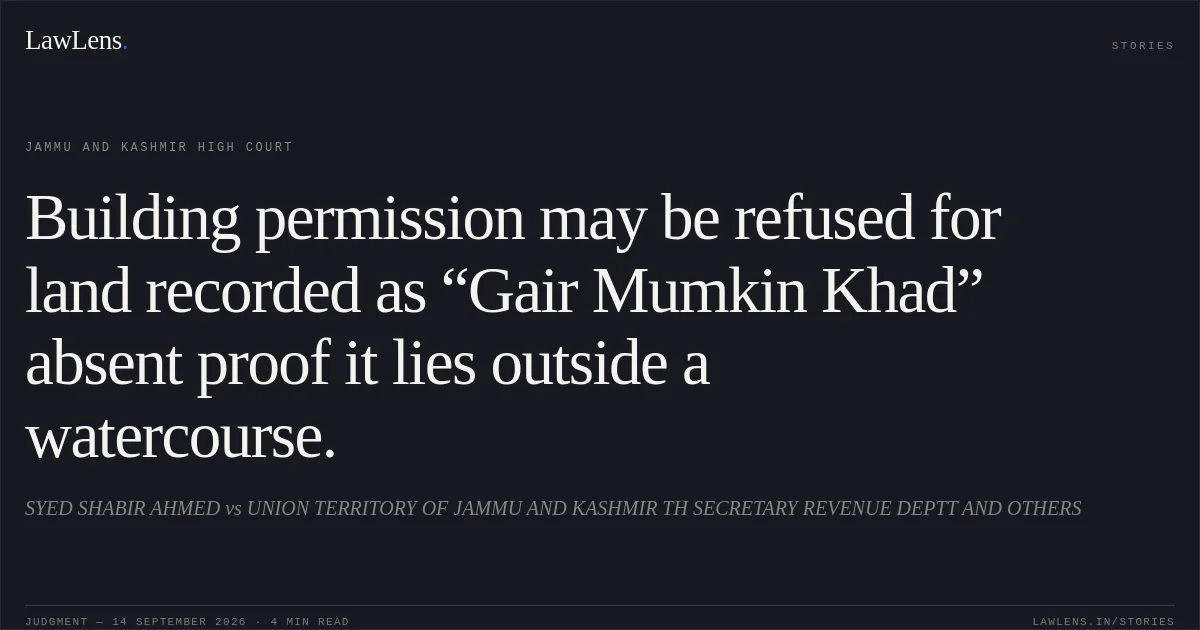
The petitioner claimed ownership and possession of land measuring 2 kanals 11 marlas comprised in Khasra No. 260-min at Village Narwal Bala, Tehsil Bahu, District Jammu. The land was recorded in the revenue records as “Gair Mumkin Khad.” The petitioner asserted that the nearest dry nallah was more than 200 metres away and that the area was fully developed. The Executive Engineer, Flood Control Division, Jammu, had issued a no-objection for residential construction, and the Tehsildar, Jammu Development Authority (JDA), had reported that the land did not belong to the JDA.
Source reference: p. 1–2The petitioner applied for building permission. The JDA rejected the application by communication dated 3 December 2020, relying on two grounds: first, the land was recorded as “Gair Mumkin Khad”; and second, land comprised in Khasra No. 260-min had allegedly been acquired by the JDA.
Source reference: p. 2–3The petitioner also challenged communication dated 22 October 2020, contending that it relied on the Big Landed Estates Abolition Act, which had subsequently been repealed.
Source reference: p. 2–3During the proceedings, the JDA filed a fresh reply clarifying that the petitioner’s land had neither been acquired nor transferred to the JDA and lay outside the acquired/transferred portion of Khasra No. 260.
Source reference: p. 4–5Separately, the Government constituted committees under Government Order No. 18-JK(Rev) of 2022 dated 4 February 2022 to identify land recorded as “Gair Mumkin Khad,” “Gair Mumkin Darya,” or “Gair Mumkin Nallah” that did not actually form part of a watercourse or water source.
Source reference: p. 3–4A subsequent public notice listed 394 kanals 8 marlas in Khasra No. 260, Village Narwal Bala, as lying outside the water channel.
Source reference: p. 6Issues
Whether the JDA could lawfully refuse building permission merely because the petitioner’s land was recorded as “Gair Mumkin Khad”?
Source reference: p. 5–6; paras. 11–12Whether the ground that the petitioner’s land had been acquired or transferred to the JDA could sustain the rejection of building permission?
Source reference: p. 4–5; para. 11Whether the petitioner was entitled to seek fresh consideration of his building-permission application in light of the subsequent Government policy and demarcation proceedings identifying land recorded as “Gair Mumkin Khad” but lying outside an actual watercourse?
Source reference: p. 6–7; paras. 13–16Law Applied
The Court applied the Jammu and Kashmir Water Resources (Regulation and Management) Act, 2010. Section 3 vests every water source in the Government, irrespective of prior private ownership. Sections 2(zzc) and 2(zze) respectively include a “khad” within the meaning of a watercourse and a watercourse within the meaning of a water source; consequently, land recorded as “Gair Mumkin Khad” is treated as a Government water source/course, on which construction is impermissible.
Source reference: p. 5–6; para. 12The Court also considered the policy framework arising from the Division Bench judgment in WPPIL Nos. 19/2014 and 20/2013 dated 12 February 2016, SRO 456, and Government Order No. 18-JK(Rev) of 2022, which established a committee-based process for delineating land incorrectly recorded as “Gair Mumkin Khad” or similar categories but not forming part of an actual water source or course.
Source reference: p. 3–4, 6; paras. 6–7, 13–14Reasoning
The Court held that the acquisition-related ground could no longer support the rejection because the JDA’s fresh affidavit expressly admitted that the petitioner’s land had neither been acquired nor transferred to it.
Source reference: p. 5; para. 11However, at the time the building-permission application was rejected, the land was officially recorded as “Gair Mumkin Khad.” Applying Sections 3, 2(zzc), and 2(zze) of the 2010 Act, the Court treated such recorded land as falling within the statutory concept of a Government-owned water source or watercourse, where construction could not lawfully be permitted.
Source reference: p. 5–6; para. 12The later Government policy and public notice created a mechanism for distinguishing land that was merely recorded as “Gair Mumkin Khad” from land that actually formed part of a water channel.
Source reference: p. 6–7; paras. 13–15Since the public notice showed substantial land in Khasra No. 260 as outside the water channel, the petitioner was permitted to submit a fresh application supported by proof of the land’s actual status.
Source reference: p. 6–7; paras. 13–15Nevertheless, the original refusal was upheld because the delineation policy came into force only after the impugned decision.
Source reference: p. 6–7; paras. 13–15Holding
The Court disposed of the writ petition. It held that the JDA’s refusal of building permission on the ground that the petitioner’s land was recorded as “Gair Mumkin Khad” was lawful at the relevant time.
The separate acquisition-related ground did not survive in view of the JDA’s subsequent admission that the land had not been acquired or transferred.
Source reference: p. 5; para. 11The petitioner was granted liberty to apply afresh for building permission before the competent authority, along with documents demonstrating that his land lies outside the actual water channel.
Source reference: p. 7; para. 16The competent authority was directed to reconsider such application in accordance with law.
Source reference: p. 7; para. 16Acts & Sections Cited
4 provisions across 1 statute referred to in this judgment. Linked provisions open on LawLens.
Administration of Estates4
Original Court PDF
SYED SHABIR AHMEDvsUNION TERRITORY OF JAMMU AND KASHMIR TH SECRETARY REVENUE DEPTT AND OTHERS
Click to open original judgment
Original judgment, available to read, download and summarize on LawLens.in
![A senior employee’s pay must be stepped up when a junior in the same cadre and post draws higher pay.. Nirmal Dev vs N E Rly.. CAT - ['Allahabad']. LawLens](/stories/thumbnails/a-senior-employees-pay-must-be-stepped-up-when-a-junior-in-the-same-cadre-and-post-draws-h-9f64fdc124814a90ad0adf013f00b440.webp)